
Search News
Industry Portal
Hot Articles
What should an industrial product specification template include for supplier comparison?
Time
Click Count
A procurement team rarely loses time because there are too many suppliers. More often, they lose time because each supplier describes the same product in a different way. One quote highlights performance, another focuses on material grade, a third sends a glossy brochure with almost no test detail. At that point, “comparison” becomes interpretation, and interpretation is where risk enters the sourcing process.
That is why an industrial product specification template matters. It gives buyers a common structure for evaluating suppliers across technical performance, compliance, delivery capability, lifecycle cost, and service support. Whether you are sourcing brushless power tools, biometric access systems, high-strength fasteners, smart lighting, or protective equipment, the template turns scattered claims into comparable facts.
For procurement professionals, the goal is not to create paperwork for its own sake. The goal is to reduce ambiguity before purchase orders are issued, before installation problems appear, and before a low-cost choice becomes an expensive operational problem.
Start with the purpose of the specification, not the format
Before adding fields and checkboxes, define what the document must accomplish. A good supplier comparison template should do three things at once: communicate minimum requirements clearly, separate mandatory criteria from preferred features, and make bid evaluation easier for both technical and commercial teams.
That sounds simple, but many templates fail because they mix “must-have” conditions with nice-to-have preferences. A supplier may offer excellent value, but if your template does not clearly show what is non-negotiable, internal discussions become subjective. Procurement then ends up revisiting engineering decisions after quotes are already in.
In industrial categories, this problem is amplified. A biometric reader is not judged the same way as a high-tensile bolt. A smart luminaire is not assessed like a cut-resistant glove. The structure can stay consistent, but the content has to reflect the product’s technical reality.
The core sections every industrial product specification template should include
At minimum, your template should cover the following categories. The exact wording can change by product type, but these sections create the foundation for fair supplier comparison.
1. Product identification and scope
Begin with a plain statement of what is being sourced. Include the product name, intended application, operating environment, and project scope. This is where you eliminate confusion between similar product families or model classes.
For example, “brushless cordless impact wrench for structural fastening in outdoor construction sites” is far better than simply writing “power tool.” For security hardware, defining whether the product is for indoor office access, data center perimeter control, or mixed-use commercial buildings changes the supplier response dramatically.
This section should also state whether the request is for a standard catalog item, a modified standard item, or a fully customized solution.
2. Technical performance requirements
This is the heart of the template. It should translate operational needs into measurable parameters. Avoid vague wording like “high performance,” “durable,” or “heavy duty.” Ask for values, ranges, tolerances, and test conditions.
Depending on the category, performance fields may include:
- Torque, speed, battery runtime, motor type, charging time, and weight for industrial tools
- Recognition speed, false acceptance/rejection metrics, enrollment capacity, operating light conditions, and integration protocol for biometric systems
- Material grade, tensile strength, hardness, coating type, thread tolerance, and vibration resistance for fasteners
- Luminous efficacy, color temperature, CRI, beam angle, dimming protocol, ingress protection, and thermal management for smart lighting
- Filtration class, cut resistance level, impact resistance, comfort range, and compatibility with other gear for PPE
The best templates do not just ask for a value. They ask how the value is determined. A quoted specification without a defined test method is difficult to compare fairly.
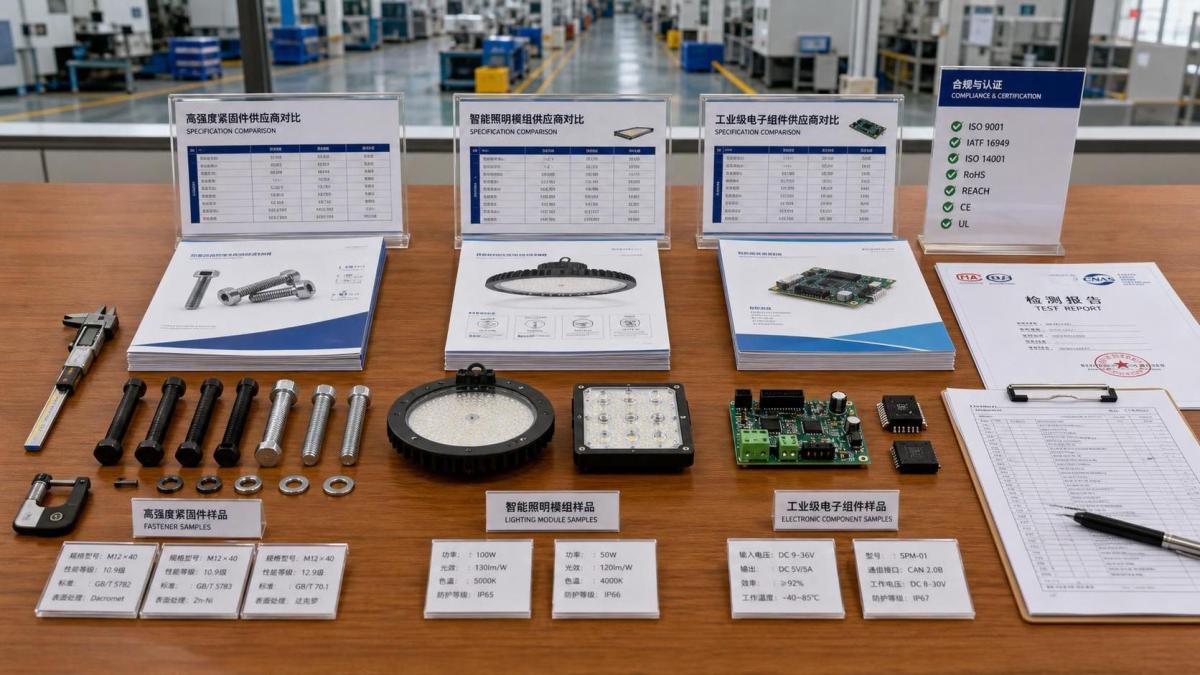
3. Materials, construction, and component details
Two products can meet the same headline performance number and still differ significantly in reliability. That is why your template should request material and construction data.
Ask for housing materials, alloy types, coatings, lens materials, seal design, cable quality, fastening method, internal electronics protection, or battery cell information where relevant. In some categories, these details affect corrosion resistance, service life, field repairability, and user safety more than a headline spec does.
For buyers working across multiple industrial sectors, this section is especially useful because it exposes where one supplier is building for demanding duty cycles and another is building for light commercial use.
4. Standards, certifications, and regulatory compliance
Compliance should never be left as a marketing statement. The template should require suppliers to list applicable standards, certifications, declarations, and regional regulatory conformity.
This may include electrical safety, EMC, IP ratings, mechanical standards, PPE classifications, fire performance, data protection obligations for connected systems, or environmental compliance such as RoHS and REACH where applicable.
For smart access and biometric security products, compliance extends beyond hardware. Procurement should ask whether data processing, storage architecture, and system deployment support applicable privacy and security obligations in the destination market. That question matters early, not after installation.
5. Testing, validation, and documentation
One of the most overlooked parts of an industrial product specification template is proof. Ask suppliers to provide test reports, inspection records, quality control procedures, sample evaluation conditions, and document revision status.
Useful template fields include:
- Test standard used
- Testing body or laboratory
- Date of report
- Sample configuration tested
- Pass/fail criteria
- Available factory inspection records
- Traceability or lot identification method
This section helps procurement distinguish between products that were genuinely validated and products supported mainly by generic datasheets.
6. Installation, compatibility, and integration requirements
Many supplier comparison exercises go wrong because the product is evaluated in isolation. In practice, industrial products live inside systems, workflows, or jobsite conditions.
Your template should therefore ask how the product connects, mounts, communicates, or operates with upstream and downstream systems. Smart lighting may need DALI or Zigbee compatibility. Access control hardware may need API or controller compatibility. Power tools may need battery platform standardization. PPE may need interoperability with helmets, eyewear, or respirators already approved on site.
This section prevents a technically acceptable product from becoming a costly integration problem.
7. Reliability, durability, and lifecycle expectations
Procurement teams are often measured on purchase price, but operations feel the consequences of poor durability. A strong comparison template should therefore include service life expectations, wear components, maintenance intervals, environmental resistance, and expected failure points.
Ask practical questions: What is the rated lifetime? What parts are consumable? Can the unit be serviced locally? Are spare parts stocked? Is firmware support required? What happens when a battery, sensor, seal, or optical module reaches end of life?
This is where total cost of ownership begins to come into view.
8. Supply capability and commercial execution details
A technically perfect product is not the right choice if the supplier cannot support your volume or schedule. Add fields for manufacturing location, lead time, minimum order quantity, surge capacity, packaging format, shipment terms, and production planning flexibility.
For strategic items, include questions about dual sourcing, continuity planning, and critical raw material exposure. Procurement decisions are not made in a lab. They are made in a world of fluctuating freight, changing regulations, and production deadlines that do not move.
9. After-sales support and warranty structure
Service should not be buried in commercial fine print. Include response time expectations, technical support channels, warranty terms, training availability, spare parts commitment, software updates if relevant, and escalation procedures.
For connected industrial systems, post-sale support can matter as much as the initial unit specification. A secure device without patch support or a smart fixture without long-term control compatibility may create future replacement costs that were invisible during tender review.
How to make the template useful for supplier comparison, not just documentation
The strongest templates are designed for scoring. That means each line item should be easy to classify as mandatory, preferred, informational, or commercial. A common approach is to create columns for requirement, supplier response, supporting evidence, compliance status, and evaluator comments.
Some procurement teams also assign weighted values. That can be helpful, but only if the basics are done well. If technical terms are vague, a scoring system creates false precision instead of better decisions.
A smarter approach is to divide evaluation into three layers:
- Gate criteria: mandatory requirements that must be met
- Comparative criteria: measurable factors used to rank qualified suppliers
- Risk criteria: items that may not disqualify a supplier immediately but affect implementation confidence
This structure is especially valuable across mixed industrial categories, where a buyer may be comparing not just product specs but installation complexity, regulatory burden, and support maturity.
Common mistakes that weaken an industrial product specification template
One common mistake is copying a previous template without challenging whether its fields still reflect the current application. Another is asking for too much data without clarifying which answers actually affect award decisions. Suppliers then respond with volume instead of clarity.
There is also a frequent tendency to specify brand-style features rather than operational outcomes. That narrows competition unnecessarily unless there is a justified compatibility reason.
And perhaps the most expensive mistake of all: treating compliance, testing, and support as attachments rather than evaluation criteria. In industrial purchasing, those “secondary” details often determine whether a product succeeds in real use.
What procurement teams should tailor by category
Even the best general template should have category-specific modules. For example, SHSS-covered sectors illustrate how different the emphasis can be.
For brushless tools, battery ecosystem compatibility, duty cycle, ergonomics, and motor protection may deserve extra weight. For biometric security, privacy architecture, spoof resistance, system uptime, and software integration belong near the top. For high-strength fasteners, metallurgy, coating integrity, and traceability are often more important than appearance or catalog breadth. For smart lighting, control protocol compatibility and thermal design matter more than a simple lumen figure. For PPE, fit, comfort over long shifts, and certified protection level must be treated as operational factors, not soft preferences.
The lesson is simple: keep the template framework stable, but adapt the technical layer to the product family.
A practical final check before issuing the RFQ
Before sending your template to suppliers, read it once from the supplier’s side and once from the end user’s side. Can a qualified supplier understand exactly what evidence to provide? Can the operations or engineering team see their real-world needs reflected in the document?
If the answer is yes, your industrial product specification template is doing its job. It is not just collecting information. It is protecting comparison quality.
For procurement professionals, that is the real value. Better templates shorten clarification cycles, surface hidden risk earlier, and create supplier evaluations based on substance rather than presentation. In industrial sourcing, where safety, reliability, and continuity often matter as much as price, that discipline is not administrative overhead. It is part of buying well.
Recommended News