
Search News
Industry Portal
Hot Articles
What drives physical security spending in the Middle East
Time
Click Count
What drives physical security spending in the Middle East? For business decision-makers, the answer goes far beyond rising threats. Rapid urbanization, critical infrastructure expansion, smart city investment, and stricter risk management are all reshaping physical security Middle East priorities. Understanding these forces helps enterprises allocate budgets more effectively, strengthen resilience, and align security strategies with long-term operational growth.
What is changing in the region is not simply the size of security budgets, but the logic behind them. In many markets, physical security used to be treated as a protective overhead: perimeter fencing, guards, cameras, access control, and incident response. Today, it is increasingly part of business continuity planning, regulatory compliance, asset protection, insurance negotiation, and even brand credibility. For companies operating in or supplying to the Middle East, this shift matters because buyers are no longer purchasing isolated devices. They are funding layered systems tied to operational resilience.
That distinction helps explain why spending remains active even when project cycles slow in other areas. Security demand in the Gulf and wider Middle East often tracks national development agendas, infrastructure rollouts, and geopolitical risk perception more closely than short-term corporate purchasing sentiment alone.
Security spending follows infrastructure, not just threat headlines
A common outside view is that physical security demand in the Middle East is mainly driven by instability. That is too narrow to be useful. Threat perception absolutely influences spending, particularly around critical sites, logistics corridors, energy assets, public venues, and border-sensitive facilities. But in commercial terms, one of the strongest drivers is simply the scale of built environment expansion.
New airports, ports, industrial zones, transport systems, data centers, hospitality complexes, mixed-use developments, utilities, and public facilities all require integrated physical protection from the design stage onward. Once a project reaches a certain size or strategic importance, security is no longer an add-on package. It becomes part of the engineering scope.
For decision-makers, that has two implications. The first is that demand often appears earlier in the project cycle than many exporters expect. Security specifications can be influenced at the consultant, master developer, EPC, or systems integrator level long before final procurement. The second is that spending tends to favor solutions that can scale across multiple sites rather than single-building installations.
In practical terms, this benefits categories such as intelligent access control, video surveillance architecture, barrier systems, command-and-control integration, secure lighting for public space, and protective hardware for high-throughput or harsh-environment applications.
Government-led development remains a major demand engine
Across much of the Middle East, large-scale spending is still shaped by public sector planning, sovereign investment, and state-backed development programs. This affects both market timing and buyer expectations. Security procurement linked to transport, energy, urban development, or public administration tends to demand long service life, integration capability, and compliance discipline.
That environment rewards suppliers and solution partners that understand how capital projects are actually executed in the region. Technical acceptance may depend less on headline innovation and more on whether a product can survive climate exposure, operate under heavy utilization, integrate with existing building management or security platforms, and be supported locally over time.
Where national transformation programs are accelerating urban modernization, physical security is often tied to broader policy goals: safer cities, more efficient public services, digital governance, and resilient infrastructure. In that context, spending decisions are shaped by visibility and accountability. A failed deployment at a strategic site is not treated as a local equipment problem; it becomes a governance problem.
Smart city investment is changing what “physical security” means
One of the most important market shifts is the merging of traditional site security with smart city and AIoT architecture. In high-growth urban projects, physical security systems are no longer evaluated only on deterrence or monitoring capability. They are being assessed for how well they connect with identity management, mobility systems, occupancy analytics, emergency response workflows, and centralized operations.
This changes the spending profile. Budget holders may still procure cameras, turnstiles, biometric readers, command software, and smart lighting as separate packages, but the value increasingly sits in interoperability. A camera network that cannot support analytics workflows or an access system that cannot integrate with broader credentialing logic may meet the original specification yet still lose out in later project phases.
For business leaders, this is where many forecasting mistakes happen. They overestimate demand for standalone devices and underestimate demand for systems integration, middleware compatibility, and cyber-physical coordination. In the physical security Middle East market, the premium often goes to solutions that reduce operational friction across large estates, not merely those with better hardware specifications.
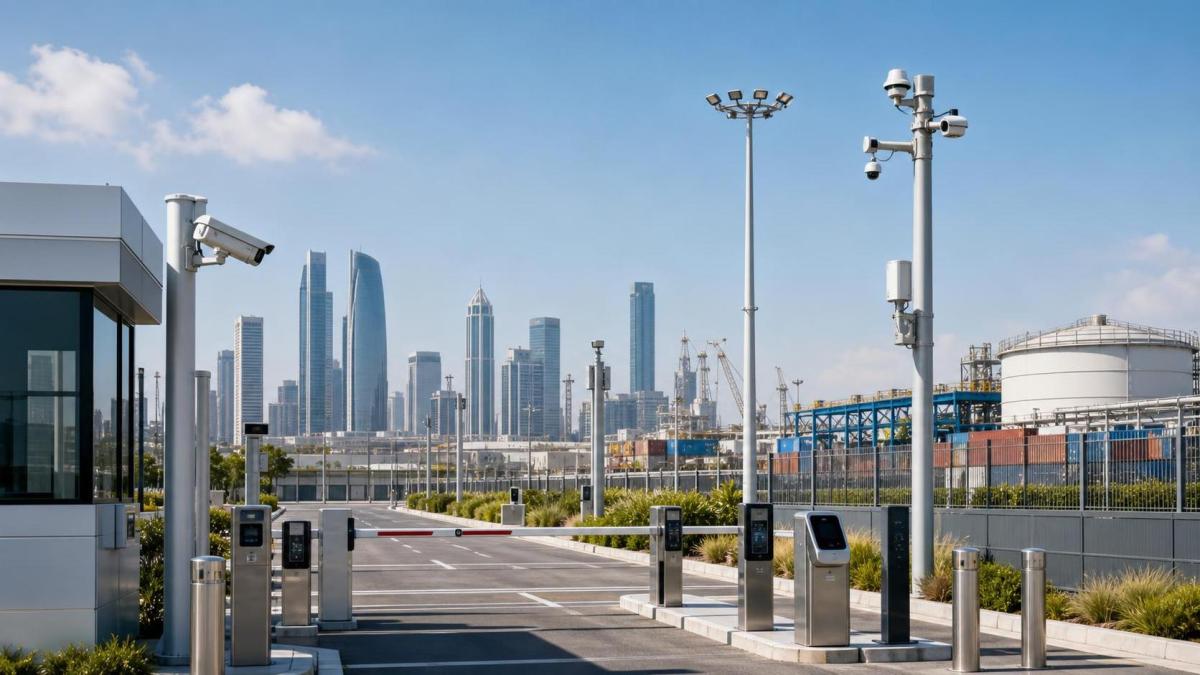
Critical infrastructure keeps security budgets more resilient than other construction-linked segments
Energy, water, utilities, transportation, and strategic industrial facilities remain among the most structurally important buyers. Even when commercial real estate sentiment fluctuates, critical infrastructure programs tend to maintain stronger security spending because the cost of disruption is disproportionately high.
That does not mean budgets are unlimited. It means decision criteria are different. Operators of substations, oil and gas facilities, desalination plants, logistics hubs, and major transport nodes focus heavily on uptime, perimeter integrity, access assurance, incident traceability, and environmental durability. They are less interested in trend-led feature lists than in system reliability under real operating conditions.
This is particularly relevant for suppliers entering the market with products positioned as premium or intelligent. In the Middle East, environmental performance is not a secondary issue. Heat, dust, humidity, corrosion exposure in coastal zones, and large site footprints all influence procurement. Security hardware that performs well in temperate indoor markets can struggle if enclosure protection, materials, thermal tolerance, or maintenance assumptions are not adapted.
As a result, spending tends to reward robust engineering and lifecycle support. Decision-makers increasingly ask not only what the system can do at handover, but what it will still do after three to five years in field conditions.
Hospitality, retail, and mixed-use projects are spending for experience as well as protection
Another important driver is the region’s emphasis on premium commercial environments. In hospitality, retail, entertainment, and large mixed-use developments, physical security is expected to work without visibly degrading user experience. This creates demand for systems that can combine control and convenience: frictionless entry, visitor management, discreet surveillance coverage, integrated emergency response, and lighting that supports both safety and place-making.
For senior management, this means security budgets may be approved not just under risk prevention, but under customer journey, tenant quality, and asset positioning. A Grade A office tower, destination mall, resort complex, or branded residential development is unlikely to treat physical security as a back-end utility. It is part of how the asset is operated and perceived.
The market consequence is a gradual shift away from purely guard-heavy models toward more technology-enabled security operations. Human presence remains important, but technology is increasingly used to reduce blind spots, improve response speed, and create auditable control.
Insurance, compliance, and corporate governance are becoming budget catalysts
Some of the most meaningful spending drivers are not visible in public announcements. Boards, insurers, multinational tenants, and compliance teams increasingly influence physical security decisions behind the scenes. This is especially true for facilities handling sensitive data, high-value goods, hazardous operations, or high public footfall.
In practice, stronger spending can be triggered by post-incident reviews, insurance underwriting requirements, multinational customer audits, internal control upgrades, or revised duty-of-care expectations. For sectors such as data centers, pharmaceuticals, advanced manufacturing, and high-value warehousing, the issue is often less about crime statistics and more about provable control.
That favors technologies and system designs that support audit trails, credential integrity, controlled access zoning, and incident reconstruction. It also means that security spending increasingly crosses departmental boundaries. Facilities, IT, compliance, legal, operations, and finance may all have a voice. For suppliers and project planners, the ability to address this multi-stakeholder buying process is often more important than a broad catalog.
Biometric and intelligent access systems are gaining relevance, but not without caution
The Middle East has shown strong interest in advanced identity and access technologies, particularly in premium commercial properties, government facilities, transport nodes, and high-security environments. Faster throughput, better credential assurance, and integration with digital identity ecosystems are attractive. But executives should avoid assuming that adoption is purely technology-led.
Three issues shape real purchasing decisions: regulatory treatment of personal data, integration with existing access infrastructure, and operational acceptance by users. Data privacy frameworks vary by jurisdiction, and some requirements remain fragmented or evolving. Where biometric systems are considered, companies should verify local legal obligations, storage architecture, consent rules, and cross-border data implications. If the exact requirement cannot be confirmed, internal teams should mark it as 【待核实】 rather than proceed on assumption.
The second issue is workflow. A high-accuracy biometric system can still fail commercially if throughput collapses during peak occupancy periods or if fallback procedures are poorly designed. The third issue is trust. Buyers increasingly want anti-spoofing capability, dark-environment performance, and integration with visitor, contractor, and staff access policy. They are not buying “biometrics” in the abstract; they are buying dependable access governance.
Regional demand is not uniform, and that affects market entry strategy
Talking about the Middle East as one market is analytically convenient but commercially misleading. The Gulf Cooperation Council markets often show stronger project scale, higher smart infrastructure ambition, and more demand for integrated systems. Other markets may prioritize cost discipline, site hardening, essential surveillance, or phased deployment models.
For exporters and investors, this means the right question is not whether the Middle East is spending on physical security, but where, through which channels, and under what project logic. In some markets, public procurement and large integrators dominate. In others, private developers, industrial operators, or specialist contractors play a larger role. Product-market fit must be defined by project type and buyer structure, not by region-wide assumptions.
There is also a timing issue. Major event cycles, tourism development, industrial policy, logistics expansion, and utility modernization do not progress evenly across countries. A supplier that treats the region as a single synchronized demand pool can easily overbuild inventory or misread lead generation signals.
Cost pressure is real, but buyers are becoming more lifecycle-oriented
Even in high-investment environments, cost discipline has sharpened. Inflation, financing conditions, project reprioritization, and pressure on operating budgets have made buyers more selective. Yet this does not automatically favor the lowest-price offer. In many security applications, especially strategic and large-footprint sites, lifecycle cost is becoming a stronger decision metric.
That includes maintenance frequency, replacement cycles, software support, energy use, false alarm burden, environmental survivability, and manpower implications. Smart lighting linked to surveillance quality, access systems that reduce guard dependency, or durable hardware that lowers downtime can justify higher upfront cost if the total operating model is convincing.
Decision-makers should be careful here. Lifecycle arguments only work when backed by credible field assumptions. Generic ROI claims are rarely persuasive in this market unless they reflect local labor cost structures, climate conditions, service availability, and asset criticality.
What business leaders should watch over the next three years
Several trends are likely to shape the next phase of physical security spending in the Middle East.
One is deeper convergence between physical security and digital operations. As more sites become data-rich and centrally managed, the line between facility protection, access governance, occupancy intelligence, and operational analytics will continue to blur.
Another is stronger emphasis on resilience. Buyers are paying more attention to redundancy, response continuity, and fail-safe design, especially in sectors where service interruption carries political, financial, or safety consequences.
A third is procurement maturity. More end users now understand the difference between feature-heavy proposals and operationally reliable solutions. That will make superficial differentiation harder. Vendors and integrators that cannot support long-term performance, certification clarity, and local service execution may find market access more difficult despite competitive pricing.
There is also likely to be more scrutiny on data handling wherever intelligent surveillance and biometric functions are deployed. The technical case for these systems may be strong, but governance expectations are tightening globally, and regional buyers are increasingly aware of that risk.
The practical takeaway
Physical security spending in the Middle East is being driven by a combination of infrastructure growth, strategic asset protection, smart city development, governance demands, and a stronger focus on operational resilience. Threat concerns matter, but they are only part of the picture.
For companies making investment, sourcing, or market-entry decisions, the most useful approach is to stop treating security as a narrow equipment category. In this region, spending is increasingly tied to how assets are built, how cities are managed, how critical services stay online, and how organizations demonstrate control under scrutiny.
The winners in this market will not necessarily be those with the most aggressive technology narrative. More often, they will be the ones that understand project structures, environmental realities, compliance expectations, and the buyer’s need for systems that remain dependable long after installation.
Recommended News