
Search News
Industry Portal
Hot Articles
Private Label Hardware Supplier: MOQ, Lead Time, and Quality Risks
Time
Click Count
Why does choosing a private label hardware supplier feel riskier than it looks?
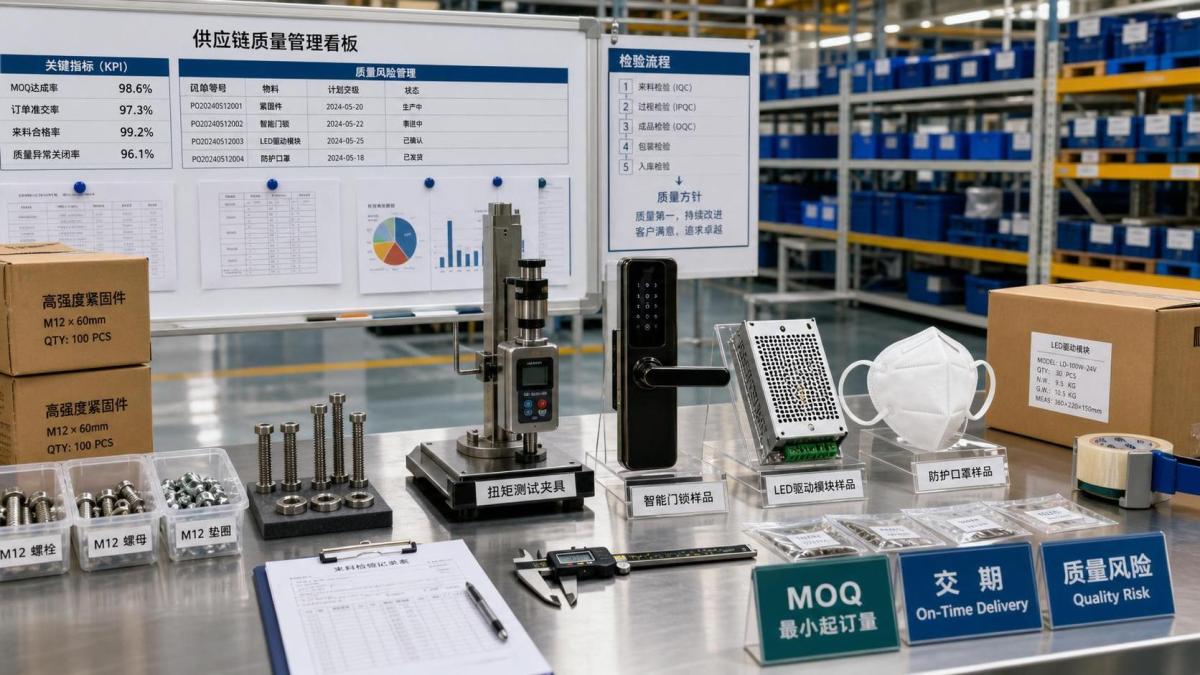
Price usually gets the first attention, but it is rarely the real decision point.
A private label hardware supplier affects inventory pressure, launch timing, warranty exposure, and brand credibility at the same time.
That becomes even more critical in hardware categories tied to safety, access control, fastening strength, lighting reliability, or worker protection.
In practical sourcing, the biggest problems rarely start with a dramatic factory failure.
They start with small mismatches: unrealistic MOQ, unstable component supply, unclear inspection limits, or packaging claims that outrun product consistency.
For a portal like SHSS, which tracks industrial brushless tools, biometric security, high-strength fasteners, smart lighting, and PPE, one pattern appears repeatedly.
The more a product sits near the “last line of defense,” the less room there is for sourcing shortcuts.
A bolt with unstable hardness, a smart lock with weak firmware control, or a respirator with poor seal consistency can create downstream costs far above the quoted unit price.
So the better question is not, “Who is cheapest?”
It is, “Which private label hardware supplier can support the commercial model without creating hidden operational risk?”
How should MOQ really be judged, not just negotiated?
MOQ looks simple on paper, yet it often hides the supplier’s real production logic.
A low MOQ may sound attractive, but it can mean manual production, higher variation, or weak material leverage.
A high MOQ is not always unreasonable either.
It may reflect tooling amortization, custom color setup, safety testing batches, or imported chip allocation.
The useful way to assess MOQ is to break it into layers.
- Product MOQ: minimum for a functional SKU.
- Packaging MOQ: cartons, inserts, labels, and branded cases.
- Component MOQ: motors, sensors, LEDs, steel grades, batteries, or filter media.
- Certification MOQ: the batch level needed for compliance or test cost recovery.
This matters because many private label hardware supplier quotes only show finished-goods MOQ, not the true commitment behind it.
In brushless tools, for example, battery packs and controllers can drive MOQ more than the housing itself.
In biometric devices, the camera module, storage architecture, and firmware branch may be the actual MOQ drivers.
In high-strength fasteners, the steel grade, heat treatment route, and thread rolling die setup change the economics quickly.
A practical benchmark table helps clarify whether the quoted MOQ is commercially workable.
A credible private label hardware supplier should explain MOQ with process logic, not just defend it as policy.
What lead time promises are actually realistic?
Quoted lead time often describes an ideal production window, not the full delivery cycle.
That distinction matters when hardware programs depend on launch dates, installation schedules, or seasonal demand.
A realistic lead time should cover at least five stages.
- Engineering confirmation and sample approval.
- Material procurement and component allocation.
- Mass production and in-line inspection.
- Final testing, packaging, and document release.
- Booking, loading, customs, and destination transit.
When a private label hardware supplier says “30 days,” ask which of those stages are included.
More often than buyers expect, only the factory production stage is counted.
Lead time pressure is stronger in categories with electronic dependency.
Smart access systems rely on imaging modules, chips, firmware validation, and cloud compatibility.
Smart LED products may depend on drivers, sensors, and protocol-level integration such as DALI or Zigbee.
Even mechanical hardware can stall if heat treatment slots, steel coil allocation, or mold maintenance are tight.
One useful check is to ask for the supplier’s longest-lead component list.
Another is to compare sample lead time with repeat-order lead time.
If both are nearly identical, the timeline may not reflect real planning complexity.
Reliable suppliers usually provide a lead time range, plus the assumptions behind it.
Where do quality risks usually hide in private label hardware projects?
The biggest quality risks are often not visible in the first sample.
They emerge when volume increases, alternate materials appear, or inspection standards stay vague.
This is especially true when products perform structural, electrical, security, or protective functions.
A private label hardware supplier can pass appearance checks while still carrying serious field risk.
Common hidden failures include these areas.
- Material substitution without notice, especially in alloys, plastics, filters, or battery cells.
- Process drift, such as weaker torque calibration, unstable heat treatment, or inconsistent lens alignment.
- Firmware variation across batches, affecting recognition speed, connectivity, or update security.
- Label and certification mismatch between tested sample and shipping batch.
- Packaging weakness that causes hidden transit damage.
For categories tracked by SHSS, quality control should match the failure consequence.
Fasteners need metallurgical consistency and mechanical verification, not just dimensional checks.
Biometric hardware needs optical performance, firmware control, and data compliance awareness.
PPE needs fit, seal, material traceability, and lot stability.
A useful habit is to define three quality layers before placing volume orders.
- Critical to safety or function.
- Important to durability and user experience.
- Cosmetic or packaging-related.
Without that hierarchy, inspections tend to spend too much time on scratches and too little on actual performance risk.
How can one compare suppliers without getting lost in quotations?
A strong comparison process turns supplier selection from price shopping into risk-adjusted evaluation.
That does not require a complex scorecard, but it does require disciplined questions.
In actual sourcing, the most useful comparison points are usually these.
- How transparent is the BOM and process route?
- What parts of the product are made in-house?
- Which tests are routine, and which are only done on request?
- How stable are repeat orders versus first orders?
- What happens when a shipment fails inspection?
A supplier that answers clearly on deviations, rework, and traceability is often safer than one with the lowest quote.
For a private label hardware supplier, operational maturity matters as much as factory capacity.
That includes revision control, document discipline, labeling consistency, and change notification.
In sectors linked to smart cities and advanced manufacturing, those details shape long-term scalability.
A brushless power tool line, a smart lock range, or a commercial lighting program can all fail commercially if supply discipline breaks during expansion.
What should be confirmed before moving from trial order to long-term supply?
The trial order is where many assumptions should be challenged, not protected.
Before scaling with a private label hardware supplier, several checkpoints deserve written confirmation.
- Approved sample reference, including version photos and key parameters.
- Critical material list and substitution rules.
- Inspection standard, sampling plan, and defect definitions.
- Packaging specification and drop-test expectations where relevant.
- Lead time assumptions for repeat orders and peak periods.
- Corrective action timeline for quality claims.
This is also the stage to verify how the supplier handles compliance documentation.
For biometric or connected products, data handling and firmware control deserve extra attention.
For structural or protective products, test reports should align with the exact shipped specification.
One reason SHSS emphasizes cross-disciplinary intelligence is that modern hardware risk is rarely single-dimensional.
Mechanical, electrical, regulatory, and commercial issues often overlap in the same sourcing decision.
That is why a dependable private label hardware supplier should be assessed as a process partner, not just a production source.
A final check before choosing a private label hardware supplier
The safest choice is rarely the cheapest quote or the fastest promise in isolation.
A better decision comes from matching MOQ, lead time, and quality control with the real product risk.
For commodity hardware, flexibility and replenishment speed may matter most.
For smart security, structural hardware, lighting systems, or PPE, consistency and traceability usually carry more weight.
The next step is practical.
List the must-have specifications, define acceptable MOQ exposure, map the full lead time path, and rank quality risks by consequence.
Then compare each private label hardware supplier against the same written standard.
That approach reduces sourcing uncertainty and creates a more scalable private label hardware strategy over time.
Recommended News