
Search News
Industry Portal
Hot Articles
How to assess commercial building security risks before upgrading
Time
Click Count
Why a security upgrade should start with risk, not hardware
A surprising number of commercial building security projects begin with a product shortlist. New cameras, biometric readers, smart locks, better perimeter lighting. The intent is reasonable, but the sequence is often wrong. If you upgrade before understanding where the building is actually exposed, you can end up with expensive technology protecting the wrong doors, recording the wrong spaces, or creating new compliance headaches without closing the real gaps.
A useful commercial building security assessment is less about buying more devices and more about understanding how the building functions under normal pressure, after hours, during contractor activity, and when something goes wrong. Office towers, mixed-use sites, retail complexes, logistics-linked campuses, and data-heavy commercial facilities all look different on paper, but they usually fail in familiar ways: uncontrolled side entries, badge sharing, poor lighting transitions, surveillance blind spots, weak visitor handling, and emergency procedures that exist only in binders.
For decision-makers, the practical question is not “What security system is best?” It is “What risks are credible for this property, and which upgrades reduce them without damaging operations, privacy, or budget discipline?”
Start with how the building is really used
The clean floor plan rarely tells the full story. A commercial building may have one formal entrance strategy and a very different lived reality. Deliveries come through service doors that stay propped open. Cleaning teams circulate outside business hours. Tenants bring in subcontractors. Parking lifts become informal access routes. A reception desk may appear to control entry, while an adjacent stairwell quietly bypasses it.
That is why the first pass of any assessment should map building use rather than equipment inventory. Look at:
- who enters the property and when,
- which areas hold higher-value assets or sensitive information,
- where public, tenant, staff, and service routes intersect,
- what tasks continue after normal occupancy hours,
- and which security controls people routinely work around.
This sounds basic, but it is where many upgrade plans become much sharper. A headquarters building with executive suites and a public lobby has a different risk profile from a light industrial office with tool storage, loading access, and temporary labor turnover. In one case, identity assurance and visitor governance may matter most. In the other, tool theft, delivery dock control, and after-hours movement may be the bigger issue.
Assess entry points by exploitability, not by count
Decision-makers often ask how many doors, gates, shutters, and access points need to be secured. The better question is which ones are easiest to exploit and most damaging if compromised.
Main entrances usually receive the most attention because they are visible. Yet service corridors, rooftop access, parking connections, plant rooms, and tenant-separated internal doors can carry higher practical risk. A rear access door with poor frame integrity and inconsistent monitoring may matter more than a premium turnstile system in the lobby.
This is also where physical hardware quality matters more than many software-led proposals admit. Locks, hinges, strike plates, door frames, fasteners, and mounting methods determine whether access control devices can actually withstand force, vibration, repeated use, or poor installation conditions. In security assessments, SHSS often frames this as the meeting point between “digital gatekeepers” and “steel sutures”: authentication can be sophisticated, but if the supporting hardware or anchoring is weak, the real security level is lower than the spec sheet suggests.
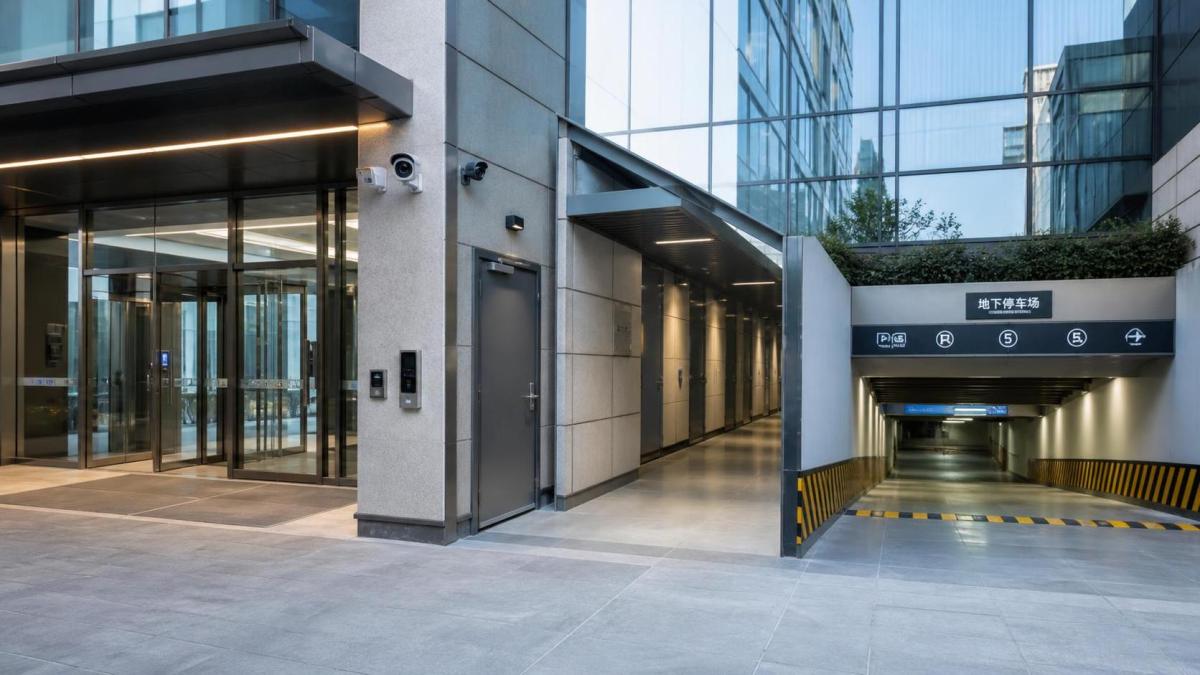
When reviewing openings, separate them into three categories:
Don’t evaluate access control in isolation
Access control is often the centerpiece of a commercial building security upgrade, especially where legacy cards, mechanical keys, or unmanaged tenant credentials are still in use. But access control only works well when matched to occupancy patterns, staffing reality, and compliance requirements.
Biometric systems, for example, can significantly improve certainty around identity at sensitive points. In some environments, 3D structured light or iris-based verification is attractive because it reduces credential sharing and can work in low-light conditions. That said, adoption should never be decided on speed or novelty alone. You also need to ask where biometric collection is proportionate, how templates are stored, what local privacy law requires, and whether tenants or employees will accept it. In Europe especially, GDPR-related issues around biometric data handling, lawful basis, retention, and cloud architecture need careful review with compliance teams before procurement is finalized.
A common mistake is placing advanced authentication at the front door while leaving internal privilege boundaries weak. If everyone who passes reception can still reach comms rooms, finance archives, or rooftop plant zones with little friction, the upgrade is mostly cosmetic.
Look for surveillance gaps the way an intruder would
Camera coverage diagrams can be misleadingly reassuring. A site may have extensive surveillance and still lack usable evidence when an incident occurs. In practice, the problem is usually not the number of cameras but camera placement, lighting inconsistency, storage policy, or the gap between monitored and unmonitored periods.
Walk the site at the times when conditions change: sunrise, evening shift handover, delivery windows, low-occupancy weekends, and bad weather if possible. Entrances that look acceptable at noon may become difficult to monitor when bright exterior light meets a dim vestibule. Parking edges, stair landings, waste collection zones, and side approaches are classic weak spots.
Lighting should be reviewed together with surveillance, not after it. Commercial and smart LED systems can materially affect security performance when they improve uniformity, reduce harsh contrast, and support occupancy-based control. In some buildings, DALI or Zigbee-enabled lighting integration also helps operators respond to movement patterns or after-hours access anomalies. Still, “smart” is not automatically better. If controls are too complex, poorly commissioned, or disconnected from security operations, staff may override them and the intended benefit disappears.
Include life safety, maintenance, and contractor reality in the assessment
Security upgrades fail when they ignore the people who keep the building running. Facility managers, electricians, HVAC contractors, cleaning teams, and fit-out crews all interact with protected spaces. If their routes and work constraints are not considered, they will create informal workarounds.
This becomes especially relevant in multi-phase retrofit work. Installing stronger doors, better readers, new cabling, or reinforced mounting hardware can temporarily affect egress, ceiling access, fire door behavior, and service continuity. The right procurement decision is often the one that reduces future risk without making maintenance painfully difficult. In other words, resilience is not just break-in resistance. It is also the ability to service, inspect, and restore the system without excessive downtime.
Where specialist PPE is required for plant rooms, rooftop works, dusty back-of-house zones, or hazardous maintenance tasks, that should also feed into the assessment. A secure area that cannot be accessed safely during an incident is only partially thought through.
Prioritize by consequence, not by how visible the issue is
Not every weakness deserves the same budget response. Some are easy to spot and irritating but low impact. Others are less obvious and can seriously disrupt operations, expose sensitive data, or create liability.
A practical prioritization model usually asks four things:
- How likely is this weakness to be exploited under normal site conditions?
- If exploited, what is the consequence for people, operations, assets, or reputation?
- Can the issue be reduced through process changes, or does it require capital upgrade?
- Will the proposed fix introduce trade-offs in privacy, flow, maintenance, or tenant experience?
That last point deserves more respect than it usually gets. Security measures that slow entry too much, generate too many false alarms, or create friction for tenants can degrade compliance over time. People stop using them properly. The best commercial building security plan is often the one that staff can follow every day, not the one with the most impressive technical brochure.
Questions worth asking vendors before you approve the upgrade
Once the risk picture is clear, vendor conversations become more useful. Instead of asking for a generic integrated solution, ask questions that test fit and lifecycle reality:
- What assumptions does the proposed design make about occupancy, staffing, and opening hours?
- Which parts of the system depend on existing door condition, structural support, or electrical infrastructure?
- How are credentials, biometric templates, logs, and video data stored and governed?
- What happens during network loss, power events, or hardware failure?
- Which maintenance items are predictable, and which are often underestimated?
- Can the system scale if the building adds tenants, restricted zones, or smart building integrations later?
In sectors where AIoT convergence is accelerating, these questions matter more than ever. Edge processing, smart lighting controls, access analytics, and integrated alarm workflows can be useful, but only when the building’s physical base is solid and the operating model is realistic. That cross-disciplinary view is where intelligence platforms such as SHSS are most relevant: not as product catalogs, but as a way to connect hardware strength, biometric capability, installation constraints, and compliance thinking into one decision frame.
A good assessment should leave you with fewer assumptions
If a pre-upgrade review is done well, it usually changes the project scope. Sometimes it confirms the need for better access control. Sometimes it reveals that lighting, door hardware, internal zoning, or contractor management is the more urgent fix. Sometimes it shows that the building does not need more devices so much as clearer rules, stronger physical anchoring, or better separation between public and restricted circulation.
That is the real value of assessing commercial building security risks before upgrading: you spend capital on the problems the property actually has, not the ones the market most likes to sell. Before approving any system, walk the routes, test the assumptions, review the data handling implications, and make sure the physical layer is worthy of the digital layer being added on top.
Recommended News