
Search News
Industry Portal
Hot Articles
Industrial Product Specification Examples That Help Compare Key Performance Requirements
Time
Click Count
Industrial product specification examples are most useful when they force a direct comparison between measurable requirements, not when they list features in isolation. A motor housing, a bolt, a biometric reader, a lighting fixture, and a respirator can all look robust in a catalog; the specification only becomes useful when it shows what the product must survive, how it is installed, what it weighs, how it behaves in service, and which limits cannot be crossed without affecting performance.
For technical evaluation, the first task is to separate core requirements from descriptive language. A clear specification usually identifies the material grade or construction method, the load or duty limit, the environmental envelope, the interface dimensions, and any maintenance constraint that changes field use. When those points are missing, comparisons tend to drift toward appearance, advertised convenience, or a single headline number that does not describe real operating behavior.
In industrial power tools, for example, a useful specification does not stop at voltage and torque. It also needs the drive type, battery chemistry, rated runtime under load, permissible ambient temperature, vibration exposure, tool mass with battery installed, and chuck or spindle compatibility. A compact brushless drill may deliver strong peak torque, yet still be a poor fit if the balance is awkward during overhead work or if the battery loses output under sustained fastening cycles. Comparing only nominal torque can hide those differences.
Material detail matters just as much in fasteners and high-strength hardware. Two bolts with the same nominal diameter and thread pitch can behave very differently if one is heat-treated for higher tensile strength, another relies on surface coating for corrosion resistance, and a third is limited by thread rolling quality or head geometry. The specification should show tensile class, proof load, finish, thread tolerance, and whether the part is intended for static assembly or vibration-prone service. In many assemblies, the failure point is not the bolt body but the joint design around it.
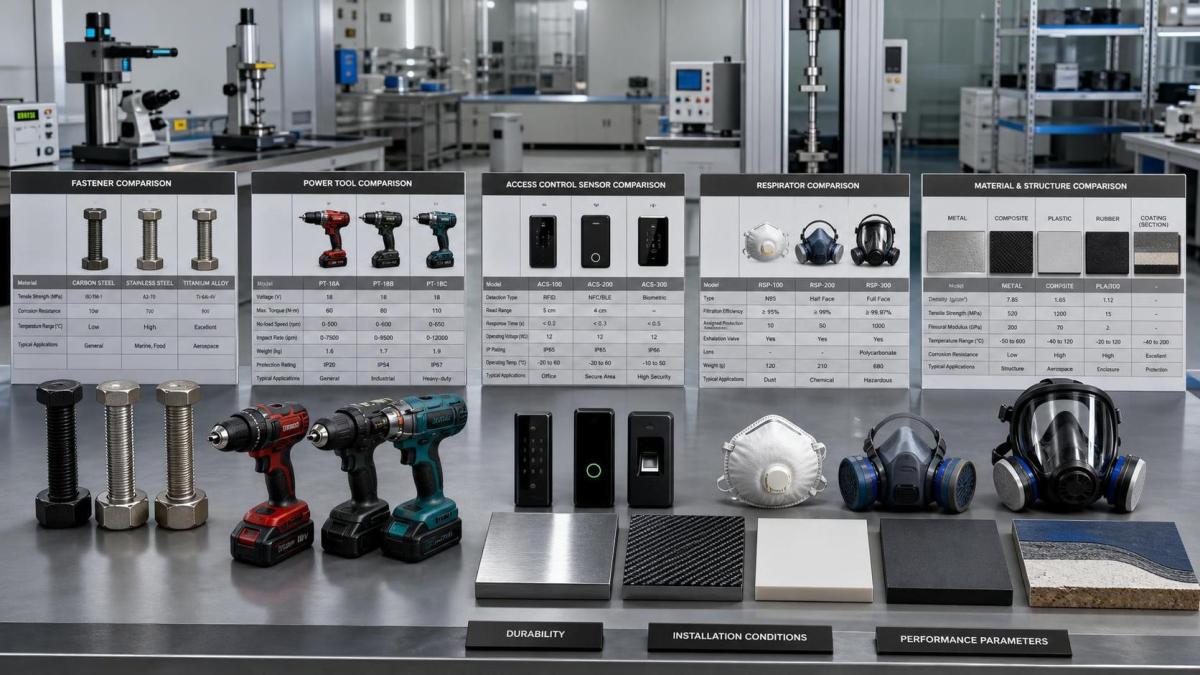
Installation conditions are another source of error. A fastener that performs well in a dry indoor frame may need a different coating or sealing washer in a humid or chemically exposed location. A lighting fixture rated for a broad operating range can still underperform if the mounting height, beam distribution, and control interface are not matched to the site. In smart lighting, the specification should distinguish luminous flux from delivered illuminance at a defined distance, then note whether color temperature, dimming curve, and control protocol remain stable after integration with sensors or building controls.
For biometric access equipment, the most relevant specification examples usually involve sensing method, capture distance, environmental tolerance, and failure handling. A reader that relies on a camera and algorithmic matching needs clear limits for lighting variation, angle of approach, protective covers, and rejection behavior when a face is partially obscured. Iris and 3D structured-light systems raise different questions: one depends on optical capture quality and user positioning, the other on depth mapping and interference from reflective surfaces. A comparison that ignores those differences can overrate the system that is simpler on paper.
Security hardware also needs a careful reading of materials and enclosure details. A housing that resists tampering in a controlled lobby may not survive dust intrusion, condensation, or repeated impact at an exterior gate. Relevant specification items include ingress protection, impact resistance, connector sealing, cable strain relief, and service access. Where the product is tied to stored identity data, maintenance procedures matter too, because a device that is easy to replace but hard to re-enroll may create operational delays even if the hardware itself is sound.
PPE specifications are often misunderstood because comfort is treated as secondary. In practice, a respirator or cut-resistant garment that fits poorly can reduce real protection. Useful examples include filter type, breathing resistance, seal geometry, glove or sleeve dexterity, puncture or cut resistance, and compatibility with eye or face protection. A label that states protection class is not enough unless the specification also explains the intended hazard profile, cleaning method, replacement interval, and whether the garment preserves mobility under wet, oily, or abrasive conditions.
Comparisons become clearer when the same product family is described under the same operating assumptions. A tool spec should identify the fastening substrate and cycle rate; a lighting spec should state mounting height and target area; a biometric device should state enrollment and verification conditions; a fastener should state joint type and preload target; PPE should state exposure type and wear duration. Without shared assumptions, one product may appear stronger simply because its test setup was easier.
One common mistake is treating a higher number as a better product without asking what the number means. Higher torque can mean a heavier tool. Higher brightness can mean a harsher beam or more heat. Higher tensile strength can come with reduced ductility. Faster recognition can bring tighter capture constraints. Better cut resistance can reduce dexterity. Industrial product specification examples work best when they show these tradeoffs openly so the evaluation does not confuse one favorable metric with overall suitability.
Transport and storage also belong in the comparison. A precision sensor may be sensitive to vibration or humidity during shipping. A battery-powered tool can require charge-state limits before long storage. Coated hardware may need packaging that controls abrasion and corrosion. Lighting equipment with integrated drivers may need shock protection and orientation control. PPE may have shelf-life or contamination concerns that do not appear in the basic performance line. These points are easy to ignore until a product arrives damaged, aged, or no longer within its intended use window.
When the specification is well written, maintenance behavior becomes visible before purchase. Replaceable filters, serviceable batteries, accessible firmware, gasket availability, and calibration intervals all affect lifecycle effort. If a product cannot be inspected without full disassembly, that design choice should appear in the evaluation. If a device depends on proprietary consumables or tightly matched accessories, compatibility should be checked early rather than after integration begins.
Good comparison work often comes down to asking whether the specification describes the same thing across different products. One manufacturer may report peak performance, another continuous rating, and a third a test result under narrow conditions. The names may look similar, but the underlying meanings are not. That is where industrial product specification examples earn their value: they make the hidden assumptions visible enough to compare, and they expose the limits that matter when equipment moves from a lab sheet into field use.
Recommended News