
Search News
Industry Portal
Hot Articles
When do industrial automation tools for production lines justify the investment?
Time
Click Count
For an enterprise decision-maker, the question is rarely whether automation is technically possible. The more difficult question is whether industrial automation tools for production lines will improve the economics of the operation enough to justify capital, disruption, training, and ongoing support.
The answer is not found in a generic “labor savings” calculation. Automation becomes a sound investment when it removes a constraint that keeps recurring: a station that cannot meet takt time, a fastening process with inconsistent torque, a quality check that depends too heavily on individual judgment, a hazardous task with frequent near-misses, or a facility whose energy and access controls remain disconnected from daily operations.
A well-scoped deployment does more than replace manual effort. It makes output more predictable. That distinction matters because predictable output improves scheduling, inventory planning, customer commitments, warranty exposure, and the confidence to scale.
Start with the production constraint, not the equipment catalog
Automation purchases often fail at the earliest stage of decision-making. A plant sees a robotic cell, connected brushless tools, machine vision, or smart lighting platform and starts with the technology. The stronger approach begins at the line’s limiting condition.
Ask a practical question: Where does work stop flowing? The answer may be an assembly station where operators repeatedly reposition a heavy tool; a packaging area where inspection errors create rework downstream; a restricted maintenance room where access records are incomplete; or a night-shift line where poor lighting contributes to inspection fatigue.
Industrial automation tools for production lines are justified when they address a bottleneck with measurable consequences. These consequences should be visible in production data, maintenance records, quality reports, injury logs, energy bills, or customer returns—not merely in anecdotal frustration.
Useful baseline measures include:
- Units produced per shift, per station, and per labor hour
- Cycle-time variation, not only average cycle time
- First-pass yield, rework hours, scrap, and warranty-related defects
- Tool downtime, battery changeovers, calibration failures, and maintenance interruptions
- Recordable safety incidents, near-misses, ergonomic complaints, and restricted-duty time
- Energy consumption by line, zone, or operating schedule
- Unauthorized-entry risk, access audit gaps, and the time required to investigate an incident
A line may already achieve its nominal output target on a good day. That does not mean it is performing well enough. If output depends on overtime, exceptional operator skill, or constant supervisor intervention, the process is fragile. Automation should be evaluated for its ability to reduce that fragility.
What a credible investment case looks like
The most dependable business case combines four categories of value: capacity, quality, risk reduction, and operating discipline. Labor savings may be part of the result, but they should not be the only pillar. In many facilities, automation does not immediately reduce headcount; it allows scarce employees to move from repetitive, physically demanding work toward setup, exception handling, inspection, maintenance, or higher-value assembly.
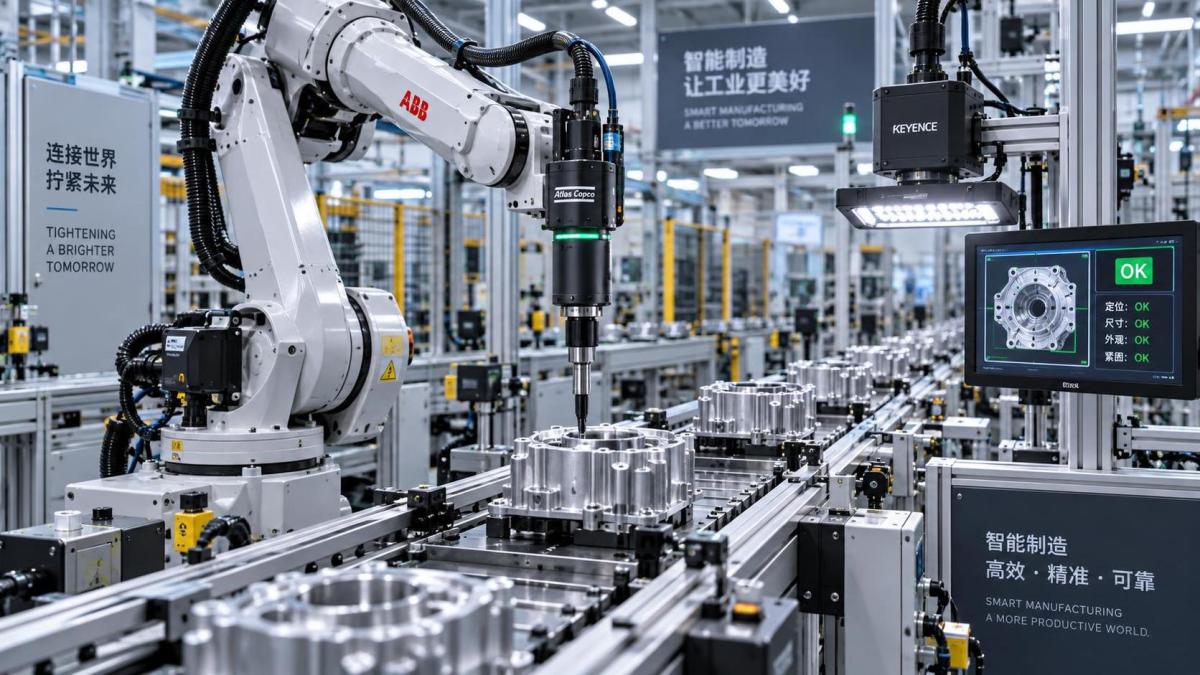
Consider a fastening operation. A connected industrial brushless tool with torque-and-angle monitoring may cost more than a conventional handheld device, but its value is not limited to speed. It can standardize fastening parameters, record completion data, alert the operator to an abnormal cycle, and reduce the chance that a critical joint reaches the next station incorrectly assembled. Where high-strength fasteners transfer significant load—as in equipment frames, industrial enclosures, transport hardware, or structural assemblies—traceability can be as commercially important as faster work.
The same logic applies to smart access control. Biometric or secure credential-based access is not justified simply because it feels modern. It becomes worthwhile when a site needs verifiable access histories for sensitive areas, needs to reduce the operational burden of lost keys and shared credentials, or must connect physical access decisions to broader security and compliance practices. Systems handling biometric information require careful attention to data minimization, consent, retention, storage, and applicable privacy law. Security value disappears quickly if governance is treated as an afterthought.
Smart LED lighting offers another example. Replacing fixtures purely to lower electricity consumption can produce a modest case. Combining high-efficiency lighting with occupancy sensing, daylight response, zone control, maintenance alerts, and appropriate task illumination changes the calculation. Better lighting can support visual inspection, safer movement around machinery, and lower maintenance interruption, while connected controls prevent unnecessary operation in low-activity areas.
Use lifecycle cost, not purchase price, as the decision lens
Low initial price is often the most expensive selection criterion in industrial environments. The procurement team should evaluate the total cost of ownership over the expected useful life of the system, including the cost of underperformance.
A practical lifecycle model includes:
- Capital cost: equipment, fixtures, sensors, controls, installation, network preparation, and safety guarding.
- Integration cost: PLC or MES connectivity, data interfaces, line balancing, commissioning, testing, and acceptance activities.
- Operating cost: electricity, consumables, battery replacements, calibration, spare parts, subscriptions, and preventive maintenance.
- People cost: training, change management, engineering support, operator redeployment, and supervisor time during ramp-up.
- Downtime exposure: planned installation downtime plus the cost of delayed recovery if the system does not achieve stable production quickly.
- Residual risk: quality escapes, safety exposure, cyber vulnerabilities, vendor dependency, and the consequences of unavailable service support.
The benefit side should be equally disciplined. Estimate additional sellable capacity only if demand exists or if capacity relief eliminates costly outsourcing, overtime, late deliveries, or lost orders. Count quality savings only when defect and rework data establish a credible baseline. Treat safety benefits responsibly: reduced risk has clear human importance, yet financial models should avoid pretending that every near-miss converts neatly into a fixed cash value.
A helpful formula is:
Annual operating gain = labor redeployment value + incremental contribution from usable capacity + quality cost avoided + energy and maintenance savings + risk-related cost reduction.
Then compare that gain against annualized capital and operating cost. The calculation should include a conservative scenario, a base scenario, and a downside case in which ramp-up takes longer or output improvement is smaller than expected. Decision-makers should be wary of proposals that show a quick payback only under perfect utilization and uninterrupted production.
When automation is premature
Not every manual process is ready for automation. A line with unstable upstream inputs, constantly changing product designs, undocumented work instructions, or unresolved maintenance issues may simply automate confusion. In those situations, the right investment may be process stabilization before equipment.
Warning signs include highly variable parts arriving at the station, frequent engineering changes without controlled updates, insufficient floor space for safe material flow, no defined owner for tool calibration, and a lack of reliable production data. These are not arguments against automation. They are signals that the deployment sequence needs adjustment.
For example, if operators use multiple fastening patterns because product variants are poorly controlled, adding connected tools without a digital work-instruction strategy may create more alarms than value. If a vision system is expected to inspect a surface but incoming lighting conditions vary dramatically, illumination design should be solved before judging the camera. If biometric access will be introduced at multiple facilities, privacy and legal review should be completed before templates are collected—not after the system goes live.
Automation is also a poor fit when a task is genuinely low-volume, highly variable, and unlikely to repeat long enough to recover the engineering effort. Flexible tooling, better ergonomics, standardized work, or semi-automated assistance may be the wiser answer.
A staged deployment reduces both technical and financial risk
Large “all-at-once” modernization programs can be appropriate for greenfield facilities, but most operating plants benefit from a staged path. Begin with one process that has a clear baseline and a visible business owner. Establish what success means before installation: target cycle-time stability, torque compliance, defect reduction, energy reduction, access audit completeness, or another concrete metric.
A pilot should test more than machine capability. It should test whether operators can use the equipment comfortably, whether maintenance can support it, whether spare parts are obtainable, whether the data is meaningful to supervisors, and whether the line can recover safely from exceptions. A technically successful pilot that creates maintenance dependence on one external integrator is not yet a scalable solution.
For industrial power tools, validate battery performance under actual duty cycles, tool balance, reaction-arm requirements, calibration intervals, and communication reliability. Brushless DC platforms can offer strong power density and reduced wear compared with brushed alternatives, but tool selection must still match torque range, fastening strategy, operator ergonomics, and environmental conditions.
For PPE and protective systems, do not frame automation as a substitute for physical protection. Automated material handling, sensing, and interlocks may reduce exposure, yet workers still need appropriate respirators, cut-resistant apparel, eye protection, and task-specific safeguards where hazards remain. The safest production line is designed around layered controls rather than a single technological promise.
Questions procurement should ask before selecting a supplier
The quality of the supplier relationship will shape lifecycle economics. Decision-makers should ask for specific answers rather than broad capability statements.
- What data can the system capture, who owns it, and how can it be exported?
- Which protocols and interfaces are supported, and what integration work is excluded from the quotation?
- What are the recommended preventive-maintenance intervals and typical wear components?
- How are firmware updates, cybersecurity patches, user permissions, and audit logs managed?
- What service response structure exists in the regions where the equipment will operate?
- Which performance assumptions depend on the customer’s fixtures, compressed air quality, network, lighting, materials, or operator practices?
- How will acceptance testing be conducted, and what happens if agreed operating conditions are not met?
For connected security products, add questions about biometric template protection, retention controls, encryption, incident response, and legal roles between customer and provider. For smart lighting, clarify driver availability, control compatibility, expected lumen maintenance, emergency-lighting requirements, and how occupancy or daylight settings will be commissioned. For fastener-critical production, confirm traceability needs, tool verification practices, and the connection between fastening records and product serial numbers.
The investment threshold is operational confidence
Industrial automation tools for production lines justify the investment when the organization can connect a defined production problem to repeatable, measurable gains—and can operate the solution after the integrator leaves. The strongest projects do not chase automation for its own sake. They build a more dependable line: one where torque is verified, access is controlled, lighting supports the task, energy is not wasted, hazards are reduced, and production decisions are based on evidence rather than guesswork.
For executives, the final decision should rest on more than a payback period. A shorter payback is attractive, but operational resilience, quality traceability, workforce safety, and the ability to expand without multiplying complexity often determine the long-term return. Invest when the process is sufficiently stable, the baseline is credible, lifecycle obligations are visible, and the selected technology can become part of the plant’s daily discipline—not another isolated asset waiting for attention.
- Last One:No more articles
- Next Article:Do dimmable LED grow lights reduce electricity use at lower settings?Sep 14, 2026
Recommended News