
Search News
Industry Portal
Hot Articles
What drives smart access systems price for a multi-site rollout?
Time
Click Count
The quoted smart access systems price is rarely the number that determines the final budget. In a multi-site rollout, the cost of readers, controllers, locks, and credentials is only one layer. The larger difference usually comes from how many doors must be made secure, how sites connect to the management platform, what existing hardware can remain, and how consistently the system must operate after handover.
A low unit price can become an expensive project when installation conditions vary, integrations are discovered late, or each site needs a different operating model. A higher initial equipment cost can be justified when it reduces repeat visits, limits local servers, simplifies credential administration, or avoids replacing the system when the organization adds sites.
The practical purchasing question is not “Which access system is cheapest?” It is: Which architecture gives the required security, operating control, and expansion path at the lowest defensible lifecycle cost?
Start with the rollout model, not the reader price
Multi-site projects are often priced incorrectly because every door is treated as identical. A headquarters lobby, warehouse loading entrance, data room, temporary construction office, and remote retail branch may all require access control, but they do not need the same credential method, hardware protection, audit depth, or availability design.
Before seeking supplier quotations, separate openings into security and operational groups. This prevents a common cost error: buying premium biometric devices for ordinary staff doors, or deploying low-cost readers at entrances where reliable identity verification and detailed audit trails are essential.
This classification also makes vendor comparisons more honest. Rather than comparing a single “price per door,” request a bill of materials and scope for each door type. It reveals whether one quotation excludes power supplies, door contacts, request-to-exit devices, emergency release components, mounting work, or commissioning.
Credential choice changes both hardware and operating cost
Credential technology is one of the clearest drivers of access control system cost. Mobile credentials, cards, PINs, and biometrics solve different problems. The right choice depends on how the organization manages users, not just on the price of the reader.
Cards and fobs can be economical for straightforward access zones, particularly when users do not change frequently and replacement procedures are already established. Their hidden cost appears in issuance, loss, collection from departing workers, and the risk of a credential being passed to another person.
Mobile credentials can reduce physical credential handling and may be convenient across many locations, especially when users already rely on managed smartphones. They still require decisions about device enrollment, support for personal versus company devices, visitor access, and what happens when a phone is unavailable.
Biometric access increases the hardware and deployment cost because the reader itself is more specialized and enrollment, privacy, lighting, placement, and fallback access all need attention. It is most defensible where identity certainty matters more than entry speed alone: protected server rooms, controlled research areas, high-value inventory zones, or locations where credential sharing is a serious concern. It is not automatically the right choice for every perimeter door.
For biometric deployments, procurement should include the full operating design: enrollment workflow, approved fallback credential, retention rules for biometric data, access rights for administrators, and secure handling of templates or identity records. Treating the reader as a standalone device creates a cost estimate that is incomplete from the start.
Site readiness often decides whether the estimate holds
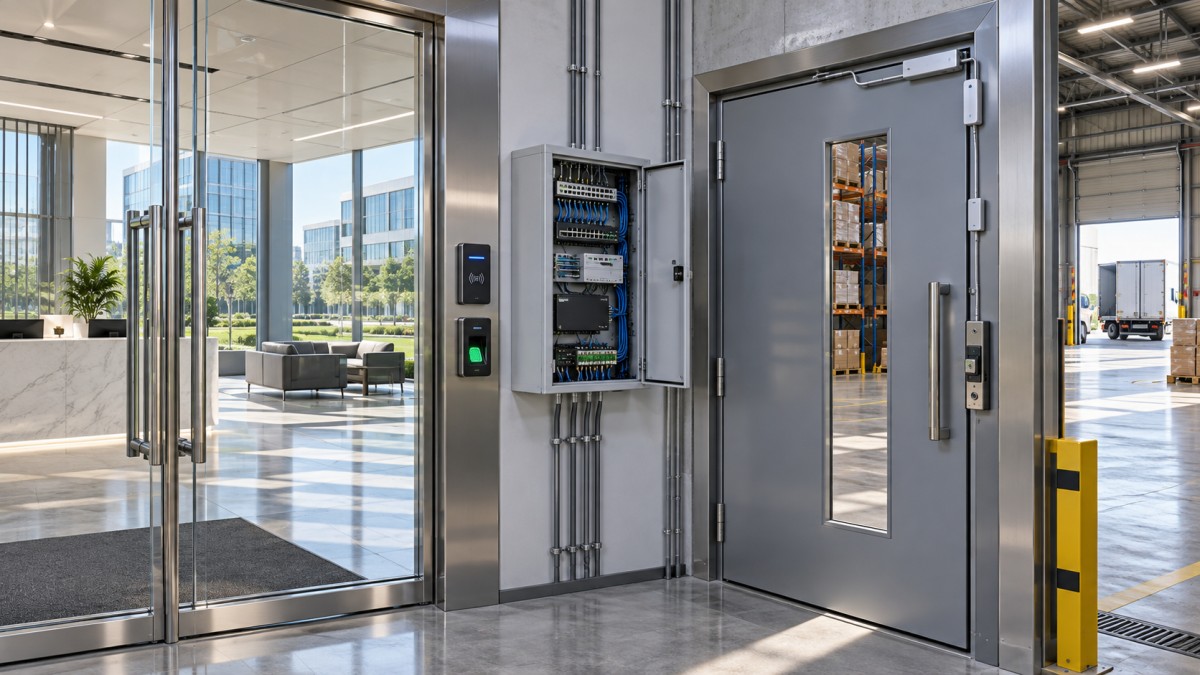
The same controller can be quick to deploy at a modern office and difficult to install at an older facility. Existing cable routes, available power, door construction, fire and life-safety interfaces, network cabinet space, and local access restrictions can materially affect installation cost.
Door hardware deserves close inspection. An access reader does not secure a door by itself. The project may need electric strikes, magnetic locks, electrified lever sets, automatic door interfaces, door position switches, exit devices, and suitable power supplies. The appropriate locking method depends on the door, the occupancy requirements, the desired behavior during a power loss, and the local safety design. Reusing existing hardware may save money, but only if its condition and electrical compatibility have been assessed.
For distributed sites, a desktop survey is not enough. Use a repeatable site-survey template that captures door photos, frame and hinge condition, lock type, cable path, power source, network availability, fire alarm interface, communications room location, and working-hour constraints. It turns uncertain field work into identifiable scope.
Cloud, on-premises, and hybrid designs have different cost profiles
Cloud-managed access control is often attractive for multi-site programs because a central team can issue credentials, change schedules, review events, and monitor device status without maintaining separate local management servers at every branch. The cost structure usually shifts toward recurring software and service fees, while local administrative effort may fall.
An on-premises approach can make sense where the organization requires local control, has an established security infrastructure, or operates in locations with restricted external connectivity. Its budget must include server hardware or virtual infrastructure, backups, patching, software maintenance, and the people responsible for administration.
Hybrid designs are useful when sites need local decision-making during a network outage but still benefit from centralized management. The important procurement detail is not simply whether a platform is “cloud-based.” Confirm what continues to work if internet connectivity is lost: existing credentials, door schedules, event storage, emergency override behavior, and later synchronization.
Comparing only capital expenditure against annual subscriptions can produce the wrong conclusion. Model the ownership period used for internal investment decisions, including licenses, support, hardware replacement assumptions, administrative labor, and expected site additions. A platform that looks costly at the first site may be more economical once the same user and policy structure serves dozens of locations.
Integration scope is where prices diverge quickly
Access systems are often expected to connect with video surveillance, visitor management, identity directories, HR systems, alarms, elevator controls, building management systems, or time and attendance tools. Each integration can improve operations, but it also adds design, licensing, testing, cybersecurity review, and support responsibilities.
Do not buy integrations because they are available. Define the operational event that the integration must improve. For example, linking a door event to video may help investigations; connecting an identity source may reduce manual account creation; connecting a visitor tool may speed approval at reception. If no owner can describe the workflow, the integration may be an unnecessary cost and maintenance dependency.
Ask suppliers to identify whether each connection is native, licensed separately, developed through an application programming interface, or dependent on a third party. “Compatible” is not the same as included, supported, or ready for the exact version of the other system.
Cybersecurity and privacy are budget items, not afterthoughts
Networked door controllers and cloud dashboards extend the organization’s digital attack surface. A multi-site system should have clear provisions for administrator roles, strong authentication, device updates, encrypted communications where supported, audit logs, account removal, and an escalation path for security incidents.
These requirements may increase the initial project scope, especially when the organization has formal IT review processes. They are still less disruptive when included in the design than when introduced after devices are installed. Biometric projects need additional care because identity data carries higher sensitivity. The purchasing team should involve security, IT, facilities, and the relevant privacy stakeholders before selecting the data flow and enrollment process.
SHSS tracks smart access and biometric security as part of the wider relationship between physical protection, connected hardware, and operational resilience. For procurement teams, that perspective is useful: a door deployment should be evaluated as both a physical hardware project and a managed information system.
Budget the work after installation
Commissioning is not the end of the rollout. Multi-site systems need user-role design, site naming conventions, access-group rules, training, documentation, testing of emergency behavior, spare-device planning, and support ownership. Omitting these items may lower the initial quotation, but it transfers risk to the operations team.
Maintenance requirements differ by environment. Outdoor readers may need more inspection than indoor units. High-traffic doors place more strain on locks and closers. Remote sites may justify standardized parts and a local support arrangement because a single failed opening can interrupt operations. Include warranty terms, replacement process, firmware support, and the cost of adding doors or users later.
A better way to compare supplier proposals
Use a normalized comparison sheet before negotiating the final price. Each supplier should price the same door schedule, credential scope, integration list, installation assumptions, training requirement, support period, and rollout sequence. Separate one-time implementation costs from recurring platform and support costs.
- Count doors by security class, not only by total quantity.
- List which existing locks, cabling, and controllers are being reused and who accepts responsibility for them.
- Specify offline behavior and recovery expectations for remote locations.
- Identify every license tied to a door, reader, user, mobile credential, integration, or management feature.
- Require a commissioning and acceptance plan, including failed-entry, emergency-release, and network-loss tests.
- Price pilot deployment and full rollout separately when site conditions remain uncertain.
A pilot is especially valuable when sites vary substantially. It should validate more than reader performance. Use it to test installer productivity, door hardware compatibility, enrollment time, support handoffs, network behavior, reporting needs, and the clarity of central administration. The result is a stronger basis for the larger rollout than a vendor demonstration alone.
Where the lowest quote usually becomes expensive
The lowest quote is risky when it depends on vague assumptions about door condition, excludes recurring licenses, treats integrations as future work, or provides limited support for geographically dispersed sites. It can also be misleading when it offers a single device class for every opening, forcing the organization to pay for unnecessary capability in low-risk areas while under-protecting critical ones.
Conversely, the most feature-rich proposal is not automatically the best investment. Advanced biometrics, complex integrations, and highly customized workflows are justified only when they solve a defined security or operational problem. Standardization across locations usually brings more value than feature variety, provided the design still allows a small number of higher-security exceptions.
Build the business case around a phased, standardized architecture: a common baseline for ordinary openings, documented exceptions for higher-risk areas, central policy management, and a clear method for bringing future sites online. That approach gives the smart access systems price a meaningful context. It turns a collection of equipment quotes into a controlled investment in physical security operations.
- Last One:No more articles
- Next Article:How custom door security hardware can meet access control requirementsSep 27, 2026
Recommended News