
Search News
Industry Portal
Hot Articles
When custom hardware solutions for facilities reduce retrofit costs
Time
Click Count
A facility retrofit rarely becomes expensive because of one major purchase order. Costs usually escape through the edges: a lock that does not fit an existing door profile, a lighting control panel that needs an extra gateway, anchors that cannot be installed in a cracked substrate, or a security upgrade that requires unplanned cable routes and night-shift labor. By the time these issues appear on site, the project manager is often managing disruption rather than design.
This is where custom hardware solutions for facilities can change the economics of a retrofit. Custom does not necessarily mean exotic or overengineered. It means selecting, adapting, or specifying hardware around the actual building condition, operational risk, maintenance capability, and installation sequence. For facilities teams, that approach can reduce rework, limit downtime, and avoid the familiar cycle of buying a “standard” product only to spend heavily making it work.
The procurement question is not simply, “What does this component cost?” It is, “What will this component cause us to spend after it arrives?”
The retrofit budget is usually decided before installation starts
Many project budgets separate equipment, labor, and contingency. In practice, those categories overlap. A low-cost device with an unclear mounting method can increase labor. A high-performance access reader with poor integration documentation can create commissioning delays. A generic fastener may be inexpensive until its corrosion resistance, load path, or thread compatibility is questioned during inspection.
For project leaders responsible for occupied commercial buildings, industrial sites, public infrastructure, or logistics facilities, the real cost drivers tend to be more specific:
- Unknown conditions behind ceilings, walls, and equipment enclosures
- Incompatibility with legacy power, wiring, door frames, mounting rails, or control protocols
- Downtime constraints that force work into nights, weekends, or short shutdown windows
- Compliance reviews involving fire safety, accessibility, privacy, electrical safety, and site security
- Rework caused by incomplete drawings, missing accessories, or ambiguous installation responsibility
- Long-term maintenance burdens created by hard-to-source consumables or proprietary parts
A tailored hardware specification addresses these variables before the order is released. That is why customization should be viewed less as a product feature and more as a risk-control method.
Where tailored hardware has the strongest cost effect
Not every item deserves a custom approach. Commodity consumables and non-critical fittings can often remain standardized. The greatest value appears at the interfaces: the points where new equipment meets an old building, a live operation, or a regulated environment.
Access control upgrades in legacy buildings
Smart access projects are often presented as a straightforward replacement of keys or card readers. Yet door hardware is rarely uniform across an estate. Facilities may have a mix of hollow metal doors, timber doors, glass entries, turnstiles, server-room cabinets, emergency exits, and exterior gates. Door thickness, handing, frame geometry, strike preparation, power transfer methods, and fire-door requirements all matter.
A custom access package may include reader backplates matched to existing drill patterns, lock bodies selected for specific door constructions, protected cable transitions, and mounting arrangements that avoid damaging finished surfaces. The objective is not visual neatness alone. It is to prevent field improvisation, which can compromise door ratings, delay handover, or require replacement doors later.
For biometric systems, the scope should also cover the data path—not just the reader. Facilities should establish whether verification occurs at the edge or through a cloud-connected platform, how credentials are enrolled, what fallback method is available during network interruptions, and who owns biometric data governance. A fast reader is of limited value if privacy and operational procedures are unresolved.
Lighting retrofits where the fixture is only one part of the system
Commercial LED upgrades can generate savings, but the installation cost is shaped by more than lumen output and fixture price. Existing ceiling types, mounting points, emergency circuits, dimming compatibility, glare requirements, moisture exposure, and access height can all affect the final number.
Custom hardware solutions for facilities are particularly useful when fixtures must attach to irregular ceilings, industrial racking, exterior poles, or difficult-to-access production areas. Brackets, junction boxes, suspension kits, corrosion-resistant fixings, and preconfigured drivers may look secondary on a bill of materials. In a retrofit, they are often what determine whether installers can complete work in one visit.
Where controls are included, specify the integration boundary with care. DALI, Zigbee, occupancy sensing, daylight harvesting, and building-management interfaces should be reviewed as a system. A project manager should ask whether existing control wiring can be retained, whether wireless devices will face interference, and how future replacements will be commissioned. A lighting system that cannot be maintained without specialist intervention can turn a promising capital project into a recurring operating cost.
High-strength fastening and mounting in uncertain substrates
Fasteners are easy to underestimate because they are physically small and comparatively low-cost. They are also the components that transfer load, vibration, thermal movement, and environmental exposure between systems. In plant rooms, warehouses, transport facilities, façades, and outdoor installations, the wrong fastening choice may force redesign long after the original contractor has left the site.
Customization can involve material selection, protective coatings, thread form, head style, embedment depth, bracket geometry, or preassembled mounting kits. The required approach depends on whether the substrate is structural steel, aged concrete, masonry, composite panels, or a combination of materials. Engineers should not accept a fastening recommendation based only on nominal load. Dynamic loads, vibration, pull-out resistance, corrosion conditions, access for torqueing, and inspection requirements all deserve attention.
In other words, the bolt is not a line item. It is part of the system’s safety case.
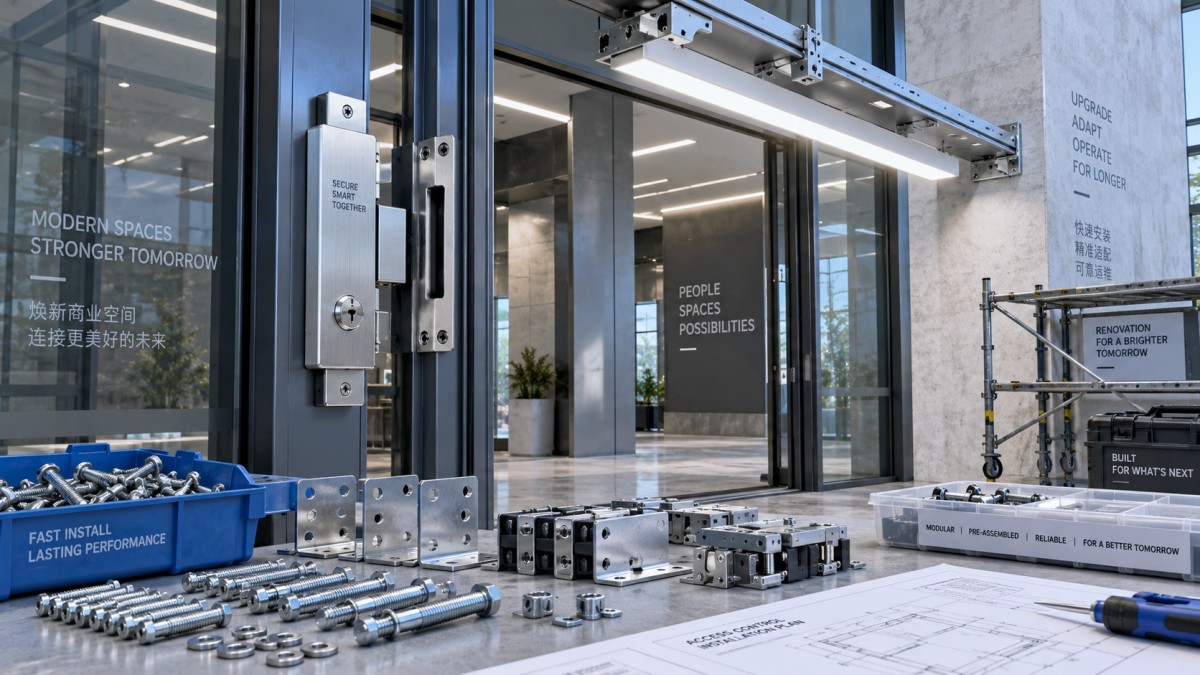
A practical way to compare “standard” and “custom” procurement
Procurement teams sometimes reject tailored specifications because they expect a longer lead time or a higher unit price. Either outcome is possible. But unit price alone is too narrow a comparison. A more useful evaluation considers the installed and operating cost of each option.
The comparison should be made at the package level. For example, a custom light mounting kit may cost more than a generic bracket, yet eliminate lifts, site drilling, repainting, and a second installation crew. A preconfigured access-control assembly may have a higher purchase price than separate components, while reducing commissioning time and eliminating compatibility disputes between trades.
Start with an interface survey, not a catalogue
The most reliable retrofit decisions begin with a site survey focused on interfaces. Before asking suppliers for quotations, document what the new hardware must connect to, pass through, support, or protect.
For each affected location, capture dimensions, substrate type, photographs, available power, cable pathways, environmental exposure, operating hours, access restrictions, and adjacent systems. For a security upgrade, include door schedules, lock functions, egress requirements, network availability, and credential policy. For lighting, record mounting height, existing circuits, control zones, ceiling conditions, and maintenance access. For tools and PPE, examine the task itself: torque requirements, dust exposure, confined-space constraints, hand-arm vibration concerns, and the availability of charging or storage points.
This process may feel slower than sending a quick request for pricing. It usually saves time because it replaces vague assumptions with procurement-ready information. Suppliers can then respond with a defined solution rather than a generic product list full of exclusions.
Specify performance outcomes, but do not leave installation details undefined
Outcome-based procurement is valuable. A brief can state that a corridor requires safer access, reduced energy use, secure credential management, or more durable equipment mounting. However, broad outcomes alone create a gap between buyer expectations and installer responsibility.
A strong specification combines performance requirements with practical constraints. It should identify:
- Required operating environment, including temperature, moisture, dust, chemicals, vibration, and UV exposure where relevant
- Mechanical interfaces, dimensional tolerances, load requirements, and approved substrates
- Electrical and network conditions, including voltage, backup power, protocol compatibility, and cybersecurity ownership
- Applicable safety, fire, accessibility, and data-protection obligations
- Installation windows, noise limits, permit requirements, and rules for occupied areas
- Required accessories, fixings, tools, commissioning steps, documentation, and spare parts
- Acceptance criteria for handover, testing, labeling, and maintenance records
This level of definition is especially important when several trades are involved. Security, electrical, mechanical, IT, and facilities teams often share responsibility at the same physical interface. If the scope does not make ownership clear, the cost of resolving gaps tends to land with the project budget.
Use standardization intelligently across a portfolio
Customization and standardization are not opposites. The best facility programs often use a standardized platform with controlled variants. A hospital group, retailer, factory network, or municipal estate may standardize on a preferred access ecosystem, lighting driver family, fastener material class, battery platform, or PPE specification. Then each site receives the mounting, configuration, or environmental adaptation it needs.
This model protects maintenance efficiency without pretending that every building is identical. It also improves future buying power: once common components, approved alternates, and installation rules are established, repeat projects require less engineering effort and carry fewer surprises.
For project managers, a sensible question is: “Which parts must remain consistent across the portfolio, and which parts must adapt to the site?” The answer often separates a scalable retrofit program from a collection of one-off fixes.
Watch for customization that hides rather than removes risk
Not every “custom solution” is genuinely engineered for the facility. Some are simply modified products with limited documentation, unclear replacement availability, or no defined testing process. These can introduce a different kind of dependency.
During supplier evaluation, ask for drawings, material details, installation instructions, compatibility statements, and a clear change-control process. Confirm whether replacement components can be supplied later and whether a customized assembly uses standard serviceable parts where possible. If a security, lighting, or fastening system has a critical function, clarify how design changes will be reviewed when field conditions differ from the survey.
It is also wise to challenge unnecessary customization. If a standard certified component fits safely and supports the operational requirement, it may be the better choice. Tailoring should solve a documented interface, safety, compliance, or lifecycle problem—not become an excuse for complexity.
A decision checkpoint before issuing the purchase order
Before committing, bring the facilities manager, installer, technical lead, and procurement owner into one short review. The purpose is not to reopen every technical detail. It is to test whether the proposed package can be installed and supported in the real world.
Ask four direct questions: Does it fit the surveyed conditions? Can it be installed within the available shutdown or access window? Does it meet the relevant safety, operational, and data responsibilities? Can the site maintain it without relying on undocumented knowledge?
If any answer is uncertain, the project is not ready for a purely price-driven award.
Thoughtful custom hardware solutions for facilities reduce retrofit costs by making hidden conditions visible early. Whether the project involves biometric access, connected lighting, high-strength mounting systems, brushless tools, or protective equipment, the principle is the same: specify the physical reality of the site, then buy the solution that works within it. The result is not merely a cleaner installation. It is a retrofit with fewer surprises, clearer accountability, and a stronger foundation for the next upgrade.
- Last One:No more articles
- Next Article:What makes biometric authentication GDPR compliant in practice?Oct 06, 2026
Recommended News