
Search News
Industry Portal
Hot Articles
When are zinc plated thread rolling fasteners a poor choice outdoors?
Time
Click Count
It usually starts with a drawing review or a late-stage material substitution. A fastener that looks perfectly acceptable on paper—steel, rolled threads, zinc plated, easy to source, lower cost than stainless—gets assigned to an outdoor bracket, enclosure, railing, lighting support, access control housing, or exposed equipment panel. Then someone asks a harder question: will it still be dependable after rain, condensation, coastal air, winter de-icing salts, and repeated temperature swings?
That is where many outdoor specifications begin to unravel. Zinc plated thread rolling fasteners are often chosen because they install quickly and the thread-forming action can be useful in thin metal or softer base materials. But the same features that make them convenient indoors do not automatically make them suitable outdoors. If the coating is thin, if the installation process damages it, or if the joint traps moisture, corrosion can move from a cosmetic issue to a serviceability problem much sooner than expected. For exposed assemblies, the question is rarely “will it rust eventually?” It is “when does the corrosion begin to interfere with preload, removal, appearance, or structural confidence?”
A common mistake is to evaluate only the fastener catalog line and not the full outdoor condition. Technical reviewers often inherit assemblies where the base material, washer choice, drainage, access for maintenance, and galvanic pairing were decided separately. The result is a joint that looked economical in procurement but becomes expensive in inspection cycles, rework, seized hardware, stained surfaces, or premature replacement.
Where zinc plating starts to lose the argument
Outdoor exposure is not one environment. A covered canopy support in a dry inland climate is different from a gate hinge near the coast, and both are different from a rooftop sensor enclosure that sees standing moisture under washers every morning. Zinc plating can provide sacrificial protection for carbon steel, but its usefulness depends on coating thickness, continuity, and how aggressively the environment consumes it. In mild, sheltered service, it may be acceptable. In more punishing outdoor conditions, it often becomes a short-lived buffer rather than a durable defense.
The first warning sign is repeated wetting. Rain is obvious, but condensation is often overlooked. Joints under covers, behind panels, around gasketed housings, and beneath overlapping sheet metal can remain damp longer than visible surfaces. If water is retained in the thread area or under the head, zinc consumption accelerates. Once the plating is locally exhausted, red rust on the steel substrate follows.
Salt changes the picture quickly. Coastal air, road de-icing residue, and industrial contaminants make a thin zinc layer work much harder. Even when the fastener initially looks clean, white corrosion products on zinc can appear early, and the protective life of the coating can drop sharply in chloride-rich conditions. If appearance matters—for architectural hardware, security equipment, exterior lighting, access panels, or visible brackets—that alone may disqualify the finish long before mechanical failure is a concern.
Temperature cycling also deserves more attention than it often gets. Outdoor assemblies expand and contract daily and seasonally. That movement can disrupt thin corrosion films, pump moisture into crevices, and increase the chance of fretting or loosening in joints that already have marginal corrosion protection. Thread rolling fasteners may also generate installation stresses in the receiving material, which is not necessarily a problem by itself, but in a corrosive environment it can make long-term removal and service more difficult.
The outdoor scenarios that cause trouble most often
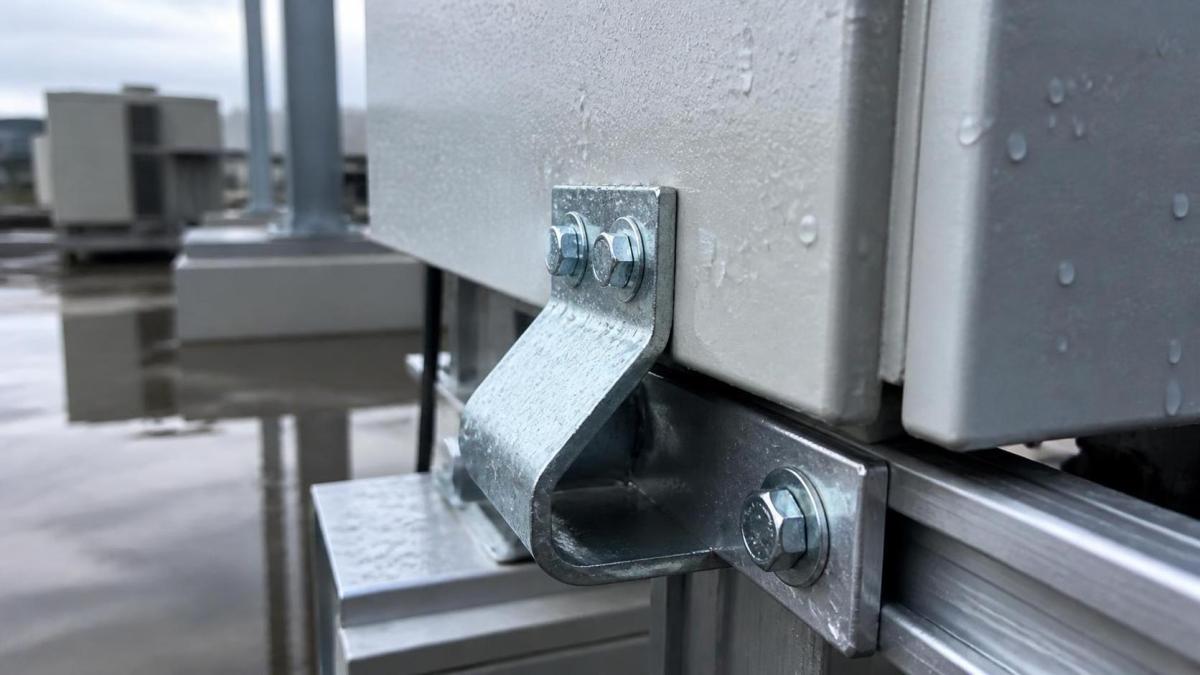
One of the most problematic applications is exposed sheet metal fastening where the thread rolling screw forms threads into a thin section and remains directly in weather. The installation process creates intimate metal-to-metal contact and may scrape or thin the plated surface on the threads and under the head. That loss is easy to miss during assembly because the part still seats normally. Months later, corrosion begins first at the damaged areas where protection was already weakest.
Another poor fit is any joint involving dissimilar metals without careful isolation. If zinc plated steel is used against aluminum, stainless, or other metals in a moisture-prone outdoor setting, galvanic effects can complicate the decision. Sometimes the zinc sacrifices itself rapidly; sometimes the surrounding material shows staining or local attack; sometimes the joint simply becomes hard to service. The exact behavior depends on area ratios, contact geometry, and electrolyte exposure, but as a selection rule, mixed-metal outdoor assemblies deserve a more deliberate approach than “zinc plated should be fine.”
Fasteners in safety-related or access-critical equipment also deserve caution. Exterior security housings, gate systems, control cabinets, and mounted hardware may not be heavily loaded in the structural sense, yet failure of removal, loss of clamping force, or corrosion locking can create a serious maintenance problem. If the hardware must open reliably for service, and if seizure or head damage during removal would create downtime, zinc plated thread rolling fasteners become a risky default.
There is also the issue of appearance bleed. On painted facades, poles, smart lighting components, architectural trim, and visible equipment covers, corrosion runoff from plated carbon steel can stain surrounding finishes. Even if the fastener itself is not yet compromised, the assembly looks neglected and often triggers replacement work earlier than planned.
Why thread rolling makes the coating question sharper
The “thread rolling” part matters. These fasteners are designed to form or displace material during installation rather than simply engage fully pre-cut threads. That can be useful for production efficiency, but it also means friction and contact pressure are concentrated exactly where corrosion protection is needed most. In outdoor service, any local damage to the zinc layer along the active thread flanks, point, or bearing surface can become the starting point for corrosion.
This does not mean every thread rolling fastener fails outside. It means the evaluator should stop treating the plating as if it remains intact after installation. In many joints, the coating that survives in storage is not the same coating condition that exists in service after forming threads in steel, aluminum, or other substrate materials.
Another subtle issue is that thread-forming joints can be more sensitive to removal and reinstallation. If outdoor corrosion develops in the formed threads, the first maintenance cycle may strip the receiving material, tear the screw coating further, or lead to seizure. For products expected to be opened periodically, that is a practical reliability concern, not just a finish preference.
A better way to evaluate the choice before release
When deciding whether to keep or reject zinc plated thread rolling fasteners for an outdoor assembly, it helps to evaluate the joint as a system rather than as a part number. Start with exposure severity. Is the joint fully exposed, partially shielded, or only occasionally wet? Is there salt, fertilizer, road spray, industrial fallout, or washdown? Does water drain freely, or does it sit under the head, washer, or flange?
Next, look at the base material. Thread rolling into carbon steel, coated steel, aluminum, or thermoplastic each changes the risk profile. If the receiving material is thin and the formed threads are critical to retention, corrosion in either the screw or the parent material can reduce serviceability long before the assembly “fails” in a dramatic way.
Then review contact combinations. If the fastener touches a more noble metal outdoors, ask whether isolation, sealing, or an alternate fastener material is needed. Do not ignore washers, inserts, clips, brackets, and coatings on mating parts. Often the galvanic problem is introduced by a small accessory part that was not part of the original corrosion review.
Finally, consider maintenance reality. Will this fastener ever need to come out after years outside? If yes, the decision standard should be stricter. A finish that is acceptable for a short-life, noncritical, easily replaceable outdoor attachment may be a poor choice for an enclosure cover, sensor mount, access-controlled housing, or anything expected to be opened without damage.
When another fastener option usually makes more sense
If the assembly is permanently outdoors and the consequences of corrosion include seizure, staining, inspection burden, or uncertain clamp reliability, many evaluators move away from basic zinc plated carbon steel. Common alternatives include stainless steel grades suited to the environment, mechanically galvanized or hot-dip galvanized hardware where geometry and tolerances permit, or specialized coated fasteners designed for higher corrosion resistance. The right choice depends on load, substrate, thread engagement, installation torque window, and compatibility with the mating material.
For thin sheet assemblies, it may also be worth revisiting the fastening method itself. A thread rolling fastener may have been chosen for convenience, but an outdoor joint may perform better with a different thread profile, a sealed insert, a rivet nut with a compatible screw, or a fully pre-threaded and better-protected connection. Sometimes the best correction is not a better coating on the same screw, but a different joint concept that reduces coating damage and moisture retention.
Where cost pressure keeps zinc-plated options under discussion, a useful compromise is to narrow their use to truly low-risk outdoor positions: sheltered locations, non-visible components, replaceable attachments, and places with low moisture retention and no salt exposure. Even then, it is better to document the exposure assumptions than to leave the choice as an unqualified default.
Signs the current specification needs to be challenged
If your review includes phrases like “exterior use,” “weather resistant,” “roof mounted,” “pole mounted,” “marine-adjacent,” “washdown area,” or “mixed-metal assembly,” that is already enough reason to pause. So is any note indicating periodic service access. Another warning is when the fastener finish is specified only as zinc plated with no discussion of coating system suitability for the actual environment.
It is also worth challenging the choice when installation relies on high driving torque, because more aggressive forming can mean more coating disturbance. The same applies when a sealing washer or painted panel could conceal early corrosion under the head. Hidden corrosion around a fastener seat is one of the reasons apparently minor outdoor hardware choices become expensive field problems.
Practical judgment for specification work
If you are reviewing exposed hardware and wondering whether zinc plated thread rolling fasteners are acceptable, the safest answer is not a blanket yes or no. They are usually a poor choice outdoors when the joint sees regular moisture, salt, trapped water, dissimilar-metal contact, or future maintenance removal. They also become hard to justify when appearance matters or when corrosion could interfere with access, clamping, or service safety.
On the other hand, in lightly exposed, low-consequence, easily replaceable assemblies with minimal corrosion drivers, they may still be workable if the limits are clearly understood. The key is to stop evaluating them as a low-cost generic fastener and start evaluating them as a time-limited corrosion system installed by a process that can damage its own protection.
That shift in thinking usually leads to better specifications. Instead of asking whether the catalog fastener can probably survive outside, ask whether the completed joint will remain removable, stable, and acceptable in appearance through its real service environment. In many outdoor applications, that question is exactly where zinc plated thread rolling fasteners stop being the economical choice and start becoming the source of avoidable risk.
Recommended News