
Search News
Industry Portal
Hot Articles
Brushless Drill vs Brushed Drill: Runtime, Torque, and Maintenance Compared
Time
Click Count
Choosing between a brushed and a brushless drill directly affects how long you can work, how much torque you can apply, and how often your tool needs servicing.
For construction sites, workshops, maintenance teams, and daily fastening tasks, the difference is practical, not just technical.
This guide compares brushless drill performance with traditional brushed models across runtime, torque, heat, maintenance, cost, and real application value.
What Is the Core Difference Between a Brushed Drill and a Brushless Drill?
A brushed drill uses carbon brushes and a commutator to transfer current into the motor rotor.
This design is proven, affordable, and easy to understand, but friction is always present inside the motor.
A brushless drill removes physical brushes and uses electronic control to manage motor rotation.
That control system adjusts power delivery according to load, speed, trigger pressure, and resistance from the material.
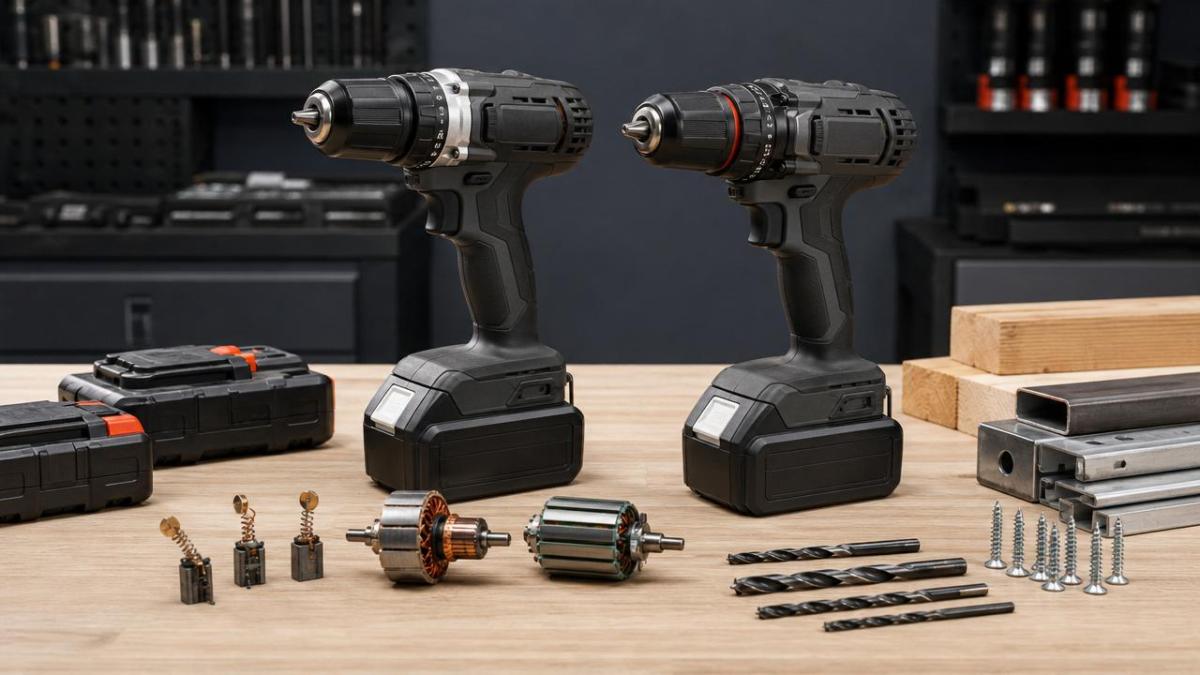
In simple terms, the brushed drill wastes more energy through friction and heat.
The brushless drill converts more battery energy into useful rotation, making it more efficient under demanding use.
This efficiency explains why many industrial power tools now use BLDC motor platforms.
For drilling steel, fastening anchors, assembling frames, or driving long screws, motor control becomes a clear advantage.
Quick definition checklist
- Brushed drill: mechanical contact, lower cost, higher wear.
- Brushless drill: electronic control, higher efficiency, lower maintenance.
- Brushed motor: simpler design, more heat during load.
- Brushless motor: smarter output, better battery use.
Does a Brushless Drill Really Deliver Longer Runtime?
Yes, a brushless drill usually delivers longer runtime from the same battery capacity.
The gain depends on material, bit size, fastening load, battery quality, and operating temperature.
In light work, the difference may feel modest because both tools operate below their stress limit.
In repetitive fastening or drilling dense materials, a brushless drill can show a much clearer runtime advantage.
The reason is load sensing.
A brushless drill does not draw maximum current when maximum power is unnecessary.
Instead, the controller meters current more precisely, helping reduce wasted energy and battery drain.
A brushed drill tends to lose more power as heat, especially during sustained trigger use.
Heat does more than waste energy.
It can also reduce comfort, shorten battery discharge efficiency, and force pauses during high-output work.
Runtime comparison in real tasks
For cordless platforms, runtime is also tied to battery chemistry and tool firmware.
A premium brushed drill may outperform a poor brushless drill with weak cells or bad thermal design.
Still, when battery systems are comparable, the brushless drill has the runtime edge.
Which Drill Offers Better Torque and Control?
Torque is not only about the highest number printed on the specification sheet.
Useful torque depends on how smoothly the drill responds when resistance changes.
A brushless drill usually offers better torque control because electronics regulate motor output instantly.
When a screw hits dense timber or a bit enters steel, the controller can adjust current delivery.
This makes the brushless drill feel more confident under load.
It can maintain speed better and reduce unnecessary bogging during repetitive work.
A brushed drill may still produce strong torque, especially in corded or heavy-duty models.
However, output is less refined because mechanical contact creates friction and electrical loss.
Torque matters most in these situations
- Driving structural screws into dense timber.
- Drilling metal with larger bits.
- Installing brackets, rails, and light framing.
- Fastening into composite materials.
- Working with hole saws or spade bits.
For precision fastening, torque control also protects the workpiece.
A brushless drill with a good clutch can reduce stripped screws, damaged threads, and inconsistent seating depth.
That is valuable in cabinetry, electrical installation, hardware assembly, and smart security device mounting.
For safety-critical installation, consistent torque supports repeatable results and fewer rework cycles.
How Much Maintenance Does Each Drill Need?
Maintenance is one of the clearest differences between the two motor designs.
A brushed drill contains carbon brushes that wear down through contact.
Over time, brushes may need inspection, cleaning, or replacement.
Dust, sparks, and worn contacts can reduce performance and cause unstable motor behavior.
A brushless drill eliminates that wear point, so the motor generally needs less servicing.
There are no brushes to replace, and friction inside the motor is lower.
That does not mean a brushless drill is maintenance-free.
Chucks, gearboxes, triggers, batteries, cooling vents, and housings still require attention.
Practical maintenance checklist
- Clear dust from vents after masonry or metal work.
- Inspect the chuck for wobble or slipping.
- Store batteries away from extreme heat.
- Avoid forcing dull bits through hard material.
- Check gearbox noise before heavy use.
- Keep battery terminals clean and dry.
A brushed drill can be economical when repair access is simple and usage is occasional.
A brushless drill makes more sense where downtime, service interruptions, or inconsistent output create real costs.
In industrial power tool planning, fewer wear components often support better long-term reliability.
Is a Brushless Drill Worth the Higher Price?
A brushless drill usually costs more at purchase because the motor and electronics are more advanced.
The real question is whether the added cost returns value through productivity, durability, and battery efficiency.
For occasional home tasks, a brushed drill can be enough.
If the tool only drills softwood, assembles furniture, or handles light repairs, low cost may matter most.
For frequent work, a brushless drill becomes easier to justify.
Longer runtime means fewer battery swaps, fewer interruptions, and better daily workflow.
Lower heat can also support tool life, especially in repetitive fastening operations.
The value is stronger when the drill belongs to an existing cordless platform.
Shared batteries reduce system cost and make upgrading to a brushless drill more practical.
Cost decision guide
Price alone should not decide the purchase.
Consider battery platform, warranty, clutch range, chuck quality, weight, grip, and available service support.
Which Drill Fits Different Applications Best?
The best choice depends on duty cycle and performance expectations.
A brushless drill is preferred when work combines repeated loads, battery dependence, and tight completion schedules.
For wood framing, metal brackets, smart access hardware, LED mounting, and PPE station assembly, consistency matters.
A brushless drill helps keep drilling speed and fastening control more stable across the day.
A brushed drill remains useful for lower-intensity settings.
It can work well for occasional repairs, simple pilot holes, and basic assembly tasks.
However, pushing a brushed drill beyond its comfort zone increases heat, wear, and battery drain.
Application-based recommendation
- Choose a brushless drill for construction drilling and fastening.
- Choose a brushless drill for metalwork with repeated load changes.
- Choose a brushed drill for occasional light household tasks.
- Choose a brushless drill for cordless productivity and battery efficiency.
- Choose a brushed drill when budget matters more than long-term runtime.
For safety-related installations, tool consistency supports better workmanship.
Fasteners, anchors, access devices, and lighting brackets all benefit from controlled torque and stable drilling.
What Mistakes Should You Avoid When Comparing These Drills?
The first mistake is assuming every brushless drill is automatically superior in every category.
Motor type matters, but build quality also matters.
A weak gearbox, poor chuck, or low-grade battery can limit any brushless drill.
The second mistake is comparing bare tool prices without batteries and chargers.
A low-cost tool may become expensive if it requires a new platform.
The third mistake is using maximum torque as the only decision point.
Control, comfort, runtime, thermal protection, and clutch precision often matter more in daily work.
Common FAQ comparison table
Also avoid ignoring ergonomics.
A lighter, balanced brushless drill can reduce fatigue during overhead work or long fastening runs.
Finally, match the drill to bits, batteries, and fasteners.
Even the best brushless drill performs poorly with dull bits or unsuitable screws.
Final Verdict: Brushless Drill vs Brushed Drill
A brushless drill is the stronger choice for runtime, torque control, heat management, and reduced maintenance.
It suits construction, workshop, industrial maintenance, installation, and repeated fastening work.
A brushed drill still has value when cost is the main concern and workloads are light.
The practical decision is not about marketing terms.
It is about how often the tool works, how hard it works, and how costly interruptions become.
Before buying, list your main materials, average daily fastening count, required torque range, and existing battery platform.
If the drill must run longer, stay cooler, and need less servicing, choose a quality brushless drill.
For modern cordless tool systems, that choice supports efficient work and more reliable results.
Recommended News