
Search News
Industry Portal
Hot Articles
High-Rate Batteries: Cycle Life vs Fast Discharge Performance
Time
Click Count
For technical evaluators, high-rate batteries are never just about peak power. In demanding tools, security devices, and other mission-critical hardware, the real question is how cycle life holds up when fast discharge performance becomes non-negotiable. This article examines the trade-offs, test metrics, and application-driven selection logic behind batteries built for both endurance and instant power delivery.
Across SHSS-relevant sectors, battery selection affects runtime stability, thermal safety, maintenance intervals, and total cost of ownership. A pack that delivers 10C discharge for 5 seconds may look impressive on paper, yet fail commercial expectations if capacity retention drops below 80% after 300 cycles.
That tension is especially important in BLDC power tools, biometric access terminals with backup power, mobile inspection equipment, emergency lighting nodes, and wearable protective systems. Technical evaluators need a framework that connects discharge rate, internal resistance, temperature rise, chemistry choice, and cycle degradation to the real duty profile of each device.
Why High-Rate Batteries Are Evaluated Differently
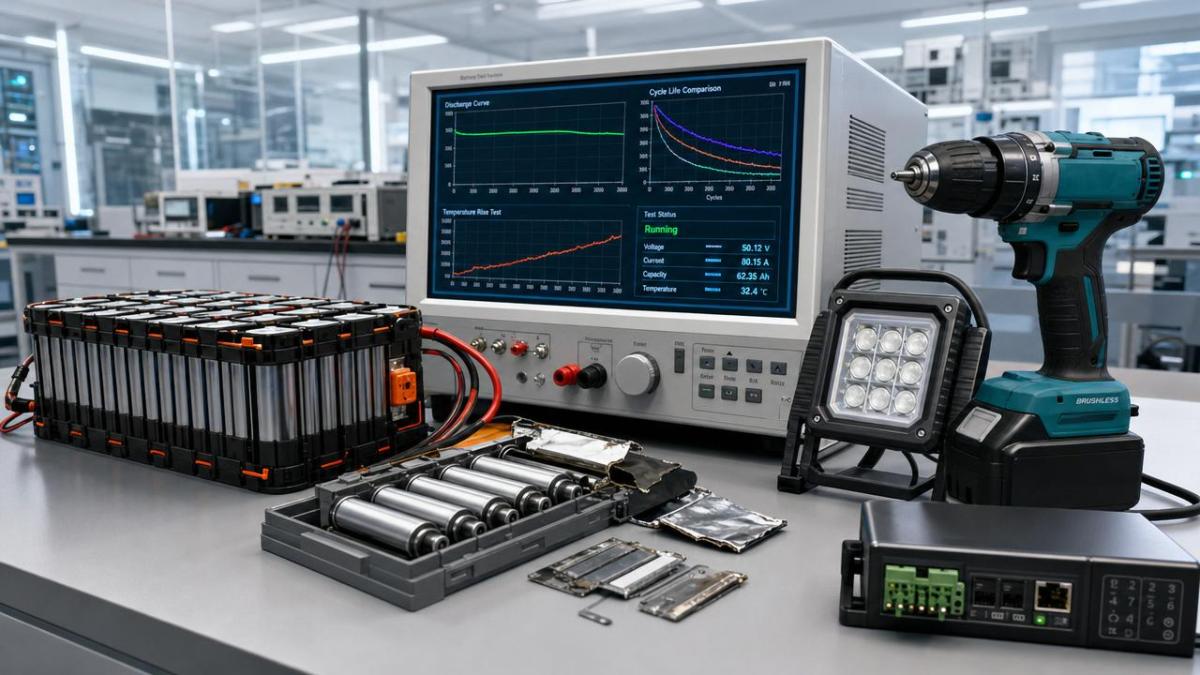
High-rate batteries are designed to deliver large current in short or repeated bursts without severe voltage sag. In practical engineering terms, that means the pack must support fast discharge events such as 5C, 10C, or even higher, while still meeting thermal, safety, and lifecycle requirements.
For technical evaluators, the challenge is that high-power output and long life often pull in opposite directions. Higher current raises cell temperature, accelerates side reactions, increases lithium plating risk under poor charging control, and pushes mechanical stress within the electrode structure.
The Core Trade-Off
A battery optimized for fast discharge usually uses lower internal resistance, thicker current collectors, and electrode designs that prioritize ion transport. However, these features can reduce energy density, increase cost per watt-hour, or shorten cycle life if the application sees hundreds of deep discharge events every year.
In handheld industrial tools, the discharge pulse may last 2 to 15 seconds, repeated dozens of times per shift. In biometric security backup systems, the average load is lower, but reliability expectations are longer, often 3 to 5 years with infrequent failure tolerance.
Typical SHSS Application Profiles
Different hardware categories place very different stress on high-rate batteries. The table below helps evaluators match discharge behavior with lifecycle expectations instead of selecting by headline current alone.
The key conclusion is simple: no single definition of “best” fits all high-rate batteries. A tool battery that survives 800 cycles at 80% depth of discharge may still be a poor choice for always-on access control if self-discharge, calendar aging, or cold-start behavior is weak.
Cycle Life vs Fast Discharge Performance: What Actually Degrades
When evaluators compare high-rate batteries, they should separate marketing claims from degradation mechanisms. Cycle life is not a single fixed number. It changes with discharge rate, depth of discharge, charge method, cell temperature, rest period, and cutoff voltage.
Four Degradation Drivers That Matter Most
1. Heat accumulation
At higher current, resistive losses rise roughly with I²R. Even a modest increase in internal resistance can turn a safe 12°C temperature rise into a 20°C to 25°C rise under repeated pulses. Once cell temperature spends significant time above 45°C, capacity fade usually accelerates.
2. Voltage sag and deeper effective stress
Under heavy load, terminal voltage falls faster. That means the pack may hit the low-voltage cutoff earlier, causing the battery management system to expose cells to harsher effective cycling even when nameplate depth of discharge appears unchanged.
3. Charge recovery strategy
High-rate discharge often leads teams to pair the pack with aggressive charging. Fast charge above 1C can be acceptable for some chemistries, but combined with repeated 5C–10C discharge, the total stress stack can reduce expected cycle life by 20% to 40% compared with moderate operating profiles.
4. Mechanical and chemical electrode fatigue
Repeated high-current flow stresses conductive pathways and active materials. Over 400 to 1,000 cycles, this may show up as rising impedance before obvious capacity loss appears. For tools and smart hardware, impedance growth is often the earlier field failure indicator.
A More Useful Way to Read Cycle-Life Claims
A supplier statement such as “1,000 cycles” is incomplete unless the evaluator also sees at least five test conditions: charge rate, discharge rate, depth of discharge, end-of-life criterion, and ambient temperature. Without those details, comparing two high-rate batteries can be misleading.
- Was the test run at 0.5C, 1C, or 5C discharge?
- Was end-of-life defined as 80% remaining capacity or another threshold?
- Was the cell kept at 25°C, or was there a real thermal load profile?
- Was the cycle window 100% depth of discharge or a partial cycle regime?
For procurement and engineering teams, these details often matter more than nominal amp-hour value. In high-demand tools, stable output through cycle 300 may be commercially more valuable than a higher starting capacity that fades sharply by cycle 200.
Which Test Metrics Should Technical Evaluators Request
A strong evaluation process converts battery selection from speculation into measurable risk control. For high-rate batteries, test reports should reflect both lab performance and application-specific behavior under repeated stress.
Minimum Metrics for B2B Review
Before approval, technical evaluators should request a practical data package rather than a generic datasheet. The matrix below summarizes the most useful indicators for cross-industry hardware programs.
If a supplier cannot provide pulse curves, impedance growth, or thermal response beyond beginning-of-life data, the technical risk remains high. For mission-critical hardware, beginning-of-life performance alone is not enough for a sound sourcing decision.
Three Evaluation Stages That Reduce Procurement Risk
- Bench screening: verify nominal voltage, discharge rate, and thermal rise across 3 to 5 sample cells or packs.
- Duty-profile simulation: replicate real load pulses, idle windows, and ambient ranges such as 0°C to 40°C.
- Pilot integration: test 50 to 200 operational cycles inside the target device before approval for scaled purchase.
This three-step method is especially relevant for SHSS sectors where battery behavior affects torque output, access continuity, emergency operation time, or field-worker safety. It also helps finance and procurement teams translate technical findings into replacement interval forecasts.
How to Choose High-Rate Batteries by Application Logic
The best battery is the one that fits the duty cycle, not the one with the highest advertised discharge number. Technical evaluators should start with load behavior, thermal constraints, expected service life, and the cost of downtime in the target hardware.
For Brushless Industrial Tools
Power tools require strong burst output, low impedance, and consistent voltage under repeated starts. A pack that supports 8C to 15C discharge may be justified if the tool is used in short-duty cycles and the enclosure can dissipate heat effectively within each work interval.
In this segment, evaluators should prioritize torque consistency through mid-life, not just new-pack power. If voltage drop increases by more than a practical threshold during cycle aging, fastening accuracy and drilling speed may both deteriorate before nominal end-of-life is reached.
For Biometric Security and Smart Access Devices
Here, the battery is often a continuity component rather than the main power source. That shifts attention toward 24/7 readiness, low self-discharge, stable backup discharge, and predictable retention after long standby periods. A lower discharge rate design with better calendar life may outperform a more aggressive high-rate option.
If the door controller, iris terminal, or smart lock must support emergency unlock or data protection during outage events, test the pack after prolonged standby plus surge demand. That scenario often reveals weaknesses not visible in standard cycling tests.
For Smart Lighting, Mobile Nodes, and Protective Systems
These devices usually demand a balance between moderate discharge, compact size, and long service intervals. In many cases, 1C to 3C continuous performance with 800 to 1,200 cycle capability is commercially more valuable than extreme pulse current that will never be used in the field.
Where maintenance access is difficult, such as distributed lighting nodes or embedded wearable electronics, replacement frequency can dominate lifetime cost. Evaluators should compare not only cell price, but pack replacement labor, downtime exposure, and safety inspection burden.
A Practical Selection Checklist
- Define actual peak current, pulse duration, and duty repetition per hour.
- Set minimum acceptable capacity retention, such as 80% after a target cycle count.
- Review temperature rise under worst-case ambient conditions.
- Check whether the BMS supports load cutoff, balancing, and thermal protection suitable for the application.
- Model replacement interval and cost over 24 to 60 months.
Common Mistakes in Evaluating High-Rate Batteries
Several recurring mistakes push projects toward either overspecification or premature failure. Both outcomes increase total cost and delay deployment.
Mistake 1: Selecting by C-rate only
A battery advertised at 20C is not automatically better for your hardware. If the application rarely exceeds 2C, that extra capability may simply add cost, reduce energy density, or compromise cycle life without operational value.
Mistake 2: Ignoring impedance growth
Capacity can remain acceptable while output quality drops. In torque tools and security devices, functional failure may happen when resistance rises enough to trigger low-voltage cutoff during a pulse, even though the pack still shows 85% nominal capacity.
Mistake 3: Testing cells but not the pack
Cell-level performance does not guarantee pack-level behavior. Interconnect resistance, thermal path design, balancing strategy, and enclosure ventilation can change real discharge performance significantly. Final approval should always include integrated pack testing.
Mistake 4: Underestimating operating temperature
A pack that performs well at 25°C may degrade rapidly in a sealed tool housing or outdoor smart cabinet. Evaluators should test realistic ambient and self-heating conditions, especially where summer cabinet temperatures can exceed 40°C.
Final Decision Framework for Technical Evaluators
The most reliable approach to high-rate batteries is to rank them across four dimensions: discharge capability, cycle durability, thermal behavior, and lifecycle cost. This prevents single-parameter decisions and aligns sourcing with actual hardware performance requirements.
In SHSS-related industries, the right choice supports faster tools, more resilient access systems, longer-lasting smart devices, and safer field equipment. The wrong choice can shorten maintenance intervals, reduce output stability, and create avoidable replacement costs within 12 to 24 months.
If you are assessing high-rate batteries for industrial tools, biometric security hardware, smart lighting, or protective electronics, build your review around real duty profiles, validated thermal data, and cycle-life conditions that match field use. For application-specific guidance, procurement screening support, or a tailored battery evaluation framework, contact us to discuss your project and explore the most suitable solution path.
Recommended News