
Search News
Industry Portal
Hot Articles
High-Rate Batteries for Brushless Tools: Key Tradeoffs
Time
Click Count
For technical evaluators, high-rate batteries are no longer just a runtime specification—they define whether a brushless tool can deliver peak torque, maintain thermal stability, and survive demanding jobsite duty cycles. As BLDC platforms push higher power density into lighter handheld designs, battery selection becomes a balancing act between discharge capability, cell temperature, cycle life, safety margins, and total ownership cost. This article examines the key tradeoffs behind high-rate packs for industrial brushless tools, helping procurement and engineering teams assess performance claims with greater precision.
Why high-rate batteries matter more in modern brushless tools
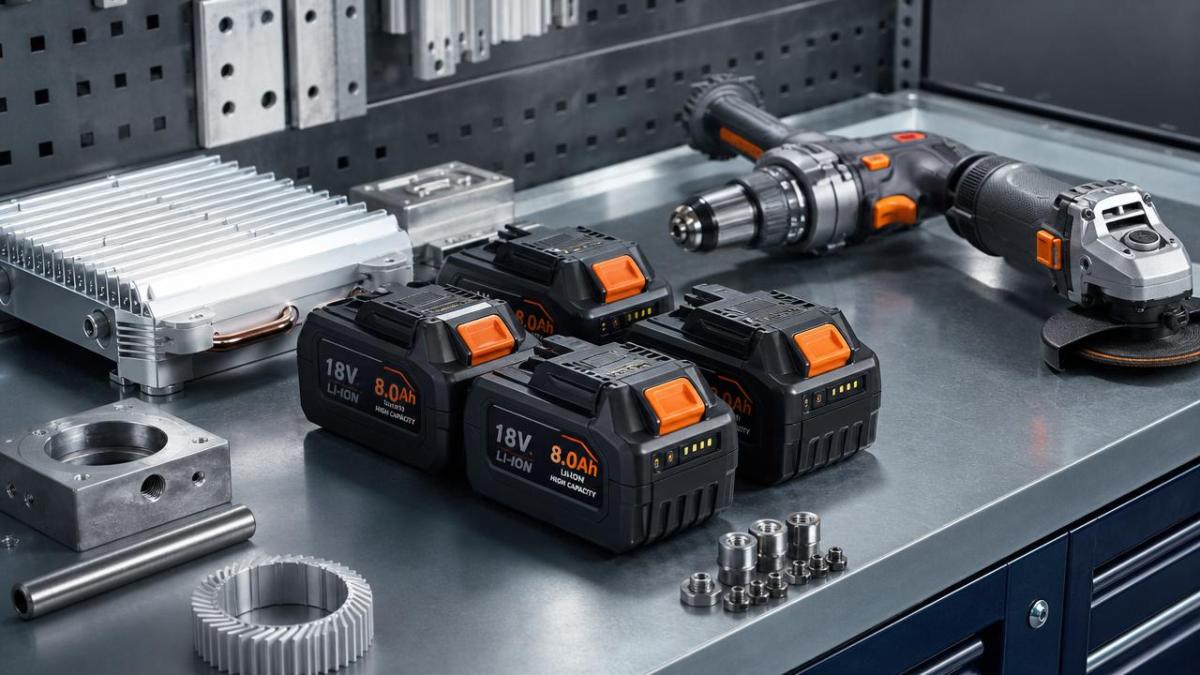
Brushless tools convert electrical energy into torque through electronically commutated BLDC motors. When a drill, grinder, impact wrench, or rotary hammer faces a dense material, the motor controller requests current instantly.
If the pack cannot deliver that pulse, voltage sag appears. The user sees slower ramp-up, reduced fastening consistency, premature cut-off, or excessive heating inside the handle and battery bay.
High-rate batteries are designed to provide higher continuous and peak discharge than ordinary energy-focused packs. They help compact tools sustain torque under aggressive load profiles.
The practical evaluation question
The key question is not whether a pack has a large amp-hour label. It is whether the complete battery, BMS, contacts, cooling path, and tool firmware can support the real duty cycle.
- For fastening tools, evaluators should examine peak current response and repeatability across hundreds of short bursts.
- For grinders and saws, continuous discharge capability and cell temperature rise become the dominant concerns.
- For fleet buyers, pack aging, replacement frequency, charger compatibility, and worker safety are equally important.
Key tradeoffs evaluators should quantify before procurement
High-rate batteries create a performance advantage, but every advantage carries a design cost. Technical evaluators should compare discharge power, thermal headroom, energy density, cycle life, and price together.
The table below summarizes the tradeoffs that often decide whether a pack is appropriate for industrial brushless tools or only suitable for lighter intermittent work.
A strong pack specification should connect electrical ratings with the tool’s actual load. SHSS recommends treating current, heat, and service life as a single system problem.
Which jobsite scenarios justify high-rate batteries?
Not every tool fleet needs the most aggressive discharge pack. The best selection depends on material density, work rhythm, ambient temperature, operator behavior, and downtime tolerance.
High-load metal and concrete work
Structural fastening, steel drilling, concrete anchoring, and heavy cutting place intense pulsed demand on BLDC drives. High-rate batteries reduce performance drop during repeated engagements.
Maintenance fleets with short service windows
Municipal crews, factory maintenance teams, and telecom installers often work under tight access windows. A pack that recovers quickly between bursts can protect schedule reliability.
Remote or safety-critical operations
When work occurs on rooftops, tunnels, energy sites, or secured facilities, battery failure is more than inconvenience. It can interrupt access control, lighting, fastening, or emergency repair tasks.
- Choose higher discharge capability for tools repeatedly used near stall conditions.
- Prioritize thermal protection where operators cannot pause between cuts or holes.
- Avoid overbuying if the fleet mainly performs light assembly or low-torque service tasks.
How to read battery parameters without being misled
Battery labels can compress complex behavior into simple numbers. Technical evaluators need to separate marketing indicators from parameters that predict real field performance.
The following parameter view helps compare high-rate batteries across suppliers, especially when evaluating industrial brushless platforms from multiple regions or product generations.
A pack promoted as “high output” should be supported by measured curves. Without test conditions, the claim may not translate into better performance on a real jobsite.
Comparison: high-rate packs, energy packs, and balanced packs
Many procurement teams face a choice between maximum runtime, maximum power, or a balanced architecture. The correct answer depends on the dominant failure mode in the fleet.
If users complain about weak torque, high-rate batteries may solve the issue. If they complain about daily runtime, a higher energy pack may be more appropriate.
For multi-site buyers, standardization can reduce charger count and spare inventory. However, standardization should not force underpowered batteries onto high-risk applications.
Safety, compliance, and transport checks for high-rate batteries
High-rate batteries store and release energy quickly, so safety validation must extend beyond normal runtime tests. Thermal runaway mitigation, short-circuit protection, and enclosure integrity matter.
Evaluators should discuss applicable lithium battery transport and safety expectations with suppliers. Common references include UN 38.3 for transport testing and IEC 62133-style safety principles.
A practical compliance checklist
- Confirm the battery chemistry, cell origin policy, pack assembly controls, and traceability documentation.
- Review BMS protections for overcharge, over-discharge, overcurrent, short circuit, and temperature extremes.
- Check transport documentation, packaging instructions, labeling requirements, and regional shipment constraints.
- Validate tool-pack communication, charger compatibility, and lockout behavior after abuse or overheating events.
SHSS views battery safety as part of a broader physical defense system. A pack that drives torque must also protect workers, tools, cargo handlers, and maintenance teams.
Total ownership cost: when a powerful pack becomes expensive
The purchase price of high-rate batteries is only one cost. Replacement frequency, charging infrastructure, job interruption, warranty handling, and inventory complexity can change the total equation.
A cheaper pack may become costly if it triggers shutdowns, slows installers, or fails before the tool platform reaches its planned replacement cycle.
Cost factors to model
- Downtime cost per crew hour when the tool cannot maintain output under load.
- Battery rotation ratio, including spare packs required for multi-shift work.
- Charger count, charging location, cooling time, and power availability at the worksite.
- Warranty terms tied to operating conditions, charging method, or unauthorized tool combinations.
For technical evaluators, the strongest business case appears when high-rate batteries prevent rework, protect schedule certainty, or reduce the number of packs needed per crew.
Common mistakes in evaluating high-rate batteries
Several procurement mistakes repeat across industrial tool fleets. They usually come from relying on a single headline value instead of testing the battery inside the complete system.
Mistake 1: treating amp-hours as power
Amp-hours describe capacity, not discharge strength. A larger pack may still perform poorly if internal resistance, BMS limits, or contact design restrict current flow.
Mistake 2: testing only at room temperature
Hot sites and cold mornings both affect lithium performance. High-rate batteries should be reviewed under temperatures close to real construction, factory, and maintenance environments.
Mistake 3: ignoring operator behavior
Continuous overload, blocked vents, dirty contacts, and rapid charging immediately after heavy discharge can reduce pack life. Training and maintenance instructions support technical performance.
FAQ for technical evaluators
The following questions reflect common search and procurement concerns when teams compare high-rate batteries for brushless tools across suppliers and operating environments.
How do I know if my tool really needs high-rate batteries?
Look for voltage sag, slow acceleration, repeated thermal cut-off, or poor torque consistency during demanding tasks. If these symptoms appear, discharge capability is likely limiting performance.
Are high-rate batteries always heavier?
Not always, but higher power often requires robust cells, stronger conductors, improved contacts, and better enclosure design. Evaluators should compare mass against usable power, not label capacity alone.
What test data should suppliers provide?
Ask for discharge curves, thermal profiles, cycle aging data, BMS protection logic, charger specifications, and load tests using tools similar to your intended application.
Can one battery type serve an entire fleet?
It can, if the fleet workload is moderate and standardization matters. For mixed heavy-duty and light-duty sites, two pack tiers may produce better performance and cost balance.
Why choose SHSS for battery and brushless tool evaluation?
SHSS connects industrial power tools, safety systems, high-strength hardware, smart lighting, and protective equipment through one technical intelligence lens. That perspective is valuable when batteries affect productivity and safety.
For brushless tools, we help evaluators translate battery claims into practical procurement criteria. The goal is not to select the loudest specification, but the most defensible system choice.
- Parameter confirmation for discharge current, thermal limits, cycle expectations, and charger compatibility.
- Selection support for construction, industrial maintenance, fastening, cutting, drilling, and secured facility operations.
- Guidance on sample evaluation, duty-cycle testing, delivery planning, documentation review, and certification requirements.
- Cost discussion covering replacement strategy, fleet standardization, spare pack ratios, and quotation comparison.
Contact SHSS when your team needs a clearer decision framework for high-rate batteries, BLDC tool platforms, or industrial hardware procurement. We can support specification review, supplier comparison, sample planning, and risk-focused selection before purchase commitments are made.
Recommended News