
Search News
Industry Portal
Hot Articles
Vietnam to Require QR Labels on Imported High-Strength Bolts
Time
Click Count
On June 27, 2026, Vietnam’s Ministry of Industry and Trade (MOIT) issued Notice No. 126/TB-BCT requiring imported high-strength bolts rated at 8.8 and above to carry a unique QR code label from August 1, 2026, or they will not be cleared through customs. For importers, exporters, fastener manufacturers, procurement teams, and supply chain service providers linked to infrastructure projects, this is worth close attention because the rule directly connects customs clearance with product traceability data.
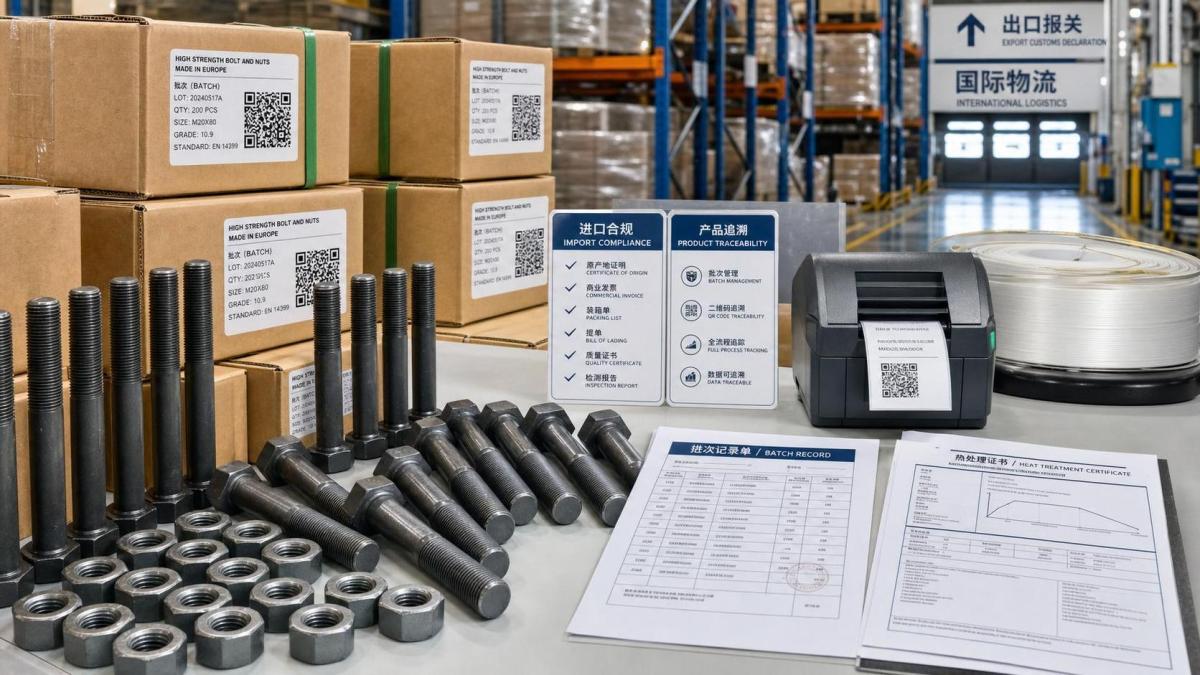
What the Notice Confirms
According to the information provided, the new requirement applies to all imported high-strength bolts at grade 8.8 or above. The QR code label must contain a batch number, a heat treatment certificate number, and information showing China as the country of origin. The implementation date is August 1, 2026. The stated purpose of the measure is to strengthen full-chain quality traceability for high-strength fasteners used in infrastructure projects.
Where the Immediate Business Impact May Appear
Customs-facing trade flows
From an industry perspective, import and export businesses are the first to feel the practical effect because customs clearance is explicitly tied to label compliance. The main impact is likely to fall on shipment readiness, document coordination, and pre-clearance checks. What deserves closer attention is whether each shipment can match the QR code information with the underlying batch and heat treatment records before cargo arrival.
Manufacturing and product preparation
Analysis shows that manufacturers and processing firms involved in high-strength bolts for the Vietnam market may need to focus more closely on how product data is organized at batch level. The business impact is not only on physical labeling, but also on whether heat treatment certificate references and origin details can be linked consistently to each unit or lot intended for import.
Procurement and project delivery teams
For buyers and end-use enterprises connected to infrastructure supply chains, the development may affect supplier selection, delivery scheduling, and acceptance planning. Observably, the issue is less about product demand in itself and more about whether compliant traceability information is available in time to avoid customs disruption.
Logistics and supply chain service providers
Service providers handling freight, customs coordination, or import documentation may also need to adjust operational checks. The likely pressure point is communication across suppliers, shippers, and importers, especially where labeling, batch records, and certificates are prepared by different parties.
What Companies Should Watch Now
The difference between a notice and operational execution
Analysis shows that the published requirement is already clear on the compliance consequence: no label means no customs clearance. What companies should watch now is how this requirement is implemented in daily operations, including how strictly shipment-level checks are carried out and whether any additional official clarification follows.
Readiness of batch and certificate records
Businesses involved in affected products should pay close attention to whether batch numbers and heat treatment certificate numbers can be retrieved, matched, and presented in a consistent way. In practice, the traceability requirement is not only a labeling issue but also a record-management issue tied to cross-border delivery.
Supplier and customer communication
What deserves closer attention is communication timing across the chain. Exporters may need to confirm data availability with upstream factories, while importers may need to communicate with customers about possible adjustments in delivery preparation, especially for orders shipping close to the August 1, 2026 effective date.
Exposure in the affected product range
Companies should also identify whether their shipments include high-strength bolts at grade 8.8 or above and whether those goods are entering Vietnam as imported products covered by the notice. This is a practical first step in determining where compliance risk is concentrated.
How This Development Is Best Understood
Observably, this is more than a narrow packaging change. The notice links market access at the border to traceability data for a defined class of fasteners used in infrastructure contexts. Analysis shows that the immediate significance lies in compliance execution, while the broader significance is the policy emphasis on product-level traceability in quality-sensitive applications. At this stage, it is more appropriate to understand this as both a near-term operational change and a longer-term signal that documentation and traceability controls may carry greater weight in cross-border industrial supply.
A Practical Reading of the Update
For the industry, the core message is straightforward: imported high-strength bolts covered by the notice will need compliant QR traceability labels from August 1, 2026 to pass customs in Vietnam. The direct facts are limited but clear, and the business relevance is immediate for companies managing affected shipments. At present, it is more appropriate to read this development as a concrete compliance change with broader policy implications that still warrant continued monitoring.
Basis of This Article and Ongoing Verification
This article is based on the user-provided news title, event date, and event summary. For this type of development, relevant source categories usually include official government notices, company announcements, industry association updates, authoritative media reporting, and standard-related documents. A specific official source link was not provided in the input, so further verification remains necessary. Continued attention should be given to any follow-up official wording, implementation details, or related compliance clarification tied to the QR labeling requirement.
Recommended News