
Search News
Industry Portal
Hot Articles
Commercial LED Lighting Costs: Retrofit vs New Install
Time
Click Count
For finance approvers, commercial LED lighting is not just a facility upgrade—it is a capital decision that affects operating costs, maintenance budgets, and long-term asset value. Whether comparing a retrofit with a full new install, the real issue is total lifecycle cost. A useful decision model should include fixture pricing, controls, labor, downtime, energy savings, code compliance, and future flexibility. In most facilities, commercial LED lighting delivers measurable value, but the best path depends on building condition, ceiling type, electrical infrastructure, and operational goals.
Commercial LED Lighting Cost Structure and Core Definitions
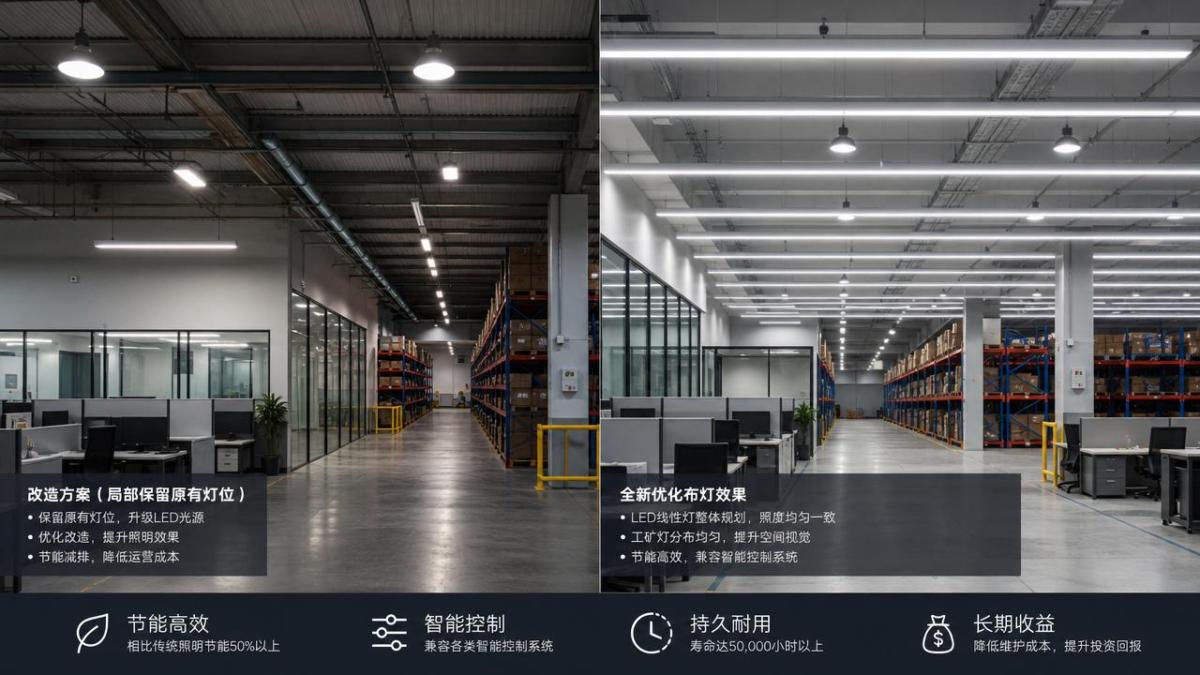
Commercial LED lighting costs are usually divided into equipment, installation, controls, commissioning, maintenance, and energy use. Looking only at fixture price often leads to a weak investment decision.
A retrofit keeps part of the existing system. It may replace lamps, drivers, or full luminaires while using current wiring, housings, or mounting positions.
A new install starts from a cleaner baseline. It often includes new fixture layout, new controls, fresh wiring routes, and updated compliance with current lighting and safety standards.
In practical terms, retrofit usually lowers upfront spending. New install usually creates better design freedom, stronger uniformity, and more room for smart controls integration.
The cost comparison becomes clearer when five variables are reviewed together:
- fixture and control hardware cost
- labor complexity and access requirements
- expected energy reduction
- maintenance savings over fixture life
- building usage changes over the next five to ten years
Current Market Signals Shaping Commercial LED Lighting Decisions
The market for commercial LED lighting is no longer driven only by energy efficiency. Decision frameworks now reflect operational resilience, occupant comfort, digital controls, and sustainability reporting.
Several industry signals are influencing retrofit and new install economics:
For mixed-use buildings, warehouses, campuses, offices, and retail sites, commercial LED lighting often intersects with wider modernization plans. Those may include access control, sensors, or AIoT infrastructure.
That broader context matters. If ceilings will open for cabling or security upgrades anyway, the incremental cost of a new install may be lower than expected.
Retrofit vs New Install: Cost Comparison Across the Lifecycle
A retrofit is generally favored when the existing layout is acceptable, the ceiling system is still serviceable, and the electrical backbone does not require major correction.
Typical retrofit advantages include lower capital outlay, faster installation, reduced disruption, and shorter project approval cycles. These benefits are strongest in occupied buildings.
However, retrofit can carry hidden limits. Existing fixture spacing may create uneven light levels. Old housings may reduce thermal performance. Legacy wiring can complicate dimming and controls integration.
A new install usually costs more at the beginning. It may involve demolition, rewiring, redesign, permitting adjustments, and more labor hours at height or above finished ceilings.
Yet new install can unlock stronger lifecycle economics. Better fixture placement can reduce total fixture count. Smarter zoning can cut waste. Modern controls can improve both savings and user experience.
The following comparison is useful during early evaluation:
In many facilities, retrofit payback ranges from two to five years. New install may take longer, but often delivers stronger value over ten years or more.
Business Value of Commercial LED Lighting Beyond Fixture Price
The strongest commercial LED lighting business case usually combines direct savings and indirect value. Energy reduction is important, but it is not the only economic driver.
Direct financial benefits commonly include:
- lower kWh consumption from high-efficacy luminaires
- lower relamping frequency and reduced maintenance visits
- possible utility rebates or tax-related incentives
- reduced cooling load in some environments
Indirect benefits are often underestimated. Better light uniformity can improve visual comfort. Tunable or well-zoned systems can support task accuracy and safer movement.
In logistics, manufacturing, and parking structures, stronger visibility can contribute to fewer errors and better hazard recognition. That adds operational value beyond electricity savings.
Smart commercial LED lighting also supports data-driven facility management. DALI, Zigbee, occupancy sensors, and daylight harvesting create a more responsive building environment.
For organizations aligning physical infrastructure with digital operations, lighting becomes a platform asset. It can support automation, scheduling, and energy benchmarking across multiple sites.
Typical Facility Scenarios and Recommended Direction
Not every building should choose the same path. The right commercial LED lighting strategy depends on asset condition, occupancy profile, and future building plans.
Hybrid strategies are also common. One area may justify retrofit, while another needs a full new install because of ceiling damage, compliance gaps, or changed use patterns.
Practical Evaluation Points Before Approval
A reliable commercial LED lighting budget should be based on a site audit, not only a catalog comparison. Field realities often shift the cost model.
Key checks before approval include:
- Verify existing voltage, controls wiring, and emergency lighting requirements.
- Measure current light levels and compare them with task needs.
- Assess ceiling height, lift access, and working-hour restrictions.
- Model energy savings using actual operating hours, not generic assumptions.
- Include disposal, patching, commissioning, and possible downtime costs.
- Review warranty terms for drivers, controls, and integrated fixtures.
It is also wise to test one pilot zone. A sample area can confirm light quality, sensor behavior, user response, and install complexity before full rollout.
Where smart buildings are a priority, choose commercial LED lighting platforms that can expand. Interoperability matters more than a low fixture price with closed controls.
Action Path for a Defensible Commercial LED Lighting Decision
A defensible decision begins with a lifecycle view. Compare retrofit and new install using total installed cost, annual savings, maintenance impact, and expected building changes.
Build the decision around three outputs: simple payback, net present value, and operational fit. That approach keeps commercial LED lighting evaluation grounded and practical.
If the current layout works and disruption must stay low, retrofit often wins. If the space needs redesign, controls integration, or long-term flexibility, new install may create better value.
The next step is straightforward: complete a site audit, map fixture counts and hours, compare at least two technical options, and calculate lifecycle returns before capital approval.
Recommended News