
Search News
Industry Portal
Hot Articles
How to Evaluate Flicker-Free Commercial LED Lighting in 2026
Time
Click Count
In 2026, evaluating flicker-free commercial LED lighting requires more than checking a product claim. Technical assessors must verify flicker metrics, driver quality, dimming behavior, standards compliance, and real-world performance under smart control systems. This guide explains how to assess commercial LED lighting with a practical, risk-based approach to support safer visual environments, reliable procurement decisions, and long-term operational value.
Understanding flicker-free commercial LED lighting
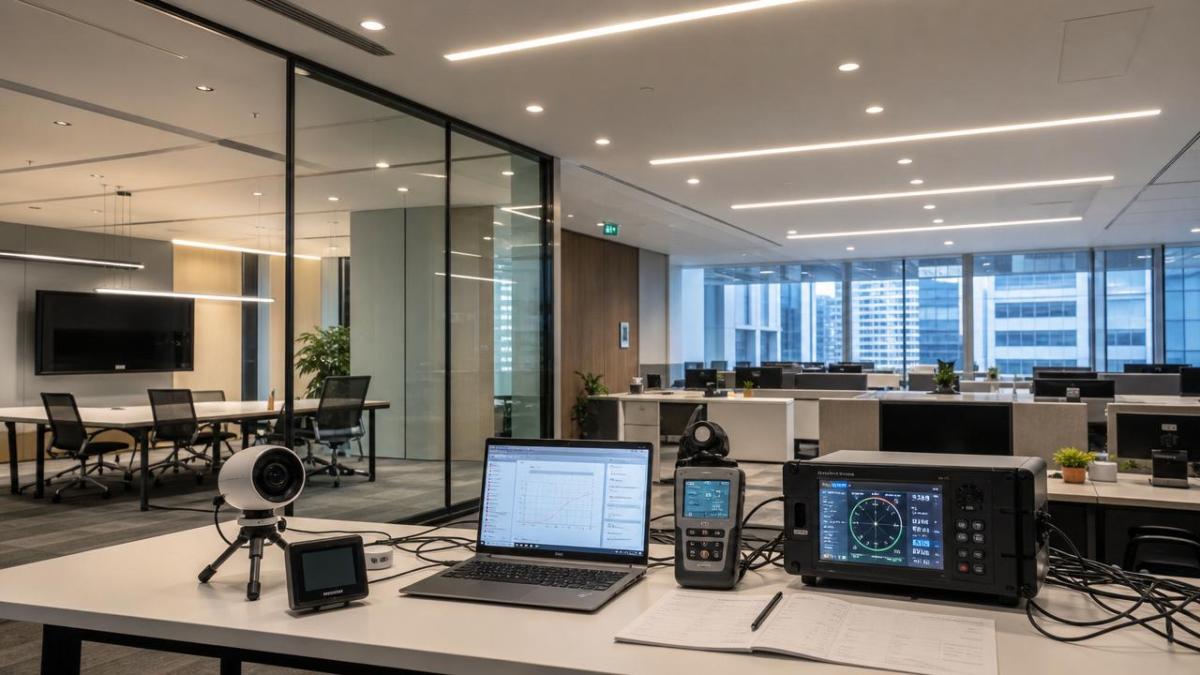
Commercial LED lighting is often described as flicker-free, but that term needs careful verification. In practice, no powered light source is perfectly constant under every condition.
What matters is whether light modulation stays low enough to avoid visual discomfort, task disruption, camera interference, or biological stress in commercial environments.
For modern commercial LED lighting, flicker evaluation should include the LED driver, control interface, dimming range, power quality, and installation context.
This is especially important in offices, schools, hospitals, retail spaces, transport hubs, control rooms, and smart buildings using DALI, Zigbee, or sensor-linked lighting automation.
Core terms that matter
- Flicker frequency: how fast light output varies over time.
- Percent flicker: the modulation depth between maximum and minimum light output.
- Flicker index: a waveform-based measure of light fluctuation severity.
- Pst LM: short-term visible flicker metric used for power-related instability.
- SVM: stroboscopic visibility measure for motion-related visual disturbance.
A good assessment of commercial LED lighting combines these metrics with practical observations. Numbers alone can miss real risks at low dimming levels or under smart control transitions.
Why flicker evaluation matters in 2026
The 2026 lighting market is shaped by energy policy, AIoT integration, health-focused building design, and stronger expectations for lighting quality beyond simple efficiency targets.
Commercial LED lighting now interacts with occupancy sensors, daylight harvesting, wireless controls, emergency backup systems, and building analytics. Each layer can affect flicker performance.
Poorly controlled flicker can create several problems. Some are visible, while others appear only during operation reviews, camera testing, or user complaints.
For SHSS-aligned sectors, lighting is part of a broader safety infrastructure. Stable light supports biometric capture, machine visibility, hardware inspection, and safer movement in demanding spaces.
Technical criteria for evaluating commercial LED lighting
A strong review process starts with measured performance, not marketing language. The most reliable commercial LED lighting evaluations examine the following technical points together.
1. Flicker metrics and test conditions
Request test data at full output and across the dimming range. Many products perform well at 100 percent, then degrade sharply below 30 percent output.
The test report should clearly show frequency, percent flicker, waveform shape, Pst LM, and SVM. It should also identify measurement equipment and operating voltage.
2. Driver design quality
The driver is often the main determinant of flicker behavior. Constant-current design, ripple suppression, filtering, and thermal stability directly influence commercial LED lighting quality.
Low-cost drivers may pass basic illumination tests yet produce unacceptable modulation under line variation, partial loads, or aging conditions.
3. Dimming method and compatibility
Check whether the luminaire uses PWM, CCR, hybrid dimming, or another control method. Each approach affects flicker, color stability, and performance at low levels.
Commercial LED lighting should also be tested with actual control systems, not only bench equipment. DALI, 0-10V, phase dimming, and wireless gateways can behave differently.
4. Standards and documentation
Look for compliance references tied to recognized measurement frameworks. Documentation should state limits, methods, and pass conditions, not vague quality claims.
- IEEE 1789 guidance for LED modulation risk.
- IEC and regional standards for flicker and stroboscopic assessment.
- Photometric reports from accredited laboratories.
- Control compatibility documentation for intended building systems.
Business value of better commercial LED lighting assessment
A disciplined review of commercial LED lighting reduces hidden lifecycle costs. It also supports more dependable lighting performance in spaces where visibility and system stability are critical.
The value extends far beyond comfort. Flicker control affects digital systems, maintenance planning, and operational risk.
- Improves visual comfort for extended indoor work.
- Reduces camera banding in security and monitoring systems.
- Supports more stable barcode, inspection, and imaging tasks.
- Lowers complaint risk after installation and commissioning.
- Protects smart building investments from poor control integration.
For integrated facilities, commercial LED lighting must work with access control, emergency pathways, surveillance cameras, and industrial workflows. Stable light becomes a functional part of safety architecture.
Typical commercial LED lighting scenarios and risk profiles
Different environments require different thresholds for acceptable flicker. The same luminaire may be acceptable in one space and unsuitable in another.
In mixed-use buildings, commercial LED lighting should be reviewed by zone. One blanket specification can overlook task-specific risks and create uneven user experience.
Practical evaluation steps before approval
A practical process helps separate credible commercial LED lighting from products that only look compliant on paper. The following sequence works well for most projects.
- Define the operating environment, control method, and critical visual tasks.
- Request accredited photometric and flicker test reports.
- Review driver specifications, ripple controls, and thermal limits.
- Test dimming performance with the actual control ecosystem.
- Observe the luminaire with cameras and moving objects.
- Check behavior during voltage fluctuation and emergency switching.
- Run a pilot installation before broad deployment.
Common warning signs
- No flicker report at dimmed levels.
- Undefined “flicker-free” label without metrics.
- Driver substitution after sample approval.
- Visible camera banding in surveillance scenes.
- Instability when connected to sensors or gateways.
Key considerations for long-term commercial LED lighting performance
Initial test results are only part of the picture. Commercial LED lighting should maintain low flicker performance throughout thermal aging, component drift, and control updates.
Pay attention to warranty language, allowed driver substitutions, firmware revision control, and maintenance procedures. Long-term consistency matters in large lighting networks.
It is also useful to align lighting review with broader hardware intelligence goals. At SHSS-relevant sites, stable lighting supports safe access, durable operations, and reliable physical security systems.
Next-step framework for specification and verification
To evaluate commercial LED lighting effectively in 2026, use a verification framework instead of relying on label claims. Measure, compare, test, and document every critical condition.
Start with application risk, then confirm metrics, driver quality, dimming behavior, and smart control compatibility. Finally, validate real-world performance through pilot observation.
This approach leads to commercial LED lighting decisions that protect visual quality, support intelligent buildings, and deliver more dependable operational value over time.
Recommended News