
Search News
Industry Portal
Hot Articles
Zigbee IoT vs Wi-Fi for Smart Street Lighting Projects
Time
Click Count
For project managers planning smart street lighting, choosing between Zigbee IoT and Wi-Fi affects capital cost, uptime, energy draw, and future maintenance. The right wireless layer also shapes dimming response, sensor integration, cybersecurity exposure, and how easily a city can scale from one district to thousands of poles.
In smart lighting projects, wireless selection is never only about bandwidth. Streetlights usually send small packets, run for years, and must stay reliable in rain, heat, vibration, and dense urban interference. That makes Zigbee IoT a common candidate, while Wi-Fi remains attractive where existing IP infrastructure already exists.
Why a Checklist Helps When Comparing Zigbee IoT and Wi-Fi
A checklist prevents expensive mistakes. It forces evaluation of network topology, pole spacing, gateway density, firmware strategy, and expected maintenance workload before procurement starts.
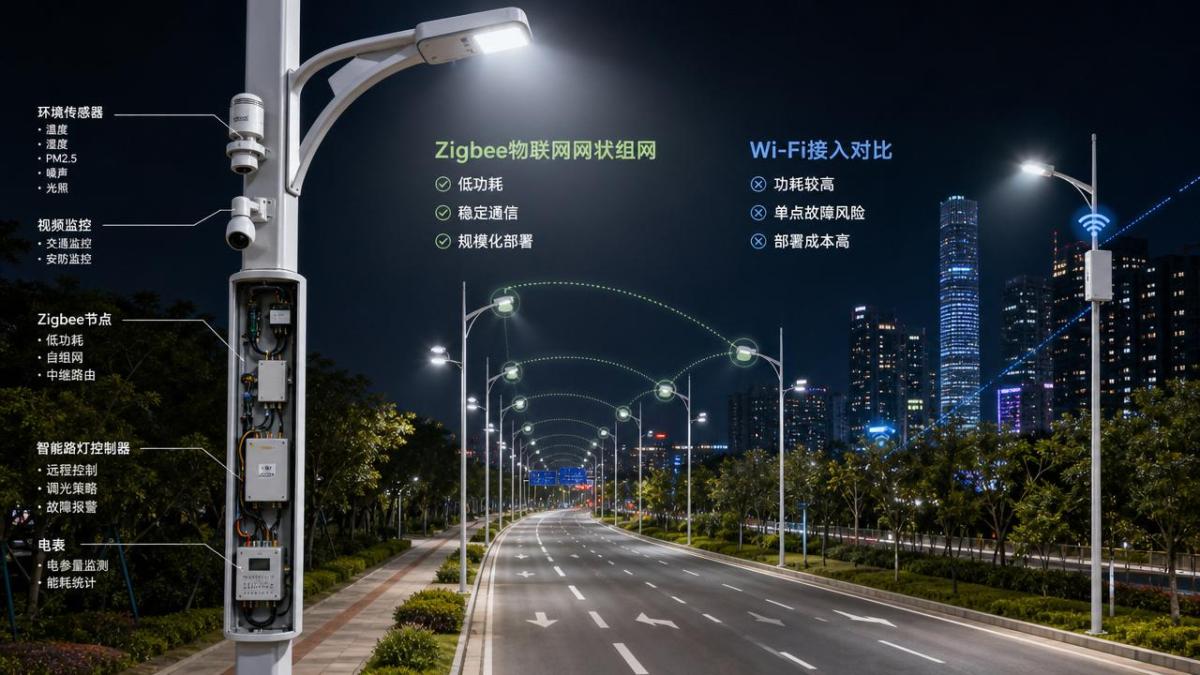
It also helps align technical decisions with broader smart city goals. In commercial and municipal lighting, the communication protocol must support uptime, adaptive dimming, sensor data, and lifecycle economics, not just initial installation speed.
Core Checklist for Zigbee IoT vs Wi-Fi in Smart Street Lighting
- Map pole distance first. Zigbee IoT mesh performs well when fixtures can relay data across regular spacing, while Wi-Fi often needs stronger access point planning and cleaner backhaul paths.
- Calculate power budget early. Zigbee radios usually consume less energy than Wi-Fi modules, which matters when controllers, sensors, and backup power are integrated into each luminaire.
- Check control traffic type. Street lighting mainly uses short command packets, status reports, and sensor triggers, which fit Zigbee IoT better than high-throughput Wi-Fi networking.
- Review gateway architecture. Zigbee IoT commonly relies on gateways bridging local mesh traffic to cloud or central platforms, while Wi-Fi devices may connect more directly to IP networks.
- Test network resilience under node failure. Mesh routing in Zigbee IoT can reroute around a failed pole, but Wi-Fi designs depend more heavily on access point coverage continuity.
- Measure deployment cost beyond hardware. Wi-Fi may look familiar, yet outdoor-grade access points, power injectors, enclosures, and network hardening can raise total system cost quickly.
- Assess latency requirements. Both options can support switching and dimming, but Zigbee IoT is often optimized for distributed control groups and routine scheduled responses.
- Inspect cybersecurity workflows. Wi-Fi uses mature IP security frameworks, while Zigbee IoT needs proper key management, commissioning controls, and segmentation at the gateway layer.
- Verify firmware update strategy. Large fleets need reliable over-the-air updates, rollback capability, and staged release groups regardless of protocol choice.
- Plan interoperability from day one. If the roadmap includes motion sensors, parking guidance, environmental nodes, or DALI controllers, ensure the wireless stack supports future expansion.
At-a-Glance Technical Comparison
Which Scenarios Favor Zigbee IoT
Dense urban roads, campuses, industrial parks, and residential districts often favor Zigbee IoT. Regular pole spacing helps create a stable mesh, reducing the need for many outdoor Wi-Fi access points. This lowers energy demand at the node level and can simplify citywide dimming control.
Projects with adaptive lighting also benefit. If luminaires respond to motion, traffic flow, or ambient light, Zigbee IoT handles frequent low-bandwidth events efficiently. It is especially useful when lighting controllers, occupancy sensors, and DALI drivers must operate as one coordinated system.
Where Wi-Fi Still Makes Sense
Wi-Fi can work well in contained environments such as ports, logistics yards, transport hubs, and commercial compounds. These sites may already have managed IP networks, trained IT teams, and stronger backhaul infrastructure.
It also fits mixed-use poles carrying cameras, signage, or public connectivity. In those cases, higher throughput may justify Wi-Fi, though lighting control alone rarely needs that capacity.
Commonly Overlooked Risks
Ignoring RF Interference Surveys
Both Zigbee IoT and Wi-Fi commonly operate in crowded spectrum. Nearby buildings, industrial equipment, and public networks can reduce reliability if a site survey is skipped.
Focusing Only on Day-One Hardware Cost
Cheap nodes do not guarantee a cheap system. Gateway count, access point maintenance, truck rolls, and firmware recovery processes can dominate total ownership cost over five years.
Underestimating Mesh Design Discipline
A Zigbee IoT network still needs proper planning. Poor relay density, blocked line paths, or careless grouping can produce unstable routes and delayed control behavior.
Treating Security as an Afterthought
Streetlights are infrastructure endpoints. Weak commissioning, shared passwords, or unsegmented gateways expose operations to avoidable cyber risk and service disruption.
Practical Execution Recommendations
- Pilot one street segment first, then record packet loss, reconnection time, dimming response, and maintenance events for at least one weather cycle.
- Build a lighting architecture that separates field communication, gateway management, and cloud analytics to simplify future protocol migration.
- Specify open integration points for DALI, sensors, and central management software so the wireless choice does not lock the project into one vendor.
- Use lifecycle models, not component price, when comparing Zigbee IoT and Wi-Fi. Include energy, replacements, support labor, and update operations.
For most smart street lighting applications, Zigbee IoT is the stronger fit because it aligns with low-power operation, mesh coverage, and frequent control signaling. Wi-Fi becomes more compelling when lighting is only one part of a broader high-bandwidth outdoor IP environment.
Conclusion and Next Step
The best protocol is the one that matches pole spacing, data profile, maintenance resources, and expansion goals. If the project centers on scalable lighting control, sensor-based dimming, and efficient operations, Zigbee IoT usually delivers the better long-term balance.
Start with a site survey, define performance targets, and run a controlled pilot comparing gateway density, energy draw, and fault recovery. That evidence will make the final Zigbee IoT versus Wi-Fi decision faster, safer, and far more defensible.
Recommended News