
Search News
Industry Portal
Hot Articles
When should high-strength bolts be tightened by torque or tension?
Time
Click Count
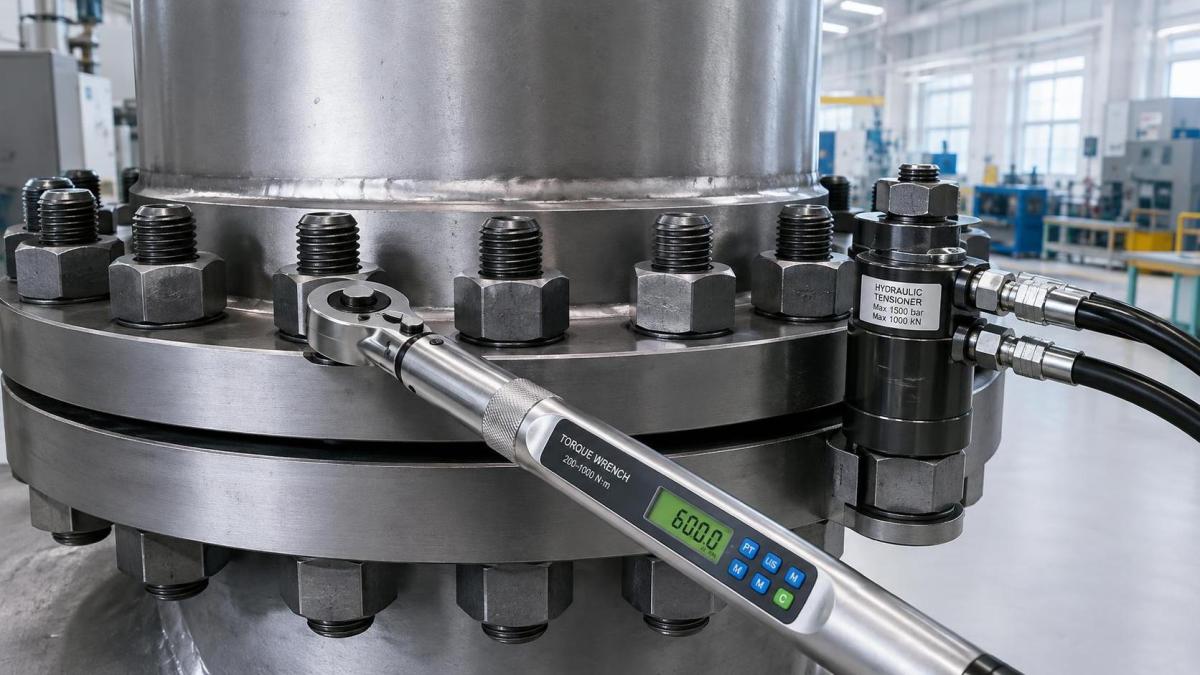
The choice is not simply “torque versus tension.” High-strength bolts should be tightened by the method that can achieve and document the required bolt preload with acceptable uncertainty for the joint being built. Use torque control where the bolted assembly, lubrication condition, tool calibration, and installation procedure are stable and verified. Use a tension-based method when preload is safety-critical, friction is variable or difficult to control, or the connection must resist fatigue, vibration, slip, or repeated load without relying on assumptions about torque-to-tension conversion.
This distinction matters because torque is only an indirect path to bolt tension. The useful result is clamp force: the tensile load created as the bolt stretches and compresses the joint members. That clamp force keeps plates together, preserves gasket compression, reduces joint movement, and helps the bolt carry fluctuating loads safely. A wrench measures turning resistance, not bolt stretch. Much of the applied torque can be consumed by thread friction and bearing-surface friction before it produces meaningful preload.
Torque control is appropriate when friction can be controlled
Torque tightening is practical, fast, and widely available. It is often suitable for production fastening, machinery assemblies, steelwork, equipment housings, and other joints where the installation condition is repeatable. Its value lies in process efficiency: calibrated torque tools can deliver a consistent input when the fastener system is consistent.
However, torque is only reliable when the torque-tension relationship has been established for the actual assembly. A torque value taken from a generic chart may not match the installed joint. Thread finish, coating, lubricant, washer type, nut geometry, surface condition, reuse, installation speed, and prevailing-torque features can all change the friction level. Two bolts tightened to the same torque can therefore produce materially different preload.
Torque control is generally a defensible choice when these conditions are present:
- The bolt, nut, washer, and joint surface condition are specified as a system rather than selected independently.
- The assembly is clean, undamaged, and free of uncontrolled paint, corrosion products, burrs, or debris in the bearing area.
- Lubrication or coating is consistent across the installation batch.
- Torque tools are calibrated, suitable for the torque range, and used with the correct reaction arrangement.
- The joint does not demand exceptionally tight preload control because of fatigue, sealing, slip resistance, or severe vibration.
- The installation process has been qualified through representative trials or an applicable project procedure.
Torque should not be treated as a universal substitute for preload verification. It is a process-control method. When the process variables are stable, it can work well. When the variables are not stable, increasing the torque value does not solve the problem; it can push some bolts toward yielding while leaving others under-tightened.
Choose tension-based tightening when clamp force is the design-critical variable
Tension-based methods aim to control or verify the bolt’s actual elongation or tensile load more directly. Depending on the connection and available equipment, this can include direct tension indicators, load-indicating washers, ultrasonic bolt elongation measurement, hydraulic tensioning, or procedures based on bolt rotation after an established snug-tight condition. The appropriate method depends on bolt geometry, accessibility, installation volume, and the project’s governing specification.
These methods are preferable where friction uncertainty is too large to accept. That is common in critical structural connections, pressure-retaining flanges, rotating equipment, highly loaded machinery, joints with demanding gasket compression, and assemblies exposed to significant vibration or load cycling. In these cases, the connection’s performance depends less on the wrench setting than on whether the intended clamp load has actually been achieved.
Direct tension measurement is especially valuable when bolts receive coatings or lubricants that may alter friction. A low-friction coating can create higher-than-expected tension at a normal torque value. Conversely, contaminated or rough threads can consume torque and leave the joint short of preload. Both outcomes are possible within the same nominal fastener grade.
The joint type should drive the decision
Before selecting an installation method, identify what the joint is meant to do under service load. A bearing-type connection transfers load after parts come into contact through bolt bearing and plate contact. A slip-critical connection depends on clamping force and friction between faying surfaces to prevent movement. A gasketed joint depends on maintaining compression around the sealing surface. A fatigue-loaded machine joint depends on keeping the clamped parts together so that external load does not repeatedly unload and reload the bolt.
These mechanisms do not demand the same degree of preload certainty. A lightly loaded equipment cover can tolerate more variation than a joint where small movement creates leakage, loosening, alignment loss, or crack initiation. For that reason, a high-strength fastener alone does not determine the tightening method. The required joint behavior determines it.
For example, high-strength bolts in a vibration-exposed assembly may need high, consistent preload so that friction between the members carries the service load and joint separation is avoided. Torque control can remain appropriate if the assembly has been validated and friction is controlled. But where coatings, lubrication, environmental exposure, or installation variability make that validation unreliable, direct tension verification is the more technically sound choice.
Do not confuse bolt strength with required preload
A common mistake is to assume that a stronger bolt should simply be tightened to a higher torque. Fastener strength class, bolt diameter, thread pitch, grip length, joint stiffness, and service loading all influence the acceptable tightening range. The correct preload is not automatically the maximum force the bolt can withstand.
Over-tightening can permanently deform the bolt, damage threads, crush softer joint materials, distort flanges, or create uneven gasket loading. Under-tightening permits micro-movement, loss of clamp force, fretting, leakage, loosening, and greater fatigue stress in the bolt. Both failures can begin with a torque value that looked reasonable on paper.
The bolt’s grip length also matters. A longer bolt stretches more for a given load and can sometimes accommodate small settlement or embedment losses better than a very short, stiff bolt. In contrast, a short bolt clamping a stack of hard components may lose a meaningful share of preload from small surface flattening. The tightening method should therefore be considered alongside joint geometry, not only bolt size and grade.
Friction is the main reason torque can mislead
In a conventional tightened joint, most applied torque is spent overcoming friction at the threads and under the turning nut or bolt head. Only a portion produces useful bolt stretch. This is why a published torque value is incomplete unless it states the assumptions behind it.
Friction changes when a fastener is galvanized, zinc-flake coated, phosphated, waxed, oiled, painted, reused, or exposed to corrosion. It also changes when washers are omitted, substituted, installed in the wrong orientation, or allowed to rotate against an unsuitable surface. Prevailing-torque nuts require particular attention because part of the applied torque is consumed by the locking feature before clamp load develops.
Where torque is selected, the installation specification should define the complete fastener condition: approved fastener set, coating or lubrication state, washer arrangement, tool type, tightening sequence, inspection method, and rules for reuse. A torque target without those controls is not a preload specification.
Installation sequence affects both methods
Even accurate bolt tension in one location can be lost or redistributed as neighboring bolts are tightened. This is particularly important for flanges, long cover plates, multi-bolt equipment bases, and large structural interfaces. Joint surfaces settle, coatings compress, and local gaps close during installation.
A controlled sequence is therefore part of the tightening method. Bolts are normally brought to a uniform snug condition first, then tightened in stages following a pattern that distributes load across the joint. For circular flanges, a cross-pattern helps limit distortion. For rectangular or elongated interfaces, the sequence should reflect the stiffness of the parts and the manufacturer’s or project procedure’s requirements.
Retightening is not automatically correct. In some joints, a defined second pass is necessary to compensate for seating. In others, repeated tightening can damage coatings, alter friction, or overload the fastener. The distinction should be established in the assembly procedure rather than decided on site.
How to make the selection before procurement
The most effective time to decide between torque and tension is before tools and fasteners are purchased. The decision affects bolt length, access clearance, washer selection, inspection planning, crew training, and documentation.
- Define the required joint function. Determine whether the connection must resist slip, maintain a seal, preserve alignment, withstand cyclic loading, or simply clamp parts together.
- Set the required preload range. Base it on the joint design, not on a generic torque chart or the bolt’s nominal strength alone.
- Assess friction variability. Review coatings, lubricants, surface treatments, prevailing-torque features, reuse policy, and expected field contamination.
- Check access and installation volume. Hydraulic tensioners and ultrasonic measurements can improve confidence but may be impractical in confined locations or low-volume routine work.
- Choose the verification method with the tightening method. A torque wrench calibration certificate does not verify bolt preload. Decide what evidence the completed joint must provide.
- Qualify the full assembly. The bolt, nut, washer, surfaces, tools, and sequence must be evaluated together because substituting one component can change the result.
When a hybrid approach is sensible
Some applications do not require every bolt to be directly measured, but still need confidence that torque control is producing the intended preload. In that situation, torque may be used for routine installation while representative assemblies are checked by a more direct tension method during qualification or production audits. This approach can identify changes in lubricant condition, coating batches, tool behavior, or operator practice before they become widespread installation defects.
A hybrid approach is useful only when the sampling plan and acceptance criteria are defined in advance. Spot checks cannot repair an uncontrolled process; they are meaningful when they confirm a controlled one.
Questions that expose a weak tightening specification
A specification needs more work if it gives only a torque number, calls for “tighten securely,” or identifies bolt grade without defining the hardware system. It is also incomplete if it does not address whether bolts may be reused, how painted or coated contact surfaces are handled, or how the installed condition will be inspected.
The practical decision is straightforward: use torque for high-strength bolted joints when torque has been correlated to preload for a controlled, repeatable assembly and the joint can tolerate the remaining variation. Move to tension-based tightening when the consequences of preload variation are high, friction cannot be held within a dependable range, or the design requires direct evidence that the desired clamp force was achieved. The method is not a preference between tools; it is a control decision for the joint’s actual failure risks.
Recommended News