
Search News
Industry Portal
Hot Articles
How to audit quality control at a biometric door locks factory
Time
Click Count
How to Audit Quality Control at a Biometric Door Locks Factory
Auditing a biometric door locks factory is not the same as inspecting a conventional lock supplier. A well-finished housing, a smooth handle, and a clean carton can still conceal the failures that matter most: false biometric acceptance, poor recognition in low light, inconsistent assembly torque, insecure firmware handling, or no workable process for tracing a defective batch.
For a quality-control or security manager, the factory audit should answer one practical question: can this supplier repeatedly manufacture a door lock that remains secure, usable, and supportable after installation? The answer cannot come from a showroom sample alone. It has to be found in the relationship between incoming materials, sensor selection, embedded software, mechanical production, test discipline, and corrective-action records.
This is especially relevant for projects such as offices, managed apartments, logistics sites, schools, and commercial buildings, where access hardware sits at the intersection of physical security and digital identity. In the wider smart-hardware field, a lock is a “digital gatekeeper,” but it is still a mechanical product mounted in a real door. The audit must therefore examine both sides with equal seriousness.
Start With the Intended Use, Not the Factory Tour
Before visiting a biometric door locks factory, define the conditions under which the locks will actually operate. A compact fingerprint lock for an interior office door should not be audited against the same expectations as a face-recognition access terminal installed at an exposed building entrance. The risks, component choices, and acceptable trade-offs differ.
Ask the supplier to map its proposed model to the project environment: door material and thickness, expected daily traffic, indoor or outdoor exposure, battery replacement responsibility, network availability, emergency egress requirements, and whether access credentials must be managed centrally. If the factory cannot turn those requirements into a clear product configuration and test plan, the later inspection is likely to become cosmetic.
This early step also protects procurement budgets. Buyers often compare unit prices without separating the cost of the lock from the cost of bad fitment. A low-priced model that requires door rework, frequent battery service, field firmware intervention, or lock-body replacement can become the expensive option very quickly.
Follow the Product Through the Factory Floor
A serious audit follows material flow rather than staying in the meeting room. Begin at incoming quality control. The factory should be able to identify the key purchased components: biometric sensor module, microcontroller or processor, wireless module, lock body, motor or clutch components, batteries or battery contacts, PCB assemblies, exterior housing, and fasteners.
Do not assume that every component needs to be produced in-house. Many capable manufacturers rely on specialized suppliers. What matters is whether they have an approved-supplier process, incoming inspection criteria, change-control procedures, and records that link component lots to finished products. A sensor substitution made for supply reasons can alter recognition behavior. A change in motor supplier can affect unlocking force, noise, battery drain, and long-term reliability.
Look for practical evidence rather than broad assurances. Are incoming samples labeled? Are rejected materials quarantined? Can the team show inspection reports for critical parts? Are electronic boards protected from avoidable handling damage? A factory with orderly process controls usually makes its problems visible. A factory that only displays a finished-goods area gives you little basis for judging consistency.
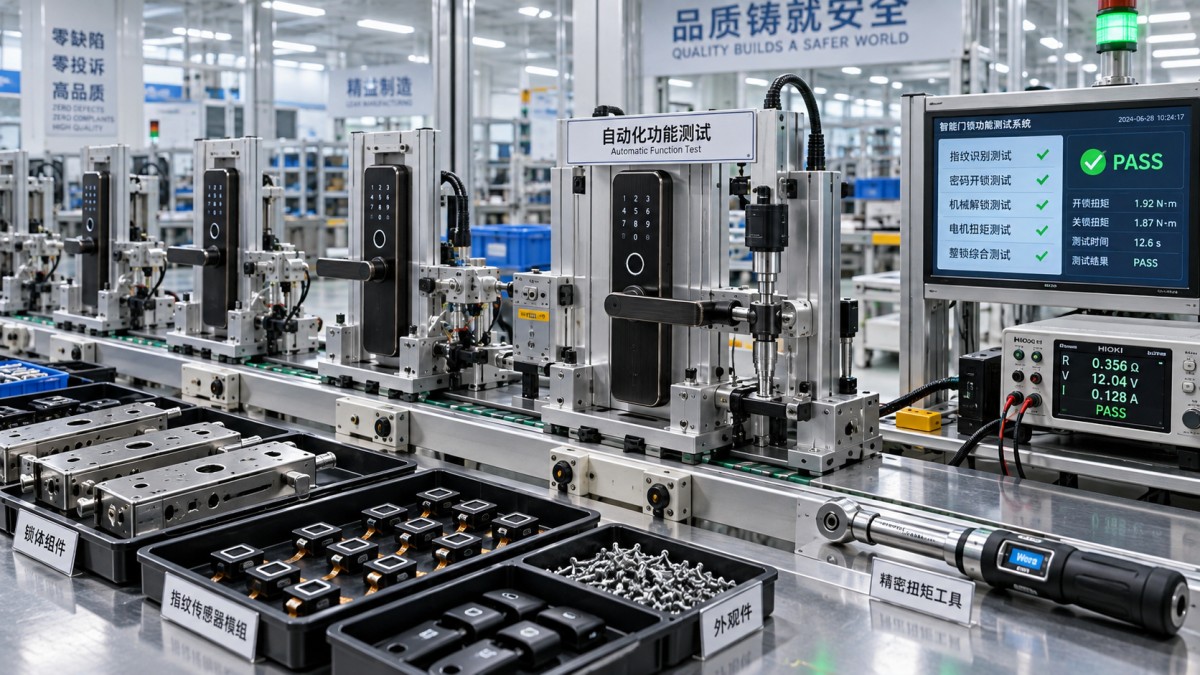
At assembly, observe where the lock body, electronics, biometric reader, handle, and exterior panel come together. The most revealing points are often ordinary ones: whether operators use controlled tools for critical screws, whether wires are routed without being pinched, whether seals and gaskets are correctly placed, and whether work instructions match the product being assembled. A loose internal connector may not appear during a short functional test, yet it can produce intermittent faults after vibration, repeated handle use, or seasonal temperature changes.
Audit Biometric Performance Beyond the Demonstration
A polished live demonstration is useful, but it is not a biometric audit. Ask how the factory verifies enrollment, recognition, rejection behavior, and presentation-attack resistance for the specific sensor technology used. Fingerprint, face, palm-vein, iris, and other biometric methods each have different operational limits. The supplier should be able to explain those limits in plain terms rather than claiming universal accuracy.
For fingerprint products, inspect the enrollment process and test several conditions that users encounter in practice: dry fingers, damp fingers, slightly misaligned placement, repeated use by different people, and users who have not been recently enrolled. For face-recognition products, verify how the device responds to variable lighting, hats, masks where relevant, glasses, screen reflections, and a user approaching at an angle. A system that works only when a person stands perfectly still at a fixed distance may be unsuitable for a busy entrance.
Anti-spoofing claims deserve particular attention. If the factory says the device includes liveness detection or presentation-attack detection, request the underlying technical documentation, test method, and model-specific configuration. A feature name on a brochure is not enough. The audit should establish whether the capability is built into the sensor, implemented in firmware, dependent on cloud processing, or optional in the delivered version.
Avoid demanding a single “accuracy percentage” without context. Recognition performance is influenced by enrollment quality, lighting, sensor condition, algorithm settings, user population, and operating environment. A more useful procurement question is: what acceptance and rejection behavior has the supplier validated for this model, under what conditions, and how is that behavior checked after a software revision?
Mechanical Quality Still Decides Whether the Door Opens
Biometric access is only one layer. The lock must physically retract, latch, resist ordinary abuse, and preserve safe exit behavior. During the audit, inspect the lock body and the interaction between the motor or clutch mechanism, spindle, handle, latch, deadbolt if present, and strike plate. These parts experience repeated shock loads that are very different from a bench test of the reader.
Ask the factory how it controls dimensional tolerances and how it verifies handle return, latch movement, motor actuation, and mechanical-key override where applicable. Test representative finished units on a suitable door fixture, not only as loose products on a table. Misalignment between a lock and strike is a common field condition, and the system should not become unreliable merely because installation is less than perfect.
Also examine the fasteners, mounting plates, escutcheon material, and corrosion protection appropriate to the intended site. In access control, small hardware decisions are rarely small in consequence. A weak mounting arrangement may allow a reader to remain electronically functional while the physical door hardware loosens over time. For exterior applications, seals, cable entries, and moisture paths deserve as much scrutiny as the finish of the front panel.
Check End-of-Line Testing and Traceability
The end-of-line station tells you whether quality is measured or merely assumed. Watch several units go through final testing. A meaningful procedure normally checks basic biometric enrollment and verification, lock and unlock actions, handle or latch operation, alarm or tamper functions where fitted, communication functions, battery status behavior, and visible assembly defects.
The important follow-up is traceability. Can the supplier identify the serial number, production date, software or firmware version, inspector, and relevant component batch for a finished lock? If a problem emerges after delivery, that information determines whether the factory can isolate affected stock or has to treat every shipment as suspect.
A factory does not need to claim zero defects to be credible. In reality, what separates a dependable supplier is the ability to detect deviations, prevent repeated escape, and document corrective action. Ask for examples of defect categories without requiring confidential customer details. The point is to understand the factory’s response discipline.
Treat Firmware and Biometric Data as Audit Items
A biometric door lock is an edge device handling sensitive identity information. Quality control therefore extends into software release management and data handling. Ask who controls firmware signing, who can approve a production firmware change, how version numbers are recorded, and whether the factory can prevent unapproved software from being loaded during assembly or service.
The supplier should explain where biometric templates are stored, whether they remain on the device or are synchronized to another system, how they are deleted during reset, and how administrator credentials are protected. The right compliance obligations vary by jurisdiction and deployment model. For projects involving personal data, contractual responsibilities and applicable privacy requirements—such as GDPR where relevant—should be reviewed with the buyer’s legal and security teams rather than left to a generic product declaration.
Pay attention to reset behavior. A secure factory should be able to explain the difference between a normal user reset, an installer reset, and a controlled factory process. If a returned unit can retain credentials, templates, or network settings without a documented sanitization procedure, the issue is not just quality; it is a potential security exposure.
Price the Risk, Not Just the Lock
When comparing suppliers, use the audit findings to calculate total deployment exposure. Consider pre-shipment inspection, sample approval, installation compatibility, training requirements, spare-part availability, firmware support, replacement procedures, and the cost of a lock failure at a critical door. These factors are often more material than a small difference in ex-works price.
It is reasonable to request a pilot batch before committing to a larger order, particularly when the project includes new biometric technology, custom finishes, integration requirements, or demanding door conditions. The pilot should be evaluated against an agreed inspection plan, not informal impressions from a few users. Document the approved hardware revision, firmware version, packaging specification, accessories, and labeling at that stage. Otherwise, a successful sample may not match the production shipment.
The best biometric door locks factory is not necessarily the one with the largest display wall or the most ambitious feature list. It is the supplier that can show control over its mechanical parts, biometric modules, production records, software changes, and failure response. If those controls cannot be demonstrated during the audit, the buyer should assume that the risk will eventually be transferred to installation teams, security administrators, and end users.
- Last One:No more articles
- Next Article:How to verify CE certification for keyless entry systems before purchaseSep 21, 2026
Recommended News