
A lower unit price can hide a higher inventory bill when a smart lock distributor requires a large minimum order. The difference matters to procurement teams.
That commitment ties up working capital, increases storage requirements, and exposes buyers to outdated models. Smaller orders, however, can increase freight costs and reduce discounts.
The right decision depends on total cost over a consistent planning period, realistic demand by configuration, and the contractual flexibility available before purchasing commitments become binding.
Buyers should therefore compare minimum order quantities against expected sales, replenishment lead times, available cash, and product support commitments before accepting an apparently attractive price.
What does the distributor's minimum order actually commit you to?
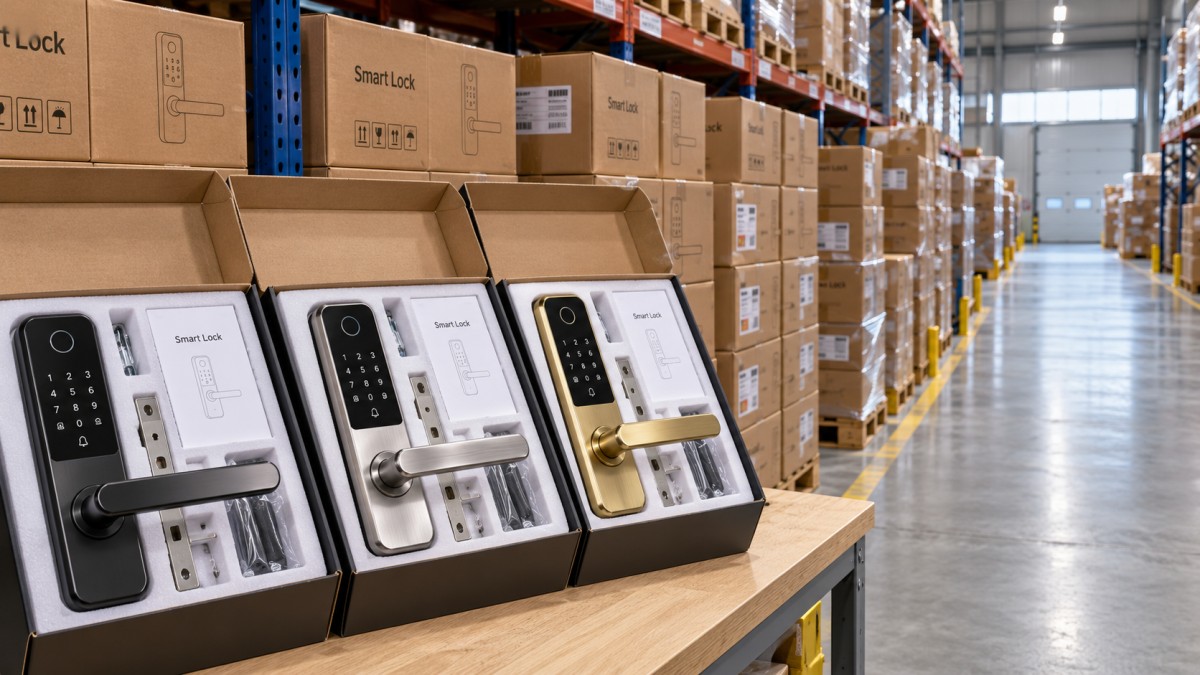
A minimum order quantity, or MOQ, specifies the smallest purchase a supplier accepts. However, the commercial meaning varies considerably between distributors and individual product lines.
One distributor may require 100 locks across its catalog. Another may require 100 units of each model, finish, regional variant, or packaging configuration you select.
Minimum order value creates a different constraint: buyers must reach a spending threshold, sometimes by combining locks, gateways, accessories, and installation components within one shipment.
Ask whether the minimum applies to each purchase order, shipment, SKU, or annual agreement. These distinctions determine how much inventory you actually receive and finance.
Also separate purchase commitments from delivery requirements. A blanket order with scheduled releases may reduce physical stock, while still creating an enforceable obligation to purchase.
For each quotation, record the minimum quantity, permitted assortment, payment schedule, delivery schedule, cancellation rights, and ownership transfer terms. Verbal flexibility should become written contractual language.
How does a larger MOQ change your inventory bill?
The purchase invoice is only the starting point. Inventory costs also include financing, receiving, storage, handling, insurance, damage, returns, and losses from unsold or obsolete units.
For smart locks, additional exposure can arise from configuration changes, discontinued gateways, unsupported applications, or revised installation requirements. These risks vary by product and market.
Use landed unit cost when valuing inventory: purchase price plus attributable inbound freight, duties, brokerage, and handling. Treat recoverable taxes separately according to local accounting rules.
A practical comparison adds annual purchasing cost, shipment costs, carrying cost, and expected markdown or write-off losses. Include shortage costs when service levels differ materially.
Avoid counting the same expense twice. If your carrying rate already includes financing, insurance, and storage, do not add those components again as separate charges.
Estimate average inventory before applying a carrying rate
When demand is reasonably steady and replenishment arrives together, average cycle stock is approximately half the order quantity. Add safety stock and other relevant inventory separately.
For example, ordering 600 units creates approximately 300 units of average cycle stock. Ordering 200 creates approximately 100, assuming regular depletion without significant demand fluctuations.
Calculate annual carrying cost as average inventory value multiplied by your annual carrying rate. Build that rate from company costs rather than an unsupported industry percentage.
Seasonal projects, irregular installations, and phased deliveries require a monthly inventory schedule. The half-order shortcut becomes unreliable when receipts and consumption occur in large, uneven batches.
Keep cash exposure separate from accounting expense
Inventory carrying cost measures an economic burden over time. Upfront cash exposure measures how much money becomes unavailable immediately; procurement teams need to assess both.
A deposit paid months before shipment can strain liquidity even before goods enter your warehouse. Include deposits, transit time, and final payment dates in cash forecasts.
Payment terms improve timing but do not eliminate stock risk. A slower-selling model still requires financing or absorbs cash once the supplier invoice becomes payable.
Does the volume discount survive a full cost comparison?
Consider a buyer expecting to use 1,200 identical locks annually. The following illustration compares two ordering policies under steady demand and unchanged pricing throughout the year.
Assume both options provide equivalent products, support, lead times, and service levels. The 24% carrying rate excludes obsolescence, which is estimated separately in this example.
The larger order saves $4,800 in purchasing and $600 in freight, but adds $4,548 in annual carrying cost. Its remaining advantage is only $852.
If that policy creates more than $852 of additional expected obsolescence or handling expense annually, its apparent advantage disappears. A modest discount leaves little protection.
The immediate cash commitment also rises from $20,300 to $58,200 per shipment, including freight. That difference may matter more than the small projected annual saving.
This illustration excludes safety stock, taxes, and shortage costs. Add them when they differ between options, and adjust shipment counts if annual demand changes materially.
Which smart lock configurations are most likely to become excess stock?
Aggregate demand can conceal weak individual SKUs. Strong sales across a lock family do not guarantee demand for every finish, door preparation, or connectivity option.
Forecast at the level customers actually specify. Depending on the product, that may include handing, mortise dimensions, cylinder format, finish, credential support, and gateway compatibility.
A buyer selling 100 locks monthly might sell only ten units of a particular configuration. A 200-unit minimum would represent twenty months of that variant's demand.
Connectivity also affects interchangeability. Bluetooth, Wi-Fi, Zigbee, and other configurations may require different accessories or management platforms; confirm compatibility for the complete deployed system before purchasing.
Request written firmware support periods, application dependencies, cloud subscription terms, and end-of-life notice procedures. Hardware remaining on the shelf may lose commercial value as support changes.
Clarify when warranty coverage begins: shipment, distributor receipt, installation, or activation. Long storage can consume warranty time when coverage starts before the end customer receives equipment.
For connected or biometric models, verify relevant market requirements and customer data policies before ordering. Approval failures can strand inventory even when the physical hardware performs.
How much stock does demand and lead time actually justify?
Start with confirmed projects, historical consumption, and a realistic sales forecast. Separate committed installation demand from speculative opportunities so that pipeline optimism does not inflate purchases.
Calculate months of supply by dividing available units by expected monthly demand. Review incoming orders as well, because overlapping receipts can create an unnoticed stock buildup.
Then compare the proposed MOQ with replenishment needs. A useful reorder point equals expected demand during replenishment lead time plus safety stock for uncertainty in demand and delivery.
For example, average demand of 80 units monthly and a two-month replenishment lead time imply 160 units of lead-time demand before adding any safety stock.
The reorder point determines when to order; the MOQ constrains how much to order. Confusing these decisions can produce excessive stock without improving availability proportionately.
Set safety stock according to demand variability, lead-time variability, and service requirements. A larger minimum order does not automatically justify reducing protection against delivery delays.
Test a downside scenario before approving the purchase. Reduce forecast demand, delay a major project, and assess the remaining stock, cash requirements, and potential markdown exposure.
What should you negotiate with a smart lock distributor?
The most valuable concession may be flexibility rather than price. Prioritize terms that reduce slow-moving inventory or align payments and deliveries with actual customer demand.
- Mixed-SKU minimums: Combine approved configurations within one order threshold, while confirming whether individual variants still have case-pack minimums.
- Scheduled releases: Agree smaller deliveries against a broader commitment, with explicit rules for release dates, payment, ownership, and cancellation.
- Stock rotation: Define eligible models, exchange windows, restocking fees, packaging requirements, and credit limits for exchanging slow-moving units.
- Price protection: Establish whether qualifying unsold stock receives credit after distributor price reductions or replacement-model launches.
- Support commitments: Document warranty activation, firmware support, end-of-life notice, and replacement procedures for defective units.
Supplier-held stock only reduces your exposure if the agreement allocates obligations favorably. Check whether you must eventually purchase all reserved units regardless of actual demand.
Likewise, consignment depends on contractual ownership and payment triggers. Confirm who bears damage, insurance, obsolescence, and return costs while products remain available for your use.
For uncertain products, propose a smaller initial order followed by volume pricing after an agreed purchase threshold. This lets demonstrated demand inform subsequent inventory commitments.
When is accepting a larger minimum order justified?
A larger MOQ can make sense when demand is predictable, configurations are standardized, support is durable, and the discount exceeds additional carrying and obsolescence costs.
It can also support a confirmed installation program where equipment specifications are approved and delivery milestones are credible. Check customer cancellation rights before assuming demand is guaranteed.
Smaller orders usually deserve stronger consideration for new models, fragmented configurations, uncertain projects, or products approaching replacement. Higher unit prices may purchase valuable flexibility in these circumstances.
Before approval, document the total annual cost difference, peak cash requirement, months of supply by SKU, and downside exposure. Assign responsibility for monitoring slow-moving inventory.
The best smart lock distributor offer delivers the required availability at an acceptable total cost. Treat MOQ as a financial commitment whose value depends on sell-through.