
Search News
Industry Portal
Hot Articles
BLDC Motor Technology: When Higher Efficiency Pays Off
Time
Click Count
As energy costs rise and uptime becomes a board-level metric, BLDC motor technology is no longer just an engineering upgrade—it is a business case. For evaluators comparing lifecycle cost, reliability, and performance, understanding when higher efficiency truly pays off can reveal where brushless systems deliver measurable ROI across tools, security hardware, and smart infrastructure.
What is BLDC motor technology, and why does it matter now?
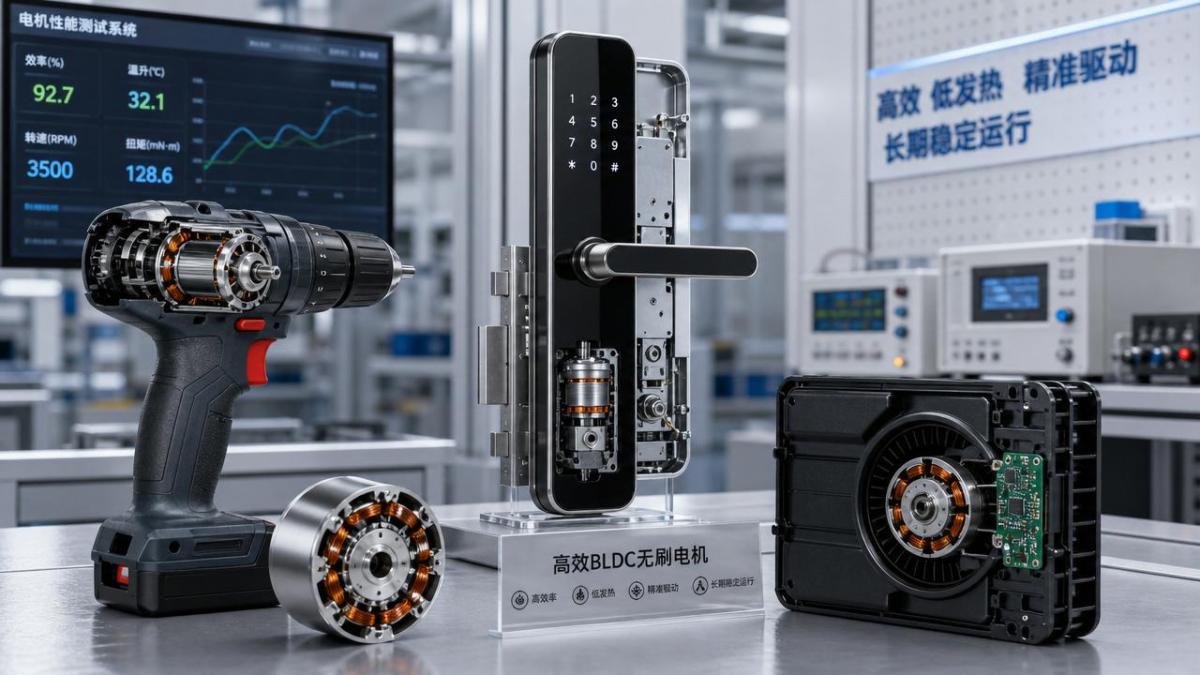
BLDC motor technology uses electronic commutation instead of mechanical brushes. That simple shift reduces friction, heat, and wear inside the motor.
In practical terms, brushless motors convert more electrical input into usable torque. Less energy is lost to heat, sparking, and mechanical contact.
That matters more today because electricity prices, battery expectations, and maintenance pressure are all rising at once.
BLDC motor technology also supports precise speed control. This is critical in industrial tools, biometric access systems, smart ventilation modules, and automated lighting mechanisms.
For integrated smart hardware, efficiency is not only about power savings. It also affects thermal stability, product size, runtime, and system reliability.
In security and infrastructure equipment, lower heat can improve sensor stability, electronics life, and enclosure safety in enclosed operating conditions.
When does higher efficiency actually pay off?
BLDC motor technology pays off fastest in applications with long operating hours, frequent cycling, or difficult service access.
If a motor runs only occasionally, the savings may be modest. If it runs daily, energy and maintenance gains compound quickly.
The strongest business cases usually include one or more of these conditions:
- High duty cycle equipment
- Battery-powered tools requiring longer runtime
- Systems exposed to dust, vibration, or harsh environments
- Devices where downtime creates security or productivity risks
- Installations with expensive maintenance visits
Consider industrial fastening tools. A brushless design can increase output consistency while extending battery life and reducing service interruptions.
Consider smart access barriers or motorized locks. Here, BLDC motor technology can improve response precision, reduce wear, and stabilize repeated open-close cycles.
Consider smart lighting systems with active cooling or moving optical components. Higher motor efficiency lowers heat load and can support longer electronic lifespan.
Payback often becomes obvious when hidden costs are included. These include replacement labor, site visits, productivity loss, and unplanned shutdowns.
How does BLDC motor technology compare with brushed motors?
The comparison should go beyond purchase price. Upfront cost is only one variable in a longer operating equation.
Brushed motors still fit simple, low-cost, intermittent applications. They remain relevant where replacement is easy and downtime has little consequence.
BLDC motor technology becomes more attractive when performance stability matters. It is especially valuable when systems must run efficiently over thousands of cycles.
For modern smart hardware, electronic control is another advantage. It enables monitoring, speed profiles, torque response, and integration with digital control boards.
Which applications benefit most from BLDC motor technology?
Not every motorized product needs a brushless architecture. The best fit depends on duty cycle, environment, and value of uptime.
Industrial power and fastening tools
High torque demand, battery dependence, and repetitive operation make this a strong match. Brushless tools often deliver better runtime and more compact power density.
Smart access and biometric security hardware
Motorized locks, turnstiles, shutters, and access barriers benefit from precise control. BLDC motor technology supports fast, repeatable movement with reduced wear.
Commercial and smart lighting systems
Where fixtures include cooling fans, tracking mechanisms, or automated positioning, brushless motors can lower energy draw and improve silent operation.
Ventilation, compact pumps, and embedded motion modules
These subsystems often run continuously. Even small efficiency gains can produce meaningful annual savings and longer service intervals.
In broad industry settings, BLDC motor technology is strongest where motion quality and ownership cost matter more than bare minimum acquisition price.
What should be checked before choosing BLDC motor technology?
A brushless upgrade should begin with application data, not marketing claims. The wrong specification can dilute expected returns.
Review these points before selection:
- Operating hours per day and annual runtime
- Peak torque, continuous torque, and speed range
- Power source, especially battery capacity limits
- Ambient temperature, dust, moisture, and vibration
- Controller compatibility and communication needs
- Service cost and expected maintenance access
It is also important to evaluate the motor together with its controller. BLDC motor technology depends heavily on control quality and tuning.
A strong motor paired with weak electronics may create noise, poor torque response, or lower-than-expected efficiency.
Thermal design deserves equal attention. Lower heat does not eliminate the need for proper enclosure airflow and component spacing.
What common mistakes reduce ROI?
Several mistakes cause disappointment even when BLDC motor technology is technically appropriate.
- Comparing only purchase price instead of total cost of ownership
- Ignoring controller cost and software integration effort
- Oversizing the motor for occasional peak loads
- Assuming all brushless systems deliver equal efficiency
- Overlooking field conditions such as dust ingress or unstable voltage
Another common error is underestimating the value of reliability. Reduced downtime often outweighs direct electricity savings.
This is especially true in security systems and infrastructure equipment, where one failure can affect safety, compliance, or service continuity.
How can payback be estimated in a practical way?
A simple payback model starts with four numbers: purchase premium, annual energy savings, annual maintenance savings, and downtime reduction value.
If the premium is modest and annual benefits are recurring, BLDC motor technology can justify itself surprisingly quickly.
Use this basic logic:
- Calculate yearly operating hours
- Estimate efficiency-related energy difference
- Add avoided maintenance labor and parts
- Include downtime cost where relevant
- Compare annual savings against initial premium
For networked hardware, there can be a fifth benefit. Better control data may support predictive maintenance and improve system-level planning.
That broader value is easy to miss, yet it aligns closely with AIoT-driven infrastructure and modern equipment intelligence strategies.
BLDC motor technology pays off when efficiency connects with uptime, precision, and lower service burden. The strongest cases appear in portable tools, smart security hardware, and continuously operating subsystems.
The right decision begins with real operating data, not assumptions. Review runtime, maintenance difficulty, control needs, and failure cost before comparing options.
Where performance stability and lifecycle economics matter, a well-matched brushless system can move from premium feature to clear financial advantage.
For the next step, build a simple ownership model for one target application. That single comparison usually reveals whether BLDC motor technology is an upgrade or a strategic investment.
Recommended News