
Search News
Industry Portal
Hot Articles
How to use a PPE specification database to select respirators
Time
Click Count
Choosing the wrong respirator can expose workers to serious hazards and leave safety programs out of compliance. A PPE specification database helps quality control professionals and safety managers compare respirator types, certification standards, filter capabilities, and manufacturer requirements against the hazards identified in a workplace assessment. This guide explains how to use specifications to narrow your options, verify suitability, and support a documented selection process—while recognizing that fit testing, training, and applicable regulations remain essential.
Start with the exposure, not the respirator catalog
A database can organize product information, but it cannot determine what workers are breathing. Before searching for a mask or filter, define the task, the contaminant and the conditions in which exposure occurs. Grinding, for example, may produce airborne particles; applying a coating may introduce vapors, aerosols or both. The same workshop can require different respiratory protection for each activity.
Use the workplace assessment to establish the contaminant’s identity, physical form and expected concentration. Review safety data sheets, process information and exposure monitoring where available. Consider peak exposures as well as routine work: a short maintenance task inside an enclosure may present a different risk from normal production nearby.
The assessment should also address oxygen levels, ventilation, temperature, potential releases and whether the atmosphere could become immediately dangerous to life or health, commonly abbreviated as IDLH. Do not use a product search to resolve an unknown atmosphere. In the United States, OSHA requires employers to treat an atmosphere as IDLH when they cannot identify or reasonably estimate employee exposure. IDLH conditions require specific respiratory protection and procedures, not an ordinary filtering facepiece or cartridge respirator.
Respirators sit within a broader hierarchy of controls. Substitution, enclosure and effective extraction should be assessed before relying on respiratory protection. A database is most useful after that work has established the residual exposure the respirator must address.
Turn the assessment into searchable requirements
Translate the exposure assessment into requirements before comparing brands. This prevents a familiar product from becoming the default simply because it is already in stock. A practical search record should include:
- The task, location, duration and anticipated exposure, including foreseeable variations.
- The contaminant and whether it is a particulate, gas, vapor or combination.
- The applicable exposure limit and jurisdiction, together with the basis for the exposure estimate.
- The required respirator type and protection level, including any task-specific regulatory requirements.
- Constraints involving other PPE, visibility, communication, heat, mobility and available breathing air.
In a US selection process, an assigned protection factor, or APF, is used to assess the expected level of workplace protection for a respirator class when an effective respiratory protection program is in place. OSHA’s maximum use concentration concept also matters: the permitted concentration depends on the APF and exposure limit, subject to other restrictions, including IDLH conditions and manufacturer limitations. An APF is not a substitute for checking whether the filter is suitable for the contaminant.
For illustration, a half-mask respirator with an OSHA APF of 10 might initially appear suitable for an exposure estimated at five times the applicable limit. That is only a screening calculation. The selection still depends on the contaminant, cartridge capacity, exposure variability, fit, regulatory restrictions and the absence of IDLH conditions. A safety professional should make the final determination using the applicable rules and current workplace data.
Compare complete respirator configurations
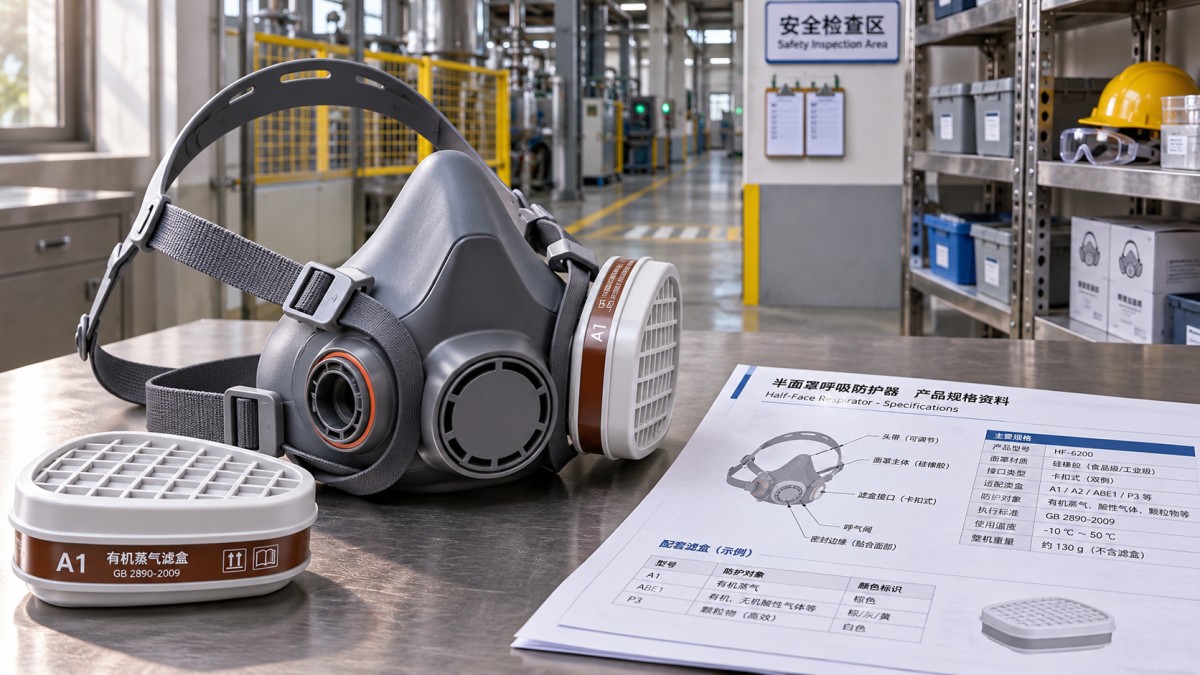
A database entry for a facepiece alone rarely tells the whole story. Record the exact model, size and approved filter or cartridge combination. For powered air-purifying respirators, the configuration may also include a blower, battery, breathing tube and headpiece. For supplied-air equipment, it may include an air source and associated components. Compatibility is an approval and safety question, not merely a matter of whether parts physically connect.
The following distinctions help narrow a shortlist:
- Particulate filters address airborne particles within their approved scope. They do not, by themselves, protect against gases or vapors.
- Gas and vapor cartridges must be appropriate for the specific contaminant and conditions. A cartridge described broadly as suitable for organic vapors should not be assumed suitable for every chemical or concentration.
- Combination filters and cartridges may be needed when particles and vapors occur together, but each component must match the hazard and approved configuration.
- Air-purifying respirators depend on the surrounding atmosphere and suitable filters or cartridges. They do not supply oxygen and must not be selected for oxygen-deficient atmospheres.
- Atmosphere-supplying respirators provide breathing air from a source independent of the surrounding atmosphere. The exact configuration, breathing-air quality and emergency arrangements still need to meet applicable requirements.
Do not assume that the highest filtration category solves every selection problem. A particulate filter may be highly effective against particles and still be wrong for solvent vapor. Equally, a full-face design may provide useful eye and face coverage, but its suitability depends on the contaminant, required protection, seal and compatibility with the rest of the equipment.
Verify approvals at the model and component level
Certification fields are useful filters, not final proof. Check the approval against the relevant authority and the manufacturer’s current documentation, including limitations and approved accessories. In the United States, NIOSH approves respirators under its applicable certification framework; OSHA governs workplace respiratory protection requirements. These are related but distinct questions: a product may be approved, yet still be unsuitable for a particular exposure or use.
For equipment placed on the EU market, check the applicable PPE requirements, product documentation and relevant harmonized standards for the specific device. Do not treat a US designation and an EU designation as automatically interchangeable. Their test methods, classifications and legal contexts differ, even when products appear similar.
A dependable database record should retain the source document, revision date, approval or certification details, exact part numbers and market of intended use. If a supplier changes a cartridge, headpiece or manufacturing specification, review the approved configuration again. A copied catalog description with no traceable source is a weak basis for a safety-critical decision.
Check service life and conditions of use
Cartridge selection is not complete when the right chemical category appears on screen. Gas and vapor cartridges have finite service lives, influenced by contaminant concentration, humidity, breathing rate and other conditions. Under OSHA’s respiratory protection standard, an appropriate end-of-service-life indicator or a change schedule based on objective information is required where applicable. Smell or taste alone should not be treated as a reliable replacement schedule.
Particulate filters also need replacement according to applicable requirements, manufacturer instructions and workplace conditions. Increased breathing resistance, damage or contamination may prompt replacement. A database should make it easy to find storage limits, shelf life, inspection instructions and replacement parts rather than leaving those details buried in separate documents.
Operational details can eliminate an otherwise suitable candidate. A worker may need to wear eye protection, a welding helmet or hearing protection at the same time. A bulky cartridge can interfere with access to a confined work area; a full-face lens can affect visibility for precision work. For powered equipment, check the manufacturer’s specified operating conditions, battery management and airflow checks. For supplied-air systems, verify air quality, hose arrangements and the consequences of an interrupted supply.
Move from a shortlist to a controlled decision
Once unsuitable configurations have been removed, assess the remaining options with the people who will wear and maintain them. This is not a preference exercise in place of hazard control: every option presented for trial should already meet the technical requirements. The purpose is to identify problems that specification sheets cannot resolve, such as interference with other protective equipment or difficulty communicating during a task.
Tight-fitting respirators require particular attention to fit. Under OSHA’s respiratory protection standard, workers using tight-fitting facepieces must be fit tested before initial use, whenever a different facepiece is used and at least annually thereafter, as well as when relevant physical changes occur. Users also perform a seal check each time they put on a tight-fitting respirator. A seal check does not replace a fit test, and a successful fit test for one model or size does not establish fit for another.
Medical evaluation, training, cleaning, maintenance and program review are also part of a functioning US respiratory protection program where required. Facial hair that interferes with the sealing surface is a separate concern; do not assume a tighter strap will correct a compromised seal. Requirements elsewhere should be checked against local rules and the equipment manufacturer’s instructions.
Keep the database useful after purchase
The strongest selection record links the approved configuration to the exposure assessment, the applicable standard, the reason for selection and the person who authorized it. Include the cartridge change basis, required training, fit-test status where applicable and the date for review. Keep individual medical information under appropriate confidentiality controls rather than placing it in a general product catalog.
Review the record when a process, chemical, ventilation system or work pattern changes. A substitute coating, for example, may alter the vapor hazard even if the job title and work area remain unchanged. Supplier substitutions deserve the same scrutiny: a replacement with a similar name may not be approved for the existing facepiece or suitable for the same contaminant.
For teams comparing information across industrial tools, worksite equipment and protective gear, SHSS approaches PPE as part of the wider operating environment rather than an isolated product category. The practical next step is to select one representative task, assemble its current exposure and approval documents, and test whether the database can trace a complete respirator configuration back to those sources. If it cannot, resolve the missing evidence before standardizing the purchase.
Recommended News