
Search News
Industry Portal
Hot Articles
How much do full-face respirators cost to maintain?
Time
Click Count
For procurement teams, the cost of maintaining a full-face respirator depends less on the facepiece itself than on how often its filters or cartridges must be replaced. A respirator used occasionally for dust control may have relatively modest recurring costs. One used frequently against gases or vapors can require a much larger consumables budget, particularly where the change schedule calls for replacement before each shift or task.
There is no reliable annual maintenance price that applies to every workplace. The useful buying figure is the expected cost per wearer, per year, built from the actual hazard, frequency of use, replacement schedule, and local prices. Fit testing, cleaning, inspection, training, and spare parts also belong in that calculation, even when they are paid from a separate safety budget.
What goes into the annual cost?
The initial full-face respirators price is only one line in the purchasing decision. A reusable facepiece may serve through many filter changes, but its usable life depends on its condition, the manufacturer’s instructions, and the environment in which it is used. Budgeting for maintenance therefore starts with the components that are consumed or require periodic attention.
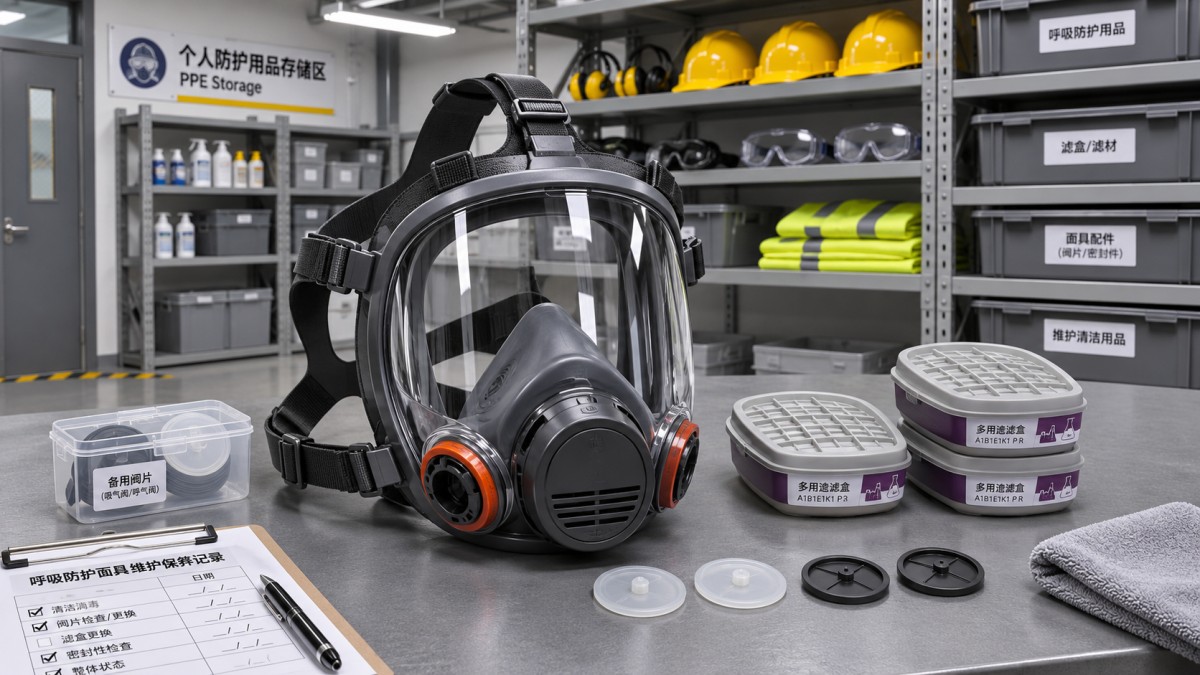
- Filters and cartridges: Particulate filters, gas and vapor cartridges, or combination units selected for the hazards. Some configurations use two cartridges or filters at a time, so a quotation should identify the cost of a complete replacement set.
- Cleaning and storage: Compatible cleaning products, clean storage facilities, and the labor needed to clean, disinfect where appropriate, inspect, and dry the facepiece.
- Replacement parts: Items such as valves, head harnesses, seals, and lens protection, where these are replaceable components for the selected model.
- Fit testing and training: Testing services or equipment, staff time, recordkeeping, and instruction in correct use and maintenance.
- Facepiece replacement: A budget allowance for units that become damaged, fail inspection, or can no longer be kept serviceable.
These categories should be priced separately from the initial purchase, but they should also be included when comparing models. A lower-priced facepiece can become the more expensive option if its compatible cartridges cost more or if essential parts are difficult to obtain.
A full-face respirator is also a configuration, not just a mask. The same facepiece may be used with different approved filters or cartridges for different tasks. A comparison based on the bare facepiece price says little about the cost of the configuration workers will actually use.
Filters and cartridges usually drive the biggest cost difference
Start with the contaminants and the respiratory protection assessment. A particulate filter may be appropriate for a task involving airborne particles, while exposure to certain gases or vapors calls for a suitable cartridge or another protective approach. Some work involves both. The selection must match the hazard and the applicable approval and manufacturer instructions for the complete respirator assembly.
Once the appropriate equipment has been identified, estimate consumption by task. Two teams with the same number of workers can have very different budgets if one wears respirators for a short weekly operation and the other uses them throughout each working shift. Shift duration, contaminant levels, work rate, humidity, storage conditions, and the cartridge’s service-life characteristics can all affect the replacement schedule.
For gas and vapor cartridges, a change schedule should be based on an appropriate service-life assessment or a suitable end-of-service-life indicator where available and applicable. Do not use the point at which a worker smells or tastes a contaminant as the purchasing schedule. Warning properties vary, and sensing a contaminant is not a dependable substitute for a planned change.
Particulate filters present a different planning problem. Loading can increase breathing resistance, and filters may also require replacement because of damage, contamination, or the manufacturer’s instructions. A simple calendar interval may be useful for stock planning, but it should not override the actual replacement criteria for the task and product.
Ask suppliers to quote the complete set needed for each change, including any prefilters, retainers, or other components required by the selected configuration. Check whether the quoted quantity means individual filters, pairs, boxes, or complete sets. A small unit-of-measure error can produce a large forecasting error when multiplied across a workforce.
Also distinguish a cartridge’s storage shelf life from its usable service life during exposure. A product that can be stored for an extended period does not necessarily provide protection for an equally long period once in use.
Build a budget from the work schedule
A practical estimate begins with the number of wearers in each exposure group. If different tasks require different cartridges or change frequencies, calculate them separately. The basic consumables calculation is:
Annual consumables cost = number of wearers × replacement sets per wearer per year × price per complete set.
For example, consider a planning scenario with 20 wearers. Each is expected to use one complete replacement set per week for 40 working weeks, and the quoted price is $30 per set. The annual consumables allowance would be 20 × 40 × $30, or $24,000. This is an arithmetic example, not a recommended change interval or a market price; actual schedules and quotations must come from the workplace and selected equipment.
Now add the other recurring costs. If the same hypothetical program allocates $2,000 for cleaning and inspection labor and supplies, $1,500 for fit testing and training, and $500 for replacement parts, the annual operating estimate becomes $28,000. At 20 wearers, that is $1,400 per wearer per year. The initial facepieces and any taxes, delivery charges, or other local costs are outside that example.
The example also shows why usage assumptions matter. If the assessed schedule required two sets per week instead of one, the consumables line would double while the facepiece purchase price would stay the same. Before approving a budget, test at least two credible usage scenarios: the planned workload and a higher-use workload that reflects overtime, additional tasks, or more frequent replacement.
A useful forecast should distinguish the planned change schedule from the quantity kept in reserve. Extra stock can cover damaged items, unexpected workload, or delivery delays, but it should be managed against storage requirements and expiry dates. Overstocking a short-dated cartridge may turn a supply problem into a disposal cost.
Cleaning, parts, and labor can change the comparison
Cleaning may look inexpensive when only the price of wipes or detergent is counted. For a procurement budget, labor is often the more useful measure: how long does it take to clean, inspect, dry, and return each facepiece to suitable storage, and who performs that work?
Follow the respirator manufacturer’s cleaning and disinfection instructions and the employer’s applicable program. Products or methods that damage seals, lenses, or other components can shorten service life. A shared facepiece may require cleaning and disinfection between users under the applicable rules and program, creating a different labor requirement from a facepiece issued for one worker’s exclusive use.
Inspection costs are similarly easy to overlook. A worker or responsible person needs time to check the facepiece and components for damage or deterioration, and a defective unit needs to be removed from service and repaired or replaced as appropriate. Lens covers may be a practical recurring expense in work where the visor is exposed to overspray or abrasion, but their value depends on the task and the manufacturer’s approved accessories.
Request a parts list before selecting a model. Check which components are replaceable, which repairs the manufacturer permits, the price of those parts, and expected availability. If a damaged component cannot be replaced separately, the likely cost may be a new facepiece rather than a small spare part.
Compatibility matters financially as well as for protection. Filters, cartridges, and replacement parts should be approved for the specific respirator assembly and used according to its instructions. An apparently inexpensive component is not a saving if it cannot be used in the approved configuration.
Include fit testing and program costs
A full-face respirator that relies on a tight seal must fit the wearer. Fit testing has an initial cost and may recur under the rules that apply to the workplace. It can also be needed when a different facepiece is selected or when changes in a wearer’s physical condition could affect fit. Include the time taken away from normal work as well as any external testing fee.
For workplaces covered by the U.S. OSHA respiratory protection standard, tight-fitting respirators generally require fit testing before initial use, whenever a different facepiece is used, and at least annually thereafter. The standard also addresses medical evaluation, training, cleaning, maintenance, and other elements of a respiratory protection program. Requirements in other jurisdictions can differ, so a multinational buyer should build the local obligations into each site’s estimate.
Fit testing is separate from the user seal check performed when putting on a tight-fitting respirator. Neither replaces equipment inspection or a suitable filter and cartridge schedule. Budgeting for these activities together helps avoid a common gap: funding the equipment while leaving insufficient time or resources to operate the protection program.
Consider workforce turnover and allocation as well. New wearers may need evaluation, training, and fit testing before use. If several sizes or models are necessary to achieve a suitable fit across the workforce, inventory and training costs may rise. A single-model contract is convenient only if the selected facepiece can be properly fitted to the people who need it.
Compare supplier offers on the same basis
When requesting quotations, give each supplier the same approved or technically acceptable configuration, expected wearer count, task profile, and assumed replacement quantities. Ask for separate prices for facepieces, complete filter or cartridge sets, replaceable parts, and any associated services. This makes it possible to compare the cost of operating each option over the same period.
For each offer, calculate the expected annual consumables spend first. Then add the site’s estimated labor, fit testing, training, and replacement-part costs. If an option has a higher initial price but lower recurring costs, divide the extra initial spend by the expected annual saving to see how long it would take to recover the difference. That comparison is useful only if both options meet the same protection requirements and the assumed replacement schedules are defensible.
Delivery terms deserve attention where work depends on a particular cartridge. A low contract price has limited value if the specified replacement sets are unavailable when needed. Ask about lead times, minimum order quantities, remaining shelf life at delivery, and how the supplier handles changes in product availability. These details affect both the quantity a site must hold and the risk of expired stock.
Finally, revisit the estimate when the job changes. A new coating, longer shift, different process, or revised exposure assessment can change the required cartridge and its replacement schedule. Keeping the budget tied to the work being performed gives procurement a more dependable number than applying a fixed percentage to the original facepiece purchase.
Recommended News