
Search News
Industry Portal
Hot Articles
What do toxic gas protection standards require for respirator selection?
Time
Click Count
Selecting the wrong respirator can expose workers to hazardous gases even when the equipment appears adequate. Toxic gas protection standards require more than choosing a mask with the right-looking filter: the selection must account for the contaminant, its concentration, oxygen level, exposure limit and the work being performed. For quality control and safety managers, the difficult part is often not finding an approved respirator, but proving that the complete system is appropriate for the actual task.
Start with the atmosphere, not the mask
A respirator cannot be selected reliably from a job title or a chemical name alone. A maintenance worker opening a process line may face a short, high-concentration release, while another worker in the same facility experiences a lower background concentration over a full shift. Those are different selection problems.
The assessment should identify the substances present, their physical form, likely concentrations, exposure duration and applicable occupational exposure limits. Safety data sheets and process records are useful starting points, but they do not replace an assessment of the work as performed. Sampling or direct-reading instruments may be needed, particularly where a task disturbs residues or where conditions change during entry.
Pay attention to mixtures. A cleaning operation can produce both solvent vapor and airborne droplets; a process upset may introduce a gas not normally present. A particulate filter alone does not protect against gases or vapors, and a gas cartridge does not necessarily remove particles. Combined hazards require an appropriately approved combination, within all relevant use limitations.
Under the U.S. Occupational Safety and Health Administration’s respiratory protection standard, 29 CFR 1910.134, the employer must identify and evaluate respiratory hazards. If exposure cannot be identified or reasonably estimated, the atmosphere must be considered immediately dangerous to life or health, or IDLH. That requirement changes the equipment decision substantially.
Know when an air-purifying respirator is off the table
Air-purifying respirators remove contaminants from ambient air; they do not supply oxygen. They are not a solution for an oxygen-deficient atmosphere or for an unknown atmosphere treated as IDLH. In the United States, OSHA defines an oxygen-deficient atmosphere as one containing less than 19.5% oxygen by volume. An oxygen reading above that threshold, however, does not establish that the atmosphere is safe or suitable for a cartridge respirator.
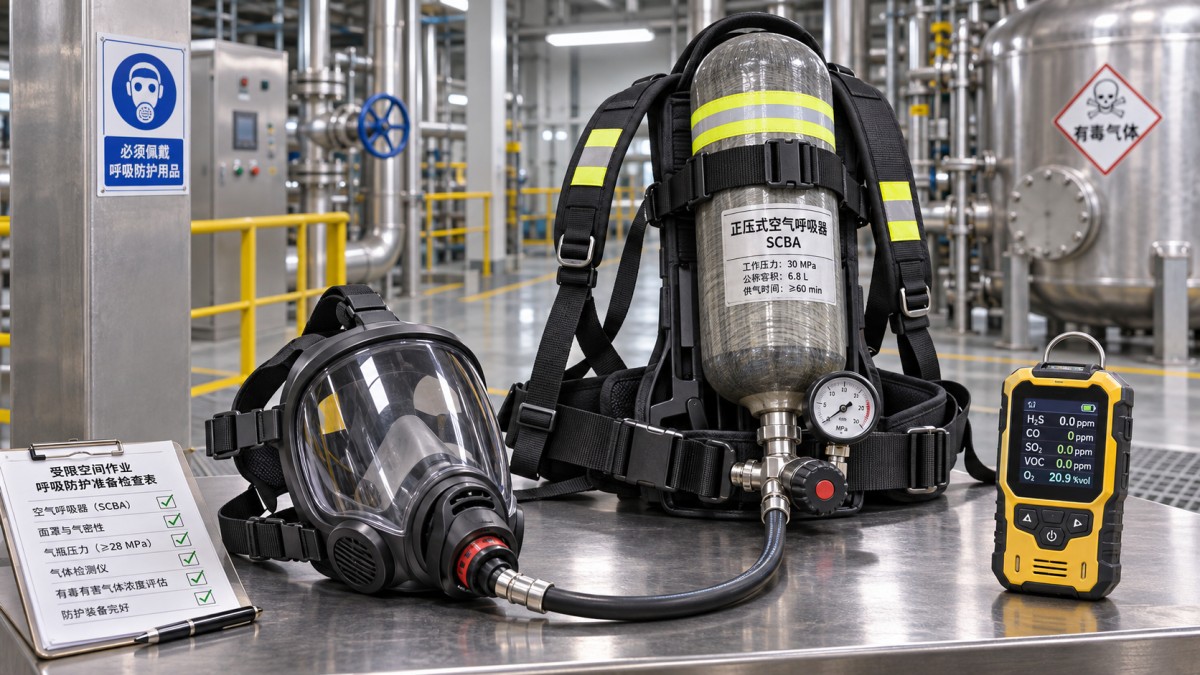
For IDLH atmospheres, OSHA generally requires either a full-facepiece pressure-demand self-contained breathing apparatus (SCBA) certified by the National Institute for Occupational Safety and Health (NIOSH) for a minimum service life of 30 minutes, or a full-facepiece pressure-demand supplied-air respirator with an auxiliary self-contained air supply. The standard also includes specific provisions for escape and certain firefighting situations. Employers must address standby personnel, communication and rescue arrangements; the breathing apparatus alone is not an entry plan.
A supplied-air respirator is not automatically suitable for every unknown or IDLH entry. Its configuration, pressure mode and auxiliary air supply matter. Likewise, SCBA duration is a rated minimum under specified test conditions, not a promise of working time for an individual carrying out strenuous work. Air consumption, cylinder pressure and the need to exit with a reserve belong in the task plan.
Consider a vessel opened for cleaning: ventilation may improve readings at the entrance while pockets remain inside, and residue disturbance can change the atmosphere. Entry decisions should follow the applicable confined-space and respiratory protection requirements, supported by monitoring and a workable rescue procedure.
Use protection factors as a screening calculation
An assigned protection factor (APF) describes the level of workplace respiratory protection a properly functioning respirator or class of respirators is expected to provide when used within an effective program. OSHA uses APFs to help determine the maximum use concentration, commonly calculated as the APF multiplied by the applicable exposure limit.
For a simple illustration, if a contaminant has an applicable limit of 10 parts per million and the selected configuration has an APF of 10, the calculated maximum use concentration is 100 parts per million. This is a screening ceiling, not permission to use the respirator at that concentration regardless of other conditions. IDLH limits, cartridge restrictions, manufacturer instructions and substance-specific rules may impose a lower limit. The concentration and exposure limit must also be compared over the appropriate averaging period.
Do not assign an APF based only on whether the facepiece is half-mask or full-face. Respirator type, operating mode and the complete approved configuration matter. For example, a powered air-purifying respirator may have different APFs depending on its facepiece or hood and supporting evidence. Use the applicable jurisdiction’s APF table and the manufacturer’s instructions, rather than transferring a figure from a different national system.
Match the cartridge to the chemical and the conditions
A cartridge marked for one family of gases is not a universal gas filter. Selection depends on the specific contaminant and the cartridge’s approval and manufacturer-specified use. Check the chemical name, concentration, temperature, humidity and any mixture restrictions against the relevant documentation. A cartridge that is physically compatible with a facepiece is not necessarily approved for that respirator assembly.
Service life deserves particular attention. Gas and vapor cartridges can reach breakthrough without an obvious warning. Smell, taste or irritation is not a dependable change indicator: some chemicals have poor warning properties, and a worker may not notice a change in time. Under OSHA’s rule, gas and vapor cartridges must have an appropriate end-of-service-life indicator certified by NIOSH, or the employer must implement a change schedule based on objective information or data that ensures cartridges are replaced before the end of their service life.
That schedule should reflect the actual work rather than a convenient calendar interval. A cartridge used intermittently in humid conditions may behave differently from one used continuously under the conditions assumed in a manufacturer’s service-life estimate. If reliable service-life information is unavailable for the combination of contaminants and conditions, do not invent a change interval; reassess the respiratory protection approach.
Fit is part of selection, not a final formality
A suitable filter cannot compensate for a leaking face seal. In the United States, tight-fitting respirators require an appropriate qualitative or quantitative fit test before initial use, whenever a different facepiece is used, and at least annually thereafter. Additional testing is required when changes, such as significant weight change or facial surgery, could affect fit. A user seal check each time the respirator is donned is separate from, and does not replace, a fit test.
Facial hair that comes between the sealing surface and the face, or interferes with valve function, is not permitted under OSHA’s requirements for tight-fitting facepieces. Prescription eyewear, protective helmets and other PPE also need to be assessed together: temple arms crossing a seal, for example, can compromise a full-face respirator. Use compatible spectacle arrangements where required by the manufacturer.
A loose-fitting powered or supplied-air hood may be worth evaluating when a tight seal is impractical. It is not a universal workaround: its approval, APF, airflow requirements, contaminants and atmosphere limitations still have to match the job. Medical evaluation, training and maintenance requirements remain relevant within the respiratory protection program.
Check the approval against the market and the complete assembly
Standards and certification marks do not mean exactly the same thing in every market. In the United States, NIOSH approves respirator configurations under 42 CFR Part 84, while OSHA regulates workplace respiratory protection. In the European Union, respiratory protective equipment is subject to Regulation (EU) 2016/425; relevant European standards depend on the equipment type, such as EN 14387 for gas and combined filters. Local selection and workplace-use rules must also be checked.
A CE mark is not a NIOSH approval, and a NIOSH-approved component does not make an arbitrary combination approved. For incoming quality checks, compare the facepiece, cartridges, filters, hoses and other components with the approval documentation and manufacturer’s permitted configurations. Check labeling, shelf life, storage condition and evidence of damage. Substituting an apparently identical part can invalidate the approved assembly or introduce a fit problem.
This distinction matters in cross-border sourcing, a recurring issue across the industrial equipment and PPE markets followed by SHSS. A certificate may demonstrate conformity to one set of product requirements without establishing that the equipment is suitable for a particular chemical, concentration or workplace task.
Keep a decision record that can survive a process change
A practical selection record should connect the hazard assessment to the chosen configuration: contaminant and sampling basis, exposure limits, oxygen and IDLH determination, APF calculation, cartridge compatibility and change schedule, fit-test status, and the conditions under which workers must leave the area. For supplied-air systems, it should also address breathing-air quality, hose arrangements and emergency provisions.
The record is useful only if it is revisited. A new cleaning agent, longer task duration, altered ventilation or replacement filter supplier can invalidate assumptions that were sound when the respirator was selected. Before approving a substitution or restarting an unusual job, check the atmosphere and the complete equipment configuration again. If the exposure cannot be characterized well enough to support air-purifying protection, do not fill the gap with a more substantial-looking cartridge.
Recommended News