
Search News
Industry Portal
Hot Articles
- How does keyless access control for hotels work during a power outage?Dr. Matthias Vance
- Report: Tariff Disruption Could Shift $4 Billion in Aerospace Fastener Revenue by 2030Hardware Mechanics Fellow
- Industrial Fasteners Market Forecast to Reach $128.3 Billion as Tariffs Disrupt Supply ChainsHardware Mechanics Fellow
How to verify CE marking on industrial respirators
Time
Click Count
A CE mark on an industrial respirator is the starting point for a compliance check. It does not, on its own, establish that the product is authentic, that its supporting documents cover the exact model supplied, or that it will protect a worker against the hazard present.
For quality control teams and safety managers, verifying CE industrial PPE means connecting four pieces of evidence: the physical product and its markings, the EU Declaration of Conformity, the relevant conformity assessment documents, and the identity and role of the notified body. A separate workplace assessment must then establish whether the respirator, filters and fit are appropriate for the job.
Start with the exact product in front of you
Before requesting certificates, record the manufacturer’s name, model designation, product type, filter classification and any batch or serial number on the respirator and its packaging. Photograph the markings and retain the packaging until the check is complete. If the respirator uses replaceable filters, record their model and classification separately.
This matters because a declaration for a manufacturer’s general product family may cover several variants, while only some of them match the item delivered. A half mask, a full-face mask and a replacement filter can have different markings and supporting documents. A certificate for one component does not automatically establish compliance for every combination assembled from it.
The CE marking should be visible, legible and indelible on the PPE. Where the nature of the product makes that impossible or impractical, the PPE Regulation permits it to appear on the packaging and accompanying documents. Respiratory protective equipment against substances and mixtures that are hazardous to health is Category III PPE. Such products normally carry the CE mark followed by the four-digit identification number of the notified body involved in the production-control conformity assessment.
For example, a marking in the form “CE 1234” points to a notified body by its identification number. The digits alone do not tell you whether the product is genuine or whether that body assessed the respirator’s design. They identify the body associated with the relevant production-control phase, which may be different from the body that issued the EU type-examination certificate.
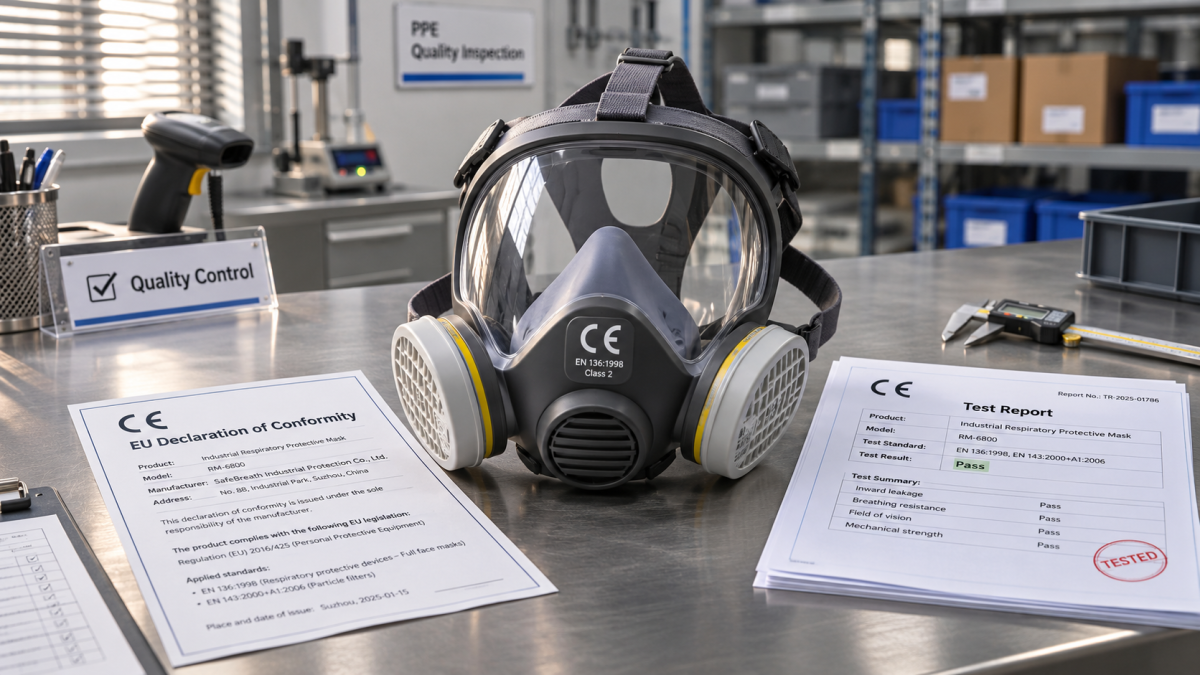
Do not treat a missing or unusual marking as a problem that can be resolved by accepting a supplier’s explanation alone. Ask for the applicable marking arrangement, product instructions and supporting evidence. If the identification cannot be reconciled, hold the lot while the discrepancy is investigated.
Match the declaration to the model and its intended use
Under Regulation (EU) 2016/425 on personal protective equipment, the manufacturer is responsible for drawing up an EU Declaration of Conformity. The declaration identifies the PPE and states that it conforms to the applicable requirements. The manufacturer must provide the declaration with the PPE or include its internet address in the instructions.
For a procurement check, obtain the actual declaration and compare it with the delivered product. Look for:
- Product identification: A model, type or other identification that can be connected to the respirator supplied.
- Manufacturer identification: The manufacturer’s name and address, consistent with the product information.
- Applicable legislation: A reference to the PPE Regulation and any other applicable EU legislation.
- Standards or technical specifications: The references and editions used, where applicable.
- Notified-body information: The body or bodies involved, their identification numbers and the conformity assessment procedures performed.
- Accountability: The place and date of issue, and the name, function and signature of the person signing for the manufacturer.
A declaration may list several models, but the relationship between the listed variants and the delivered configuration should be clear. Check the mask size, filter type and any relevant suffixes rather than relying on a similar-looking product name. If a supplier sends a declaration for “Model 200” and the delivered item is marked “Model 200-X,” ask the manufacturer to explain whether the latter is covered and provide evidence that identifies it.
The standards listed on the declaration help establish what was assessed, but their presence is not a substitute for reading the scope. Check the cited edition and any amendments against the certificate, product instructions and the relevant references published by the European Commission. A harmonised standard can support a presumption of conformity for the essential requirements it covers; a standards reference by itself does not prove that an individual product has been properly assessed.
Read the classification as well as the standard number
For a filtering half mask, markings may refer to EN 149 and a class such as FFP1, FFP2 or FFP3. These classes distinguish filtering performance; they do not make the device suitable for every airborne hazard. For reusable masks and separate filters, other standards and classifications can apply to the facepiece and the filter. A gas filter’s type and capacity class, for example, are part of the selection decision.
Do not infer gas or vapour protection from an FFP classification alone. Likewise, the presence of a particulate filter does not make a respirator suitable for an oxygen-deficient atmosphere. Use the manufacturer’s instructions and the workplace hazard assessment to determine what the complete configuration can be used for.
Check both stages of Category III assessment
Category III respiratory PPE is subject to an EU type-examination and an additional procedure addressing conformity during production. The latter is commonly described as either Module C2, involving supervised product checks at random intervals, or Module D, involving assessment of the manufacturer’s production quality assurance system.
Ask the supplier for the EU type-examination certificate and the evidence relevant to the production-control procedure. The declaration should identify the notified body involved in each procedure and the certificate or approval details. Depending on the arrangement, the same notified body may perform both roles, or different bodies may be involved.
Review validity dates in context. The relevant question is whether the manufacturer had the required assessment in place when the product was placed on the EU market. A document that has expired by the time of a later warehouse inspection does not, by itself, establish when a particular unit was placed on the market or whether it was compliant at that time. Conversely, an apparently valid document does not establish that the delivered unit is authentic.
If the certificate is unclear, request the complete document, including any annexes that define the models and configurations covered. A cropped image showing only a logo, certificate number and expiry date leaves too much room for an unrelated or altered document to be passed off as product evidence.
Verify the notified body independently
Use the European Commission’s NANDO database to identify the notified body associated with each four-digit number. Check that the organisation is designated under the PPE Regulation for the relevant conformity assessment activities and product scope. A real number belonging to a real organisation is only the first check: it must also fit the role claimed in the documents.
NANDO is a directory of notified bodies and their designated activities, not a general database proving that every certificate or respirator is authentic. To verify a certificate, use a verification service offered by the issuing body where available, or contact it through details obtained independently from its official website. Provide the certificate number, manufacturer and model, and ask whether the document and scope match its records.
Pay particular attention when the supplier provides only a certificate-search link or contact address embedded in the document. Establish the organisation’s official contact details separately. If the notified body cannot confirm the document, or if the certificate number exists but refers to a different product, do not release the affected stock until the discrepancy is resolved.
Separate compliance evidence from workplace suitability
A consistent set of CE documents supports a conformity claim. It does not answer whether workers can safely use the respirator for a particular task. That decision depends on the contaminant, its concentration, oxygen conditions, exposure duration and the manufacturer’s specified limitations.
For a dust-producing operation, for example, the safety manager still needs to determine the level of respiratory protection required and whether the selected filtering facepiece can achieve it in the conditions of use. For solvent vapours, the assessment must address the relevant substances and select an appropriate gas or vapour filter; particulate protection alone is insufficient. Filter service life and replacement arrangements also need to reflect the exposure and the manufacturer’s instructions.
Where a tight-fitting facepiece is selected, fit is part of the protection decision. A respirator can have the correct certification and filter while leaking around a poor face seal. Follow the applicable workplace fit-testing requirements and procedures, account for factors such as facial hair at the seal, and train users to carry out the manufacturer’s recommended seal checks.
The supplied instructions should also cover practical matters such as compatible components, storage, inspection and replacement. If those instructions do not identify a proposed mask-and-filter combination, obtain confirmation from the manufacturer before approving it. Mixing components that physically connect is not evidence that the assembled respirator has been assessed as a compatible system.
Decide what to release, hold or reject
A useful receiving decision links each lot to its evidence. Retain the product identification, photographs, declaration, relevant certificates, notified-body verification and supplier records together. Record who reviewed the documents and the outcome, so a later investigation can trace the decision to the material that supported it.
Place a lot on hold when the model cannot be matched to the declaration, the notified-body number conflicts with the production-control evidence, essential annexes are missing, or the certificate’s authenticity is in doubt. Ask the manufacturer or authorised supply-chain contact for a specific explanation and corrected evidence. A generic assurance that the product is “CE certified” does not resolve a model or certificate mismatch.
Reject or escalate the supply if the evidence shows that documents are counterfeit, belong to another product, or do not support the conformity claim. Follow the organisation’s incident and supplier-control procedures, including any applicable reporting obligations. Where affected units have already been issued, the safety response should address the workers and tasks concerned as well as the remaining inventory.
The strongest procurement record is a traceable chain: the respirator and its configuration match the declaration; the assessment documents cover that product; the notified bodies and their roles can be checked; and the workplace assessment supports the intended use. Any broken link deserves a clear resolution before the equipment is relied on for protection.
Recommended News