
Search News
Industry Portal
Hot Articles
High-Strength Bolts Grade 10.9: Common Selection Mistakes and Load Risks
Time
Click Count
Why do high-strength bolts grade 10.9 fail even when the size looks correct?
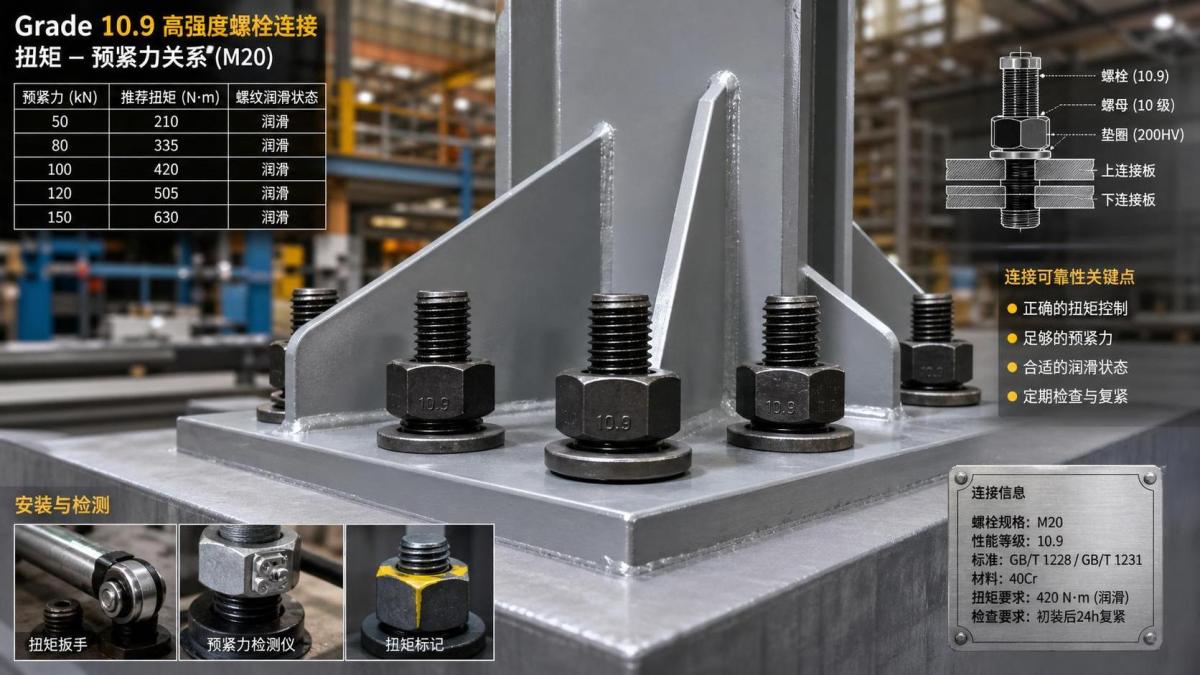
A correct diameter does not guarantee a safe joint. That is the first mistake behind many failures involving high-strength bolts grade 10.9.
In practice, bolt performance depends on preload, clamp force, friction, thread condition, joint material, and real load direction. Size is only one part of the picture.
Grade 10.9 fasteners are widely used where load transfer must stay stable under vibration, impact, or repeated cycles. Think steel structures, equipment frames, heavy tools, access systems, and smart infrastructure cabinets.
That matters across the SHSS world. Fasteners may sit behind brushless tools, biometric enclosures, lighting poles, or protective industrial assemblies. Small errors at the joint level can undermine a much larger system.
A common field pattern is simple. The drawing calls for high-strength bolts grade 10.9, the installer matches diameter and length, then assumes the requirement is met. The hidden risk starts there.
If preload is too low, the joint slips. If preload is too high, the bolt may enter plastic deformation. If the load path is misunderstood, fatigue can begin long before visible loosening appears.
So the better question is not, “Is this the right bolt size?” It is, “Will this assembled joint survive the real service condition?”
What should you really verify before selecting high-strength bolts grade 10.9?
Selection gets more reliable when the joint is checked in layers. Start with the application, then move toward the fastener details.
The most useful first check is load type. Is the bolt mainly carrying tension, shear, combined loading, or dynamic vibration? A static cover plate and a vibrating machine base do not need the same judgment.
Then confirm the joint stack. Plate thickness, hardness mismatch, washer use, hole tolerance, and bearing surface quality all affect clamp stability.
Thread engagement also deserves closer attention than it usually gets. Too little engagement reduces load capacity. Too much thread inside the shear plane can also weaken performance in some designs.
Surface treatment is another frequent blind spot. Zinc flake, hot-dip galvanizing, phosphating, and plain oil finish each change friction behavior. That directly changes tightening torque and achieved preload.
To make this easier to review, the table below summarizes the checks that most often prevent avoidable load risks.
This approach is more dependable than selecting only by grade marking. High-strength bolts grade 10.9 perform well when the whole joint is engineered, not when the label is trusted on its own.
Where do preload and torque mistakes usually begin?
Most preload mistakes begin with the assumption that torque equals clamp force. It does not, at least not consistently across different surfaces and installation conditions.
Torque is only an indirect control method. A large share of tightening input is lost to friction under the head and in the threads. Small friction changes can create large preload variation.
That is why one batch of high-strength bolts grade 10.9 may behave differently after a coating change, lubricant change, or supplier substitution, even when dimensions stay the same.
Another issue appears with power tools. Modern brushless tightening tools are fast and consistent, but consistency alone does not guarantee the correct preload. Tool calibration, angle control, and joint hardness still matter.
In actual assemblies, several warning signs point to preload trouble:
- Visible joint settlement after short service time
- Paint cracking around the washer area
- Repeated loosening under normal vibration
- Bolt fracture near the first engaged thread
- Large torque scatter across the same assembly line
A better control plan usually combines calibrated tools, controlled friction conditions, approved washers, and periodic audit checks using tension verification or torque-angle review.
When the joint is safety-related, preload verification should be treated as a process characteristic, not just an assembly routine.
Does surface treatment change the load risk of grade 10.9 bolts?
Yes, and more than many teams expect. Surface treatment affects friction, corrosion behavior, inspection appearance, and sometimes delayed failure risk.
For high-strength bolts grade 10.9, electroplating demands particular caution because hydrogen embrittlement can become a serious concern if process control is weak.
The danger is that the bolt may pass incoming inspection, assemble normally, and fail later under sustained stress. That delayed fracture is much harder to trace back.
Hot-dip galvanizing brings a different challenge. Coating thickness can affect thread fit, and the friction coefficient may differ enough to require a revised tightening specification.
In outdoor structures, smart lighting poles, enclosure supports, and industrial access systems, corrosion resistance is essential. But corrosion protection should never be separated from preload control and thread compatibility.
A practical review should cover three points together:
- Whether the coating is approved for grade 10.9 mechanical properties
- Whether the tightening value matches the real friction condition
- Whether the supplier can document process control and batch traceability
That combination reduces both visible corrosion problems and hidden load-related failures.
When is grade 10.9 the wrong choice, even if higher strength sounds safer?
Higher strength is not always the better answer. In some joints, high-strength bolts grade 10.9 introduce unnecessary cost or even extra failure sensitivity.
For low-load assemblies with soft base materials, the joint may fail in the connected parts before the bolt strength matters. In that case, improving washer support or joint design gives more value.
If corrosion exposure is severe and maintenance access is poor, another material system or coating strategy may deserve priority over a simple strength upgrade.
The same applies when installation control is limited. A high-grade fastener assembled with uncontrolled friction can create a false sense of security.
More useful than asking whether grade 10.9 is strong enough is asking whether the full joint concept is balanced. That includes load path, environment, installation method, inspection frequency, and replacement interval.
In heavy-duty fastening, the SHSS perspective is relevant here. Mechanical safety is linked to the performance of surrounding systems, from powered tools to urban equipment. The fastener should fit that system logic, not sit outside it.
How can you spot load risks before the bolts go into service?
The strongest prevention step is to review failure modes before release, not after the first incident. For high-strength bolts grade 10.9, early checks are usually cheaper than field correction.
A sound pre-service review often includes drawing verification, fastening procedure approval, supplier documentation, and a simple risk screen for fatigue, slip, corrosion, and preload loss.
Where loads are critical, sample joint testing helps. That may include torque-tension correlation, vibration resistance checks, or clamp retention after thermal cycling.
The review does not need to be complicated to be useful. It does need to be disciplined.
- Verify the specified standard, property class, and mating parts
- Check whether the first engaged thread sits in a high-stress zone
- Confirm washer hardness and bearing face condition
- Review coating compatibility with torque settings
- Define acceptance criteria for installation and reinspection
If those points are documented early, high-strength bolts grade 10.9 are far less likely to become a hidden liability later.
What is the most practical next step when bolt selection still feels uncertain?
Do not start with a catalog comparison alone. Start with a joint review sheet that captures load type, environment, coating, preload method, engagement length, and inspection plan.
Then compare candidate high-strength bolts grade 10.9 against that sheet, not just against nominal strength. This keeps decision-making tied to real failure risk.
Where the application supports critical urban, industrial, or safety hardware, it also helps to align fastening decisions with broader system reliability thinking. That is where SHSS-style cross-disciplinary review makes sense.
The main lesson is straightforward. Most bolt failures do not begin with dramatic overload. They begin with ordinary selection gaps that stay invisible until service conditions expose them.
If you need a practical path forward, map the real load, verify preload control, examine surface treatment, and test the joint where uncertainty remains. That sequence prevents many costly surprises.
Recommended News