
Search News
Industry Portal
Hot Articles
Heat Treatment ISO 898: How It Affects Bolt Strength
Time
Click Count
Bolt performance is often judged by numbers on a drawing, yet those numbers are only credible when the metallurgical route is controlled. In heat treatment ISO 898, the real issue is not simply whether a bolt was hardened, but how that process shapes strength, hardness, ductility, and fatigue behavior under service load.
That matters across construction, transport, energy, industrial tools, and smart infrastructure. For a platform like SHSS, where fastening reliability supports broader systems of safety and operational continuity, understanding heat treatment ISO 898 helps connect a small component to very large consequences.
Why ISO 898 Heat Treatment Deserves Close Attention
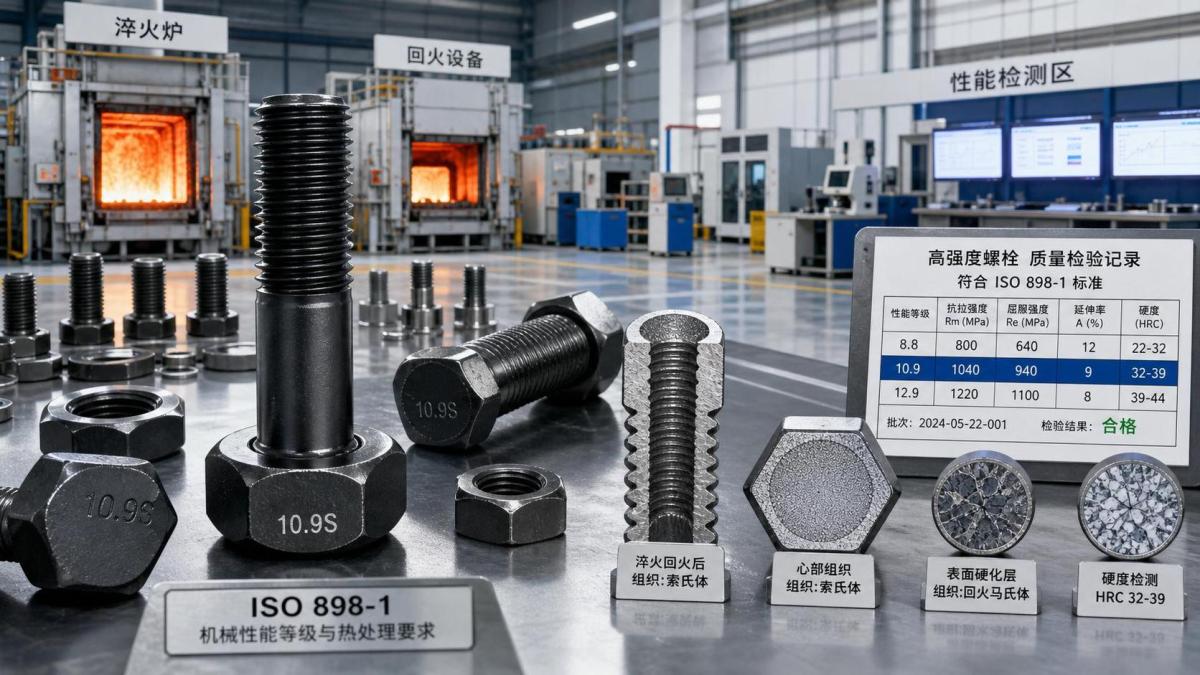
A bolt can look correct, pass a quick dimensional check, and still fail in use. The difference often sits inside the steel microstructure, which is heavily influenced by heat treatment ISO 898 requirements and the way a manufacturer executes them.
ISO 898 sets mechanical property expectations for carbon steel and alloy steel fasteners. Strength classes such as 8.8, 10.9, and 12.9 are not labels for marketing. They represent defined tensile and yield performance that depends on chemistry, forming, and heat treatment working together.
In practical terms, heat treatment ISO 898 matters because bolts rarely serve in static, clean, low-risk conditions. They face preload loss, cyclic loading, vibration, temperature swings, installation error, and surface damage. A poor heat treatment path can turn a rated fastener into a hidden liability.
What Heat Treatment Changes Inside the Bolt
Heat treatment is controlled heating, holding, cooling, and often tempering. The goal is to create a microstructure that delivers the target balance of strength and toughness.
For high-strength fasteners, quenching and tempering is common. Quenching raises hardness and strength. Tempering then reduces brittleness and stabilizes the structure so the bolt can carry load without sudden cracking.
This is where heat treatment ISO 898 becomes a decision framework rather than a factory detail. If a bolt is under-hardened, tensile strength may fall short. If it is over-hardened or poorly tempered, ductility can drop and fracture risk rises.
The mechanical effects usually show up in four linked properties:
- Tensile strength, which defines the maximum load before rupture.
- Yield strength, which indicates when permanent deformation begins.
- Hardness, which reflects resistance to indentation and correlates with strength.
- Ductility and toughness, which determine whether the bolt bends or breaks under stress concentration.
These properties are not independent. Raising one too aggressively can damage another. That tradeoff is central to evaluating heat treatment ISO 898 compliance.
How Strength Classes Relate to Heat Treatment ISO 898
Different property classes require different metallurgical discipline. Lower classes may rely on simpler processing. Higher classes demand tighter control of alloy selection, quench severity, tempering temperature, and hardness distribution.
The table is useful because it shows why heat treatment ISO 898 should be reviewed by class, not treated as one universal checkpoint. A method acceptable for one grade may be inadequate for another.
Where Problems Usually Start
Many fastener failures linked to ISO 898 are not caused by a single dramatic mistake. They develop from small process deviations that escape notice until bolts enter demanding service.
Uneven hardening
If cooling is inconsistent, the core and surface may not reach the same microstructural condition. That can produce strength variation, unexpected deformation, or local crack initiation.
Improper tempering
A bolt can meet hardness expectations and still be too brittle. Tempering errors often show up later in impact-sensitive or vibration-loaded joints.
Decarburization
Surface carbon loss during heating can weaken thread roots. Since threads carry severe stress concentration, this becomes a serious issue in preload-critical assemblies.
Hydrogen embrittlement
High-strength bolts, especially after plating or acidic cleaning, can fail with little visible warning. In this range, heat treatment ISO 898 review should be linked with surface finishing and baking controls.
Why the Topic Matters Beyond Fastener Plants
In SHSS sectors, bolts are not isolated products. They support tool housings, anchor structural frames, secure lighting systems, and hold protective assemblies together in aggressive environments.
A brushless industrial tool may deliver very high torque in a compact form. That shifts more installation stress into the fastener and joint. If heat treatment ISO 898 is poorly controlled, the tool’s efficiency only exposes the weakness faster.
Smart city hardware creates a similar pattern. Access control systems, commercial lighting supports, and outdoor enclosures may all depend on reliable clamping force over time. Corrosion exposure, thermal cycling, and maintenance intervals make metallurgical stability more valuable than headline strength alone.
That is why heat treatment ISO 898 belongs in broader risk evaluation. It sits at the point where materials science, installation behavior, and asset reliability meet.
How to Read Compliance More Carefully
A certificate can confirm declared performance, but it should not end the review. Heat treatment ISO 898 is best understood through both documentation and evidence from the part itself.
- Check the declared property class against the actual application load and preload target.
- Review hardness values with attention to both average result and permitted variation.
- Look for tensile, proof load, and elongation data from the same production route.
- Confirm whether plating, coating, or pickling adds embrittlement risk.
- Ask whether thread rolling occurred before or after heat treatment, since that affects fatigue behavior.
- Where failure cost is high, use metallographic review or independent lab validation.
This approach avoids a common mistake: treating all compliant bolts as functionally equal. In reality, two suppliers may claim the same class while delivering different consistency, residual stress condition, and service margin.
Application Context Changes the Right Answer
The best heat treatment ISO 898 decision depends on where the bolt works. Strength class alone does not define suitability.
This is where technical judgment becomes more valuable than simple grade matching. Heat treatment ISO 898 should be interpreted in relation to load path, environment, finishing route, and maintenance access.
A Practical Next Step for Evaluation
The most useful next move is to build a review matrix that links ISO 898 class, heat treatment route, coating method, and real service conditions. That creates a more defensible basis for comparing suppliers or validating design choices.
Where risk is moderate, document review and mechanical test records may be enough. Where failure affects safety, uptime, or expensive assets, add hardness mapping, microstructure checks, and post-coating embrittlement controls.
In the end, heat treatment ISO 898 is valuable because it turns bolt strength from a printed claim into a measurable, repeatable performance standard. The closer that standard is tied to actual use conditions, the more reliable the joint becomes.
Recommended News