
Search News
Industry Portal
Hot Articles
How ISO requirements affect industrial fastening system selection
Time
Click Count
ISO requirements affect industrial fastening system selection long before a bolt, nut, washer, or anchor is ordered. They define the technical language used to specify geometry, mechanical properties, coatings, testing, inspection, and documentation. The practical consequence is significant: a fastener that appears dimensionally interchangeable may be unsuitable if its property class, thread tolerance, surface treatment, assembly behavior, or traceability does not match the applicable ISO requirements.
For critical joints, the selection question is not simply whether a fastener is “ISO certified.” ISO standards generally set requirements for products, tests, and management systems; they do not automatically make a particular bolted joint fit for a particular load case. A technically defensible selection links the relevant standard to the joint’s real demands: tensile and shear loading, preload retention, vibration, temperature, corrosion exposure, access for installation, maintenance strategy, and failure consequence.
ISO compliance begins with defining what is actually being standardized
An industrial fastening system is a combination of components and controls rather than an isolated bolt. A standard hex bolt paired with an unmatched nut, non-equivalent washer, or unvalidated coating can produce a joint whose behavior differs materially from the nominal design expectation.
The ISO documents relevant to fasteners generally fall into several functional groups:
- Product and dimensional standards define nominal geometry, such as head form, shank length, thread length, and wrenching dimensions.
- Mechanical property standards define strength classes, proof loads, hardness limits, and test conditions.
- Thread standards establish profiles, pitches, tolerances, and fit classes.
- Coating and corrosion standards address coating types, thicknesses, supplementary treatments, and corrosion-test methods.
- Assembly performance and test standards address torque–clamp-force behavior, prevailing torque, or structural bolting assembly performance.
- Inspection and quality standards define sampling, acceptance procedures, surface-defect evaluation, and quality-management controls.
This distinction matters because compliance with one standard does not establish compliance with another. For example, a bolt conforming to an ISO dimensional standard may have the correct external shape but no demonstrated mechanical property class. Similarly, a supplier operating under ISO 9001 has a quality management system, but ISO 9001 certification alone does not demonstrate that a supplied fastener meets ISO 898-1, ISO 3506-1, ISO 10683, or any project-specific bolting requirement.
Mechanical property standards determine the available safety margin
For carbon steel and alloy steel bolts, screws, and studs, ISO 898-1 is one of the central references for specified property classes. Familiar markings such as 8.8, 10.9, and 12.9 are not generic descriptions of “high strength”; they refer to defined mechanical-property requirements under stated conditions. The property class affects nominal tensile strength, yield-related behavior, proof load, hardness, and the expected compatibility of the component with its intended service.
Nuts are governed separately. ISO 898-2 establishes mechanical-property requirements for nuts with specified property classes. The nut must be selected to resist thread stripping and to support the intended bolt preload. Pairing a high-strength bolt with an unsuitable nut can shift failure from the bolt shank to the internal thread, often before the desired clamp load is reached.
Property class selection should therefore start with the required joint behavior, not with the highest available strength. A higher-strength bolt can permit higher preload, but it can also increase susceptibility to hydrogen embrittlement when electroplated or improperly processed, reduce ductility in certain conditions, and create incompatibility with softer joint materials or less capable tightening methods. It may also transfer higher loads into flanges, tapped holes, castings, or thin sheet components that were not designed for them.
For stainless steel fasteners, ISO 3506 series standards are more relevant than ISO 898. Stainless grades are usually identified through material group and property class, such as A2-70 or A4-80. Their corrosion resistance, magnetic response, galling tendency, and strength behavior differ from carbon steel fasteners. A stainless fastener should not be evaluated by assuming that a numerical class used for carbon steel has the same implications for yield, preload, or environmental suitability.
Selection documentation should identify, at minimum, the fastener material family, property class, applicable standard, size range, thread condition, and required markings. “High tensile ISO bolt” is not a sufficient technical specification for a safety-relevant connection.
Thread standardization controls fit, load transfer, and interchangeability
Thread geometry is often treated as a purchasing detail, yet it directly affects assembly reliability. ISO metric screw threads use a 60-degree profile, with basic dimensions established in ISO 68-1 and general-purpose metric thread series covered by ISO 261. ISO 965 series standards address tolerances and limits for general-purpose metric screw threads.
The thread designation must include more than nominal diameter and pitch where fit is important. A designation such as M16 × 2 identifies nominal diameter and pitch, but does not by itself define the tolerance class, coating allowance, or mating condition. External and internal thread tolerances must be compatible, particularly where plating, zinc flake coating, galvanizing, thermal expansion, contamination, or repeated assembly are relevant.
Coatings can materially change thread fit. An electroplated coating may be relatively thin but still affect a close-tolerance thread. Hot-dip galvanized fasteners require special attention because coating thickness is much greater and internal threads may need to be tapped oversize to maintain assembly fit. A project cannot safely assume that a galvanized M20 nut and an uncoated M20 bolt will assemble properly, or that a coated bolt will generate the same prevailing torque as an uncoated equivalent.
Thread engagement also deserves joint-specific review. Standard product lengths and thread lengths do not guarantee adequate engagement in tapped components. The base-material strength, thread form, hole depth, blind-hole conditions, and risk of bottoming all influence whether the joint will fail in bolt tension, thread stripping, or local bearing deformation.
Product standards prevent ambiguity, but they do not validate the joint
Dimensional standards such as ISO 4014 for hexagon head bolts with shank and ISO 4017 for fully threaded hexagon head screws are useful because they establish common forms and dimensions. Their use reduces ambiguity in drawings, bills of materials, and cross-border procurement. However, substituting one product form for another simply because both share the same thread size can alter the joint.
A partially threaded bolt provides an unthreaded shank through part of the grip length; a fully threaded screw places threads through the entire engaged length. Depending on the joint, this can affect shear-plane behavior, fatigue performance, bearing conditions, and the ability to achieve a repeatable preload. Product-form selection should reflect the load path and grip arrangement rather than availability alone.
Washers require similar discipline. ISO washer standards define dimensions and product characteristics for particular washer types, but a washer is not always a neutral accessory. Its hardness, outside diameter, bearing area, surface finish, and compatibility with the clamped material can influence embedment, local crushing, corrosion crevice formation, and preload loss. Where a bolted joint depends on controlled preload, the washer is part of the functional assembly.
Preload requirements change how tightening must be specified
Many industrial joints are designed around clamp force rather than nominal bolt strength. The desired preload keeps interfaces in compression, limits relative movement, reduces fatigue loading in the bolt, and can provide slip resistance where friction-type behavior is required. Yet preload is difficult to infer from applied torque alone.
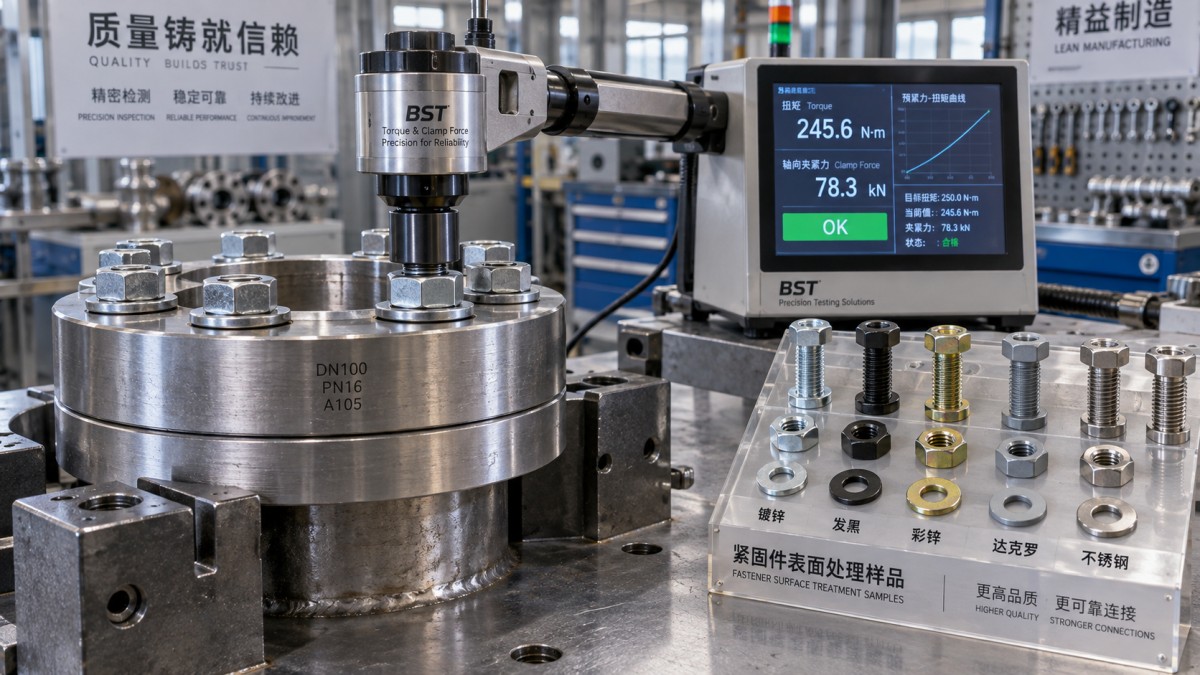
The torque applied during tightening is consumed by thread friction, bearing-face friction, and only partly converted into bolt elongation and clamp force. Lubrication, coating type, surface roughness, washer condition, assembly speed, reuse, and tool calibration all change this relationship. The same nominal torque can therefore create substantially different preload in two assemblies that look identical on a drawing.
ISO 16047 provides a test method for torque/clamp-force testing of threaded fasteners. It is particularly useful when an assembly specification relies on tightening torque and when coatings or lubricants are controlled. The resulting torque–clamp relationship should be treated as assembly-specific: bolt, nut, washer, coating system, lubricant, and tightening method need to reflect the actual supplied combination.
For joints exposed to vibration or dynamic loading, preload retention is often the central performance issue. A locking feature should not be selected only because it is described as vibration resistant. Prevailing-torque nuts, for example, may be evaluated using ISO 2320, but prevailing torque is not equivalent to verified clamp-load retention in every joint configuration. The joint stiffness, transverse movement, thermal cycling, surface settlement, and tightening procedure still determine service performance.
Structural steel connections may require a different framework. ISO 14399 covers high-strength structural bolting assemblies for preloading. These assemblies are intended to function as defined systems, and mixing bolts, nuts, and washers from unrelated sources can undermine the performance assumptions behind the assembly designation. Where a structural specification calls for a system-standard assembly, purchasing components independently on nominal grade alone is not an equivalent substitution.
Corrosion standards must be connected to the real exposure mechanism
Corrosion resistance is frequently specified by finish name—zinc plated, hot-dip galvanized, zinc flake, stainless steel—without defining the required environment or coating performance. ISO requirements help make the specification more precise, but only if the correct standard is connected to the correct service condition.
ISO 4042 addresses electroplated coatings on threaded steel fasteners. ISO 10683 addresses non-electrolytically applied zinc flake coating systems. ISO 1461 is commonly relevant to hot-dip galvanized coatings on fabricated iron and steel articles, subject to the scope and product details of the relevant specification. These are not interchangeable coating descriptions. They have different thickness ranges, friction characteristics, hydrogen-embrittlement implications, appearance, repair practices, and thread-fit consequences.
ISO 9223 provides a framework for classifying atmospheric corrosivity. It can support an exposure-based conversation, but it does not replace a detailed assessment of chemical splash, chloride deposition, wet-dry cycling, galvanic coupling, trapped moisture, elevated temperature, or inaccessible maintenance locations. A fastener that performs acceptably in an outdoor atmospheric environment may be inappropriate near process chemicals, coastal splash zones, or insulated joints where moisture is retained.
Salt spray testing under ISO 9227 is often requested in procurement documents. It is a standardized corrosion-test method, not a universal predictor of field life. Neutral salt spray results should not be converted directly into years of service without evidence connecting the test condition to the actual environment. The test can be useful for checking coating consistency against a defined requirement, but it cannot by itself validate every corrosion mechanism in service.
High-strength electroplated fasteners require particular review because hydrogen introduced during cleaning or plating can contribute to delayed brittle failure. The risk depends on strength level, material condition, process controls, and post-treatment. A generic instruction to “plate to ISO” is inadequate where high-strength bolts are involved; the specification should identify the permitted coating process, baking or de-embrittlement requirements where applicable, and documentation expected from the manufacturer.
Traceability and inspection are part of selection, not administrative extras
A technically correct specification has limited value if conformance cannot be verified. ISO 3269 provides general principles for acceptance inspection of fasteners. Its relevance is practical: inspection planning should identify what is checked, from which lot, by which method, and against which acceptance criteria. Sampling is not a substitute for process control, but it creates a structured basis for receiving verification.
Critical fasteners should be traceable to a manufacturing lot and supported by documentation that corresponds to the supplied product, not merely to a similar catalog item. Depending on the application and contractual requirement, records may include chemical composition, mechanical test results, coating certification, dimensional inspection, torque–clamp data, and heat or lot identification. A certificate without a clear link to the delivered lot has weak evidential value.
Marking requirements are also functional. Head markings can identify property class and manufacturer or identifying mark, subject to the applicable product standard and size limitations. Missing, inconsistent, or illegible marks do not automatically prove a fastener is defective, but they should trigger a review of specification requirements, source control, and documentation.
Surface condition deserves the same attention as test certificates. ISO 6157 series addresses surface discontinuities in fasteners. Laps, seams, cracks, folds, and forging defects can reduce fatigue performance or create corrosion-initiation sites. This becomes especially relevant in highly stressed bolts, cyclic equipment, pressure-containing systems, and joints where failure cannot be tolerated.
Common selection errors arise from treating ISO as a single label
The most persistent error is assuming that “ISO compliant” is a complete specification. It is not. A fastener may conform to a dimensional ISO standard but have no stated property class. It may meet a mechanical-property standard but be paired with a coating that changes thread fit or tightening behavior. It may pass a corrosion test but be incompatible with the actual chemical exposure. It may be supplied with a material certificate while the joint still lacks a validated tightening method.
Another error is assuming nominal equivalence across standards and regional systems. Dimensional similarity does not prove equal property requirements, marking rules, test methods, or assembly behavior. Cross-referencing standards is acceptable only when the exact edition, scope, exclusions, material condition, and project acceptance criteria have been reviewed.
A more reliable specification describes the fastening function in a connected way: product form and dimensions; thread and tolerance; material and property class; nut and washer compatibility; coating system; required preload or tightening method; environmental constraints; test requirements; lot traceability; and acceptance documentation. Not every joint needs this degree of detail, but criticality should determine the depth of control.
ISO requirements do not select the fastener automatically. They establish the boundaries within which a fastening system can be evaluated consistently. The final engineering decision remains joint-specific: the selected components must achieve the intended clamp force, resist the expected loads and environment, remain installable with available tools and procedures, and retain evidence of conformity through the supply chain. That is the difference between ordering standardized hardware and specifying a dependable industrial fastening system.
Recommended News