
Search News
Industry Portal
Hot Articles
How to Evaluate a High Strength Bolts Factory for Traceability and Load Standards
Time
Click Count
How to Evaluate a High Strength Bolts Factory for Traceability and Load Standards
Choosing a high strength bolts factory is rarely a purchasing exercise alone. In structural work, rail systems, heavy equipment, energy projects, and critical industrial assemblies, bolts are load paths. If the factory cannot prove what steel went in, how heat treatment was controlled, what tests were run, and whether each lot can be traced after shipment, then the discussion about unit price is premature.
That is why technical evaluation usually starts with a simple question: if a bolt fails in service or gets challenged during inspection, can the manufacturer reconstruct its full production history quickly and credibly? A reliable answer requires more than a neat certificate folder. It requires process discipline on the shop floor, record discipline in quality control, and standard discipline in testing.
In the wider hardware world observed by platforms such as SHSS, the same logic applies across very different products. A biometric access device is judged by algorithm reliability, a BLDC fastening tool by torque consistency, and a smart lighting system by protocol stability. High-strength fasteners sit in that same family of critical hardware, except their failures are brutally physical. They do not glitch. They crack, loosen, shear, or stretch beyond design intent.
Start with the standards the factory actually manufactures to
A common mistake is to ask whether a supplier makes “high-strength bolts” without defining the standard system. That phrase can cover very different product and testing requirements depending on the market. A factory may be familiar with ISO property classes, ASTM structural bolting requirements, DIN-based dimensions, or project-specific specifications. These are not interchangeable just because the nominal size looks similar.
So the first checkpoint is not the catalog. It is the factory’s control plan for the exact standard you need. Ask what mechanical properties are verified for that standard, what dimensional tolerances are checked, whether the bolts are supplied plain, black, zinc coated, hot-dip galvanized, or with another finish, and whether the finish changes the testing or acceptance route. On some projects, confusion starts right here: the plant quotes one grade, tests to another, and marks cartons in a third naming convention.
A technically mature plant should be able to explain, without hesitation, which standards govern raw material selection, thread dimensions, heat treatment, mechanical testing, coating thickness if applicable, and lot release. If the answer stays vague, expect trouble later.
Traceability is not paperwork; it is a chain that should survive an audit
When people hear traceability, they often think of a heat number printed on a material certificate. That is only the first link. Real traceability means the factory can connect incoming steel, forging or forming batch, heat treatment load, thread rolling stage, surface treatment batch, laboratory results, packaging lot, and shipment records.
If a supplier says every carton is traceable, ask how. Is the lot code tied to ERP records? Is it manually written on tags? Are mixed lots ever repacked? How are rework parts handled? In many audits, the weak point is not production but relabeling during final packing. Once labels are swapped, or partial lots are merged without strict controls, traceability becomes more ceremonial than useful.
Good factories usually have a practical answer to this: each manufacturing lot remains segregated physically and digitally; test samples are retained by lot; and the release report references the same lot identity that appears on packaging. If you want to go one level deeper, ask for a backward trace exercise. Pick one shipped lot number and ask the team to retrieve the raw material record, furnace record, test report, and dispatch date. The speed and confidence of that response tells you more than a polished presentation.
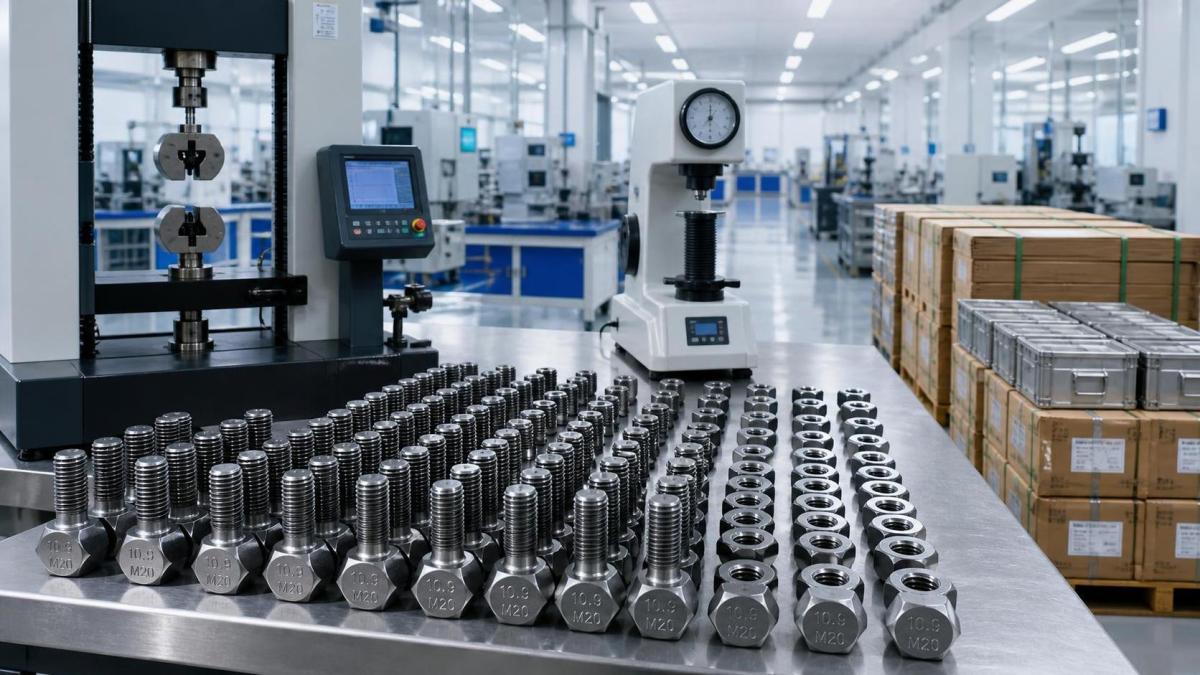
Raw material control is where load reliability begins
A bolt’s mechanical performance does not start at tensile testing. It starts with steel chemistry, cleanliness, and consistency. Technical evaluators should ask what raw material forms the factory buys, how incoming material is identified, whether there is supplier qualification, and whether positive material identification is used when the project requires it.
Material certificates alone are not enough if there is no internal receiving verification. At minimum, the plant should have a defined method for checking heat number, size, surface condition, and certificate consistency. For more critical applications, chemical verification or outsourced confirmation may be appropriate, depending on project rules. This matters because downstream process control cannot compensate for the wrong steel grade entering production.
It is also worth checking whether the factory understands the material risks associated with coatings and service environment. Hydrogen-related concerns, embrittlement risks in certain strength ranges, and corrosion interactions are not details to leave for after the purchase order. A plant that handles only commodity fasteners may not manage these issues with the same caution as one focused on structural or safety-critical hardware.
Heat treatment separates serious factories from traders with test reports
If there is one area where evaluation should become hands-on, it is heat treatment. High-strength bolts live or die by controlled hardening and tempering conditions. Poor furnace uniformity, overloaded baskets, weak quench control, or incomplete recordkeeping can create lot-to-lot variation that does not always show up in one favorable test sample.
Ask whether heat treatment is in-house or subcontracted. Neither model is automatically bad, but both must be controlled. If outsourced, who approves the subcontractor, who reviews furnace records, and how is lot identity protected during transfer? If in-house, look for calibration discipline, furnace maintenance records, load mapping where required, and clear separation of treated and untreated product.
An experienced team should also be able to explain process windows in practical terms: not proprietary recipes, but how they prevent decarburization, distortion, under-hardening, or mixed hardness within a lot. When the answer is only “we test after treatment,” that is not enough. End-of-line testing is important, but process capability matters just as much.
Load standards are about test method discipline, not just pass/fail results
Factories often provide tensile values, hardness values, or proof load statements. The real question is whether those values were obtained using the correct standard method for the product and lot. Sample preparation, thread engagement, grip length, wedge testing where applicable, and the frequency of inspection all influence whether the data has meaning.
For technical review, ask to see the laboratory workflow rather than only the final certificate. Is the test equipment calibrated? Are operators trained to the relevant method? Is there a retained sample policy? How are nonconforming results investigated? In some factories, the lab is competent but overloaded, so testing becomes selective during peak production. That may not be visible from a single report.
Another point that gets overlooked is assembly performance. In many field applications, bolts do not fail in a pure tensile coupon scenario. They fail because preload control, nut compatibility, thread fit, lubrication condition, and coating friction were not managed as a system. If the project requires assembly testing, rotational capacity checks, or preload-related verification, make sure the factory has experience with those requirements instead of assuming generic mechanical tests are sufficient.
Look beyond the bolt to the manufacturing route
A credible high strength bolts factory should be able to walk you through the actual route: wire or bar receipt, heading or forging, trimming, thread rolling, heat treatment, surface finishing, sorting, testing, packing. That sounds basic, but it reveals where variation enters.
Thread rolling before or after heat treatment, for example, is not a trivial discussion. The route depends on product type and specification, and each route carries different implications for dimensional consistency, surface condition, and fatigue behavior. The evaluator does not need to dictate the route, but should confirm that the plant’s chosen process matches the product standard and intended service conditions.
The same goes for finishing. Hot-dip galvanizing, mechanical plating, zinc flake systems, and plain oil finish are not mere cosmetic options. They influence fit, corrosion resistance, and sometimes re-tapping or nut matching strategy. A factory that treats coating as a late-stage add-on may create compatibility problems that only appear at installation.
Certification matters, but it should match the risk profile
Quality management certification can be useful, but it does not prove that every lot meets load standards. Treat certifications as part of the screening process, not the final decision. What matters more is whether the plant can connect its management system to actual fastener controls: document revision, gauge calibration, nonconformance handling, internal audit findings, and supplier corrective actions.
For some projects, third-party witnessing, independent testing, or project-specific approvals may be necessary. If that applies, ask early whether the manufacturer has a routine way of supporting witness inspection, preserving samples, and producing full documentation packs. Factories that are comfortable with this are usually better prepared for technically demanding customers.
What usually shows up during a real factory assessment
In practice, the biggest red flags are not always dramatic. They are small inconsistencies that suggest the system is less controlled than it appears. A few examples:
- Material certificates exist, but the heat number on the shop floor cannot be matched to current production.
- The lab has modern equipment, but calibration labels are overdue or records are incomplete.
- Heat treatment is outsourced, yet the bolt factory cannot produce the corresponding furnace batch record promptly.
- Packaging labels show lot numbers, but operators admit mixed partial quantities are sometimes combined for shipment.
- The sales team knows the grade names, while the production team speaks in internal codes that do not clearly map to the customer specification.
None of these automatically disqualifies a supplier. But each one deserves follow-up, because bolt failures often begin as documentation gaps or control shortcuts long before they appear as mechanical defects.
A practical way to compare factories
When comparing candidates, resist the urge to reduce everything to a scorecard too early. Two factories may both pass your checklist, yet one understands structural risk and the other simply knows how to answer audits. A useful approach is to compare them on three layers: evidence of traceability, evidence of process control, and evidence of standard-specific competence.
That last layer is where experienced evaluators usually make the call. A supplier may have clean systems but limited familiarity with the exact load standard, coating combination, or assembly requirement your project needs. Another may have strong product knowledge but weak documentation discipline. The right choice depends on the consequence of failure and how much development time the project allows.
In sectors followed closely by SHSS, from fastening systems to security infrastructure, the strongest manufacturers tend to share one trait: they can explain their controls in engineering language, not just commercial language. That is what you want to hear from a high strength bolts factory when structural responsibility is on the line.
Before approval, ask for one more thing: a sample document trail for a recent production lot and a clear statement of what will be supplied with each shipment. If the factory can define that package up front and maintain lot integrity through production, testing, and dispatch, you are no longer buying bolts on trust alone. You are buying a controlled manufacturing outcome.
Recommended News