
Search News
Industry Portal
Hot Articles
A product specification checklist for ordering high-strength bolts
Time
Click Count
Ordering high-strength bolts is not a matter of matching a diameter and length from a catalogue. In a bridge connection, a vibrating production line, a wind-exposed steel frame, or a heavy equipment assembly, the bolt is part of a load path. A small error in strength class, thread fit, coating thickness, or test documentation can become an installation delay—or a more serious joint-performance problem—once material reaches site.
For procurement teams, the useful question is not simply “What bolt do we need?” It is “What must be written, verified, and retained before this order is released?” A disciplined product specification checklist turns scattered engineering notes into a purchasing document a supplier can quote, manufacture, inspect, and ship against. It also prevents a common sourcing failure: receiving a bolt that looks correct but is not suitable for the intended preload, environment, mating nut, or governing standard.
Start with the joint, not the bolt catalogue
The same M20 bolt can mean very different things in different applications. A general machinery joint may require a standard property-class bolt and controlled tightening. A structural steel connection may require a complete bolting assembly with specific installation requirements. A high-temperature flange, by contrast, may call for bolting materials selected for elevated-temperature service rather than a conventional metric property class.
Before naming a grade, collect the conditions that drive the choice: whether the joint is bearing-type or slip-critical, whether it sees cyclic vibration, whether preload is essential, whether access restricts tightening tools, and whether the bolted connection will be exposed to moisture, chlorides, chemicals, heat, or dissimilar metals. Procurement should ask for this context early. It is much easier to clarify an ambiguous design note before a purchase order than to resolve a dispute after production has begun.
For organizations working across construction, industrial equipment, smart-city infrastructure, and security hardware, this distinction matters. The fastener that closes an equipment enclosure is not specified in the same way as the fastener carrying structural load in a support frame. Treating all “high-strength bolts” as one buying category usually creates unnecessary risk.
The core product specification checklist
A practical checklist should contain enough detail to eliminate assumptions, but not so much copied language that contradictions go unnoticed. The following fields are the minimum starting point for most technical purchase orders.
The checklist should also identify the revision level of drawings and specifications. A surprisingly common problem is a purchase order referencing an old drawing while the project team is using a later revision with changed thread engagement, coating, or washer requirements.
Strength grade is only one line on the order
Terms such as property class 8.8, 10.9, and 12.9 are widely used for metric fasteners, while inch-series applications may refer to ASTM grades or other specified systems. Those designations should never be treated as generic labels that can be casually substituted. They are connected to defined mechanical requirements, test methods, dimensions, marking rules, and sometimes restrictions on coating or use conditions.
If the design references ISO 898-1 for carbon steel and alloy steel bolts, screws, and studs, state that reference clearly and confirm which product category is covered. If the application is structural steelwork, the project may instead identify an applicable structural bolting standard or assembly requirement. In North American projects, ASTM F3125 is often specified for structural bolt assemblies, while ASTM A193/A193M is commonly encountered in certain high-temperature or pressure-service bolting applications. These examples are not alternatives by default; selection depends on the design code, service conditions, and contract documents.
One purchasing rule is worth keeping: do not write “equivalent grade acceptable” unless engineering has defined what equivalence means. Similar tensile-strength figures do not automatically establish equivalent ductility, hardness limits, thread form, head dimensions, coating compatibility, or certification requirements.
Dimensions need more discipline than “M16 × 80”
A size callout such as M16 × 80 is incomplete for many critical orders. It may not tell the supplier the pitch, whether the bolt is fully threaded or partially threaded, which head pattern is required, which dimensional standard applies, or what tolerance is acceptable. For a replacement order, it may also fail to identify whether the existing joint uses a special flange face, reduced shank, shoulder, or nonstandard thread length.
Specify thread designation in full when it matters. For metric products, identify the nominal diameter and pitch; for inch products, identify diameter, threads per inch, and thread series where relevant. Include the required thread tolerance or fit when the drawing requires it. Standards such as ISO 965 cover ISO general-purpose metric screw threads, while ASME thread standards are relevant in many inch-series designs. The buyer does not need to become a metrology specialist, but the purchase order should make it impossible to supply a coarse-thread item where a fine-thread design is required.
Also check usable thread engagement against the assembled stack-up. A bolt that is nominally long enough may leave threads inside a shear plane, bottom out in a tapped hole, or offer too little engagement after washers and coatings are considered. These are engineering checks, but procurement can catch obvious gaps by requesting the joint stack dimension and confirming the intended bolt grip.
Coating decisions can change fastening behavior
Corrosion resistance is the obvious reason to specify a finish, but it is not the only reason. Coatings alter friction. Friction affects the relationship between installation torque and bolt tension. In a preloaded joint, that relationship is not a minor detail; it is central to achieving the intended clamp load.
This is why a high-strength bolt should not automatically receive an electroplated coating simply because it is the familiar low-cost option. Certain high-strength fasteners may require careful control of processes associated with hydrogen embrittlement. The appropriate coating system, baking requirements where applicable, and verification method need to be determined by the governing specification and the fastener manufacturer’s qualified process—not guessed from appearance.
For hot-dip galvanized assemblies, thread allowance and nut compatibility need special attention. Thick metallic coatings can affect fit, and structural bolting systems may have specific requirements for supplied nuts, washers, lubrication, and installation. If the joint is exposed to marine conditions, de-icing salts, industrial chemicals, or outdoor condensation, state the exposure rather than merely requesting “anti-rust treatment.” It gives engineering and the supplier a better basis for selecting a finish.
Ask for an assembly when the assembly is what matters
A high-strength bolted joint is often a system of bolt, nut, washer, surface condition, and tightening method. Buying these items separately can be reasonable for controlled internal assembly, but it creates room for mixing incompatible components at site. This is especially risky when the installation method relies on defined tensioning behavior.
Where the project requires a bolting assembly, the order should state whether bolts, nuts, and washers must be supplied, packed, and traceable as matched sets. Include any required locking feature, such as prevailing-torque nuts or mechanical locking elements, only where it has been selected for the application. Locking hardware is not a substitute for correct preload, proper joint design, or a verified tightening procedure.
Installation tools deserve a brief check as well. A field team using impact tools, hydraulic tensioners, torque wrenches, or tension-control equipment may need specific head geometry, access clearance, or lubrication assumptions. SHSS’s coverage of industrial fastening tools and high-strength hardware points to a practical truth: tool capability and fastener specification must agree. A torque value copied from an unrelated bolt-and-coating combination is not a reliable installation instruction.
Traceability and testing should be written into the purchase order
For low-risk, noncritical applications, basic supplier documentation may be sufficient. For safety-related, structural, infrastructure, pressure-service, or heavily loaded equipment, buyers commonly need stronger controls. The exact requirement should come from the project specification, but the order should be explicit about what evidence must accompany shipment.
Useful requirements may include manufacturer identification, lot or heat traceability, product markings where required, material test certificates, dimensional inspection records, mechanical-property test results, hardness results, coating thickness or adhesion checks, and records of any special testing required by the governing standard. If independent inspection is required, define the inspection point: raw material, in-process production, final lot, pre-shipment, or loading. “Third-party inspection required” is too vague to manage efficiently.
Be careful with the phrase “certificate of conformity.” It may confirm that a supplier declares compliance, but it does not necessarily provide the same technical detail as a test certificate linked to a production lot. If lot-level evidence is required for project acceptance, say so directly.
Three purchasing mistakes that repeatedly cause trouble
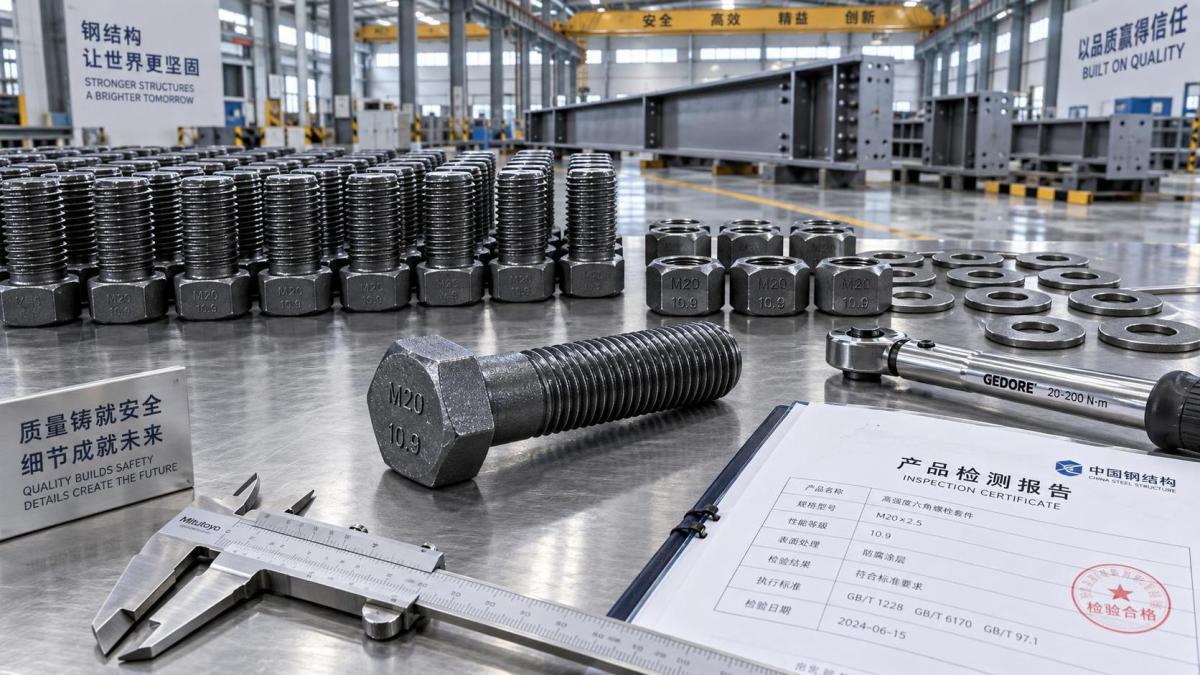
Buying by appearance. A black oxide finish, a large hex head, or a stamped number does not by itself prove conformance. Markings must be assessed against the relevant standard and documentation, not visual impression alone.
Separating technical approval from commercial release. The approved sample, quotation, drawing, and final purchase order should carry the same specification. Changes introduced during negotiation—such as a different finish, alternate factory, or split shipment—can quietly alter the technical basis of supply.
Leaving packaging and identification to chance. Mixed lots, missing labels, and repacked fasteners make traceability difficult even when the original product was compliant. Require labels showing item description, size, grade or material designation, quantity, lot reference, and purchase-order reference where appropriate.
A better release process for critical fasteners
Before issuing the order, have engineering confirm the performance and standard basis, quality confirm the inspection and documentation plan, and site or production teams confirm installation realities. Then send the supplier one controlled specification package rather than a trail of emails. Ask the supplier to acknowledge every critical attribute, especially material grade, thread, finish, mating components, certificates, marking, and delivery condition.
The strongest product specification checklist is not the longest one. It is the one that makes the functional requirements visible and leaves no room for silent substitution. When the bolt is carrying load, resisting vibration, or protecting the integrity of an industrial asset, clarity at purchase order stage is far less expensive than discovering ambiguity during installation.
Recommended News