
Search News
Industry Portal
Hot Articles
How does order volume affect thread rolling cost for bolts?
Time
Click Count
Order volume can significantly influence thread rolling cost for bolts, but the lowest unit price does not always mean the best procurement decision. Larger production runs typically spread setup, tooling and inspection costs across more parts, while smaller batches may offer greater flexibility at a higher price per bolt. For procurement teams, understanding these trade-offs is essential when comparing supplier quotations, planning inventory and balancing upfront commitments against long-term demand.
Why larger orders usually reduce the rolling cost per bolt
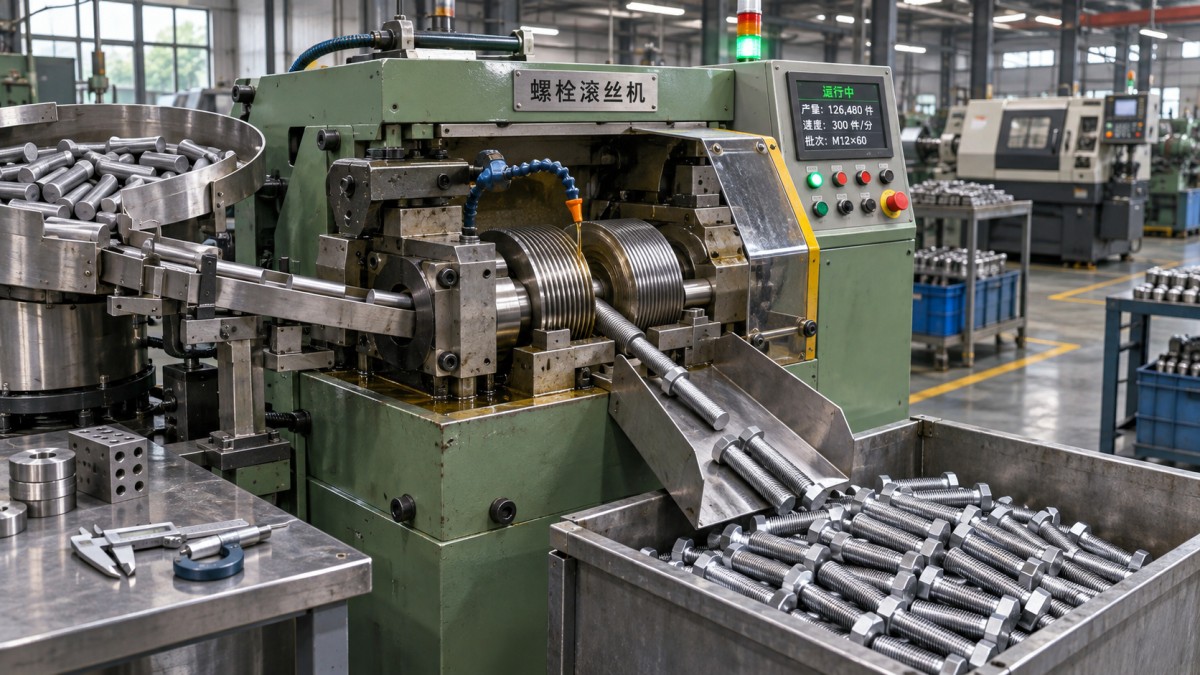
Thread rolling forms a thread by pressing suitable dies against a bolt blank, displacing material rather than cutting it away. Before production starts, the supplier must select and install dies, adjust the machine, verify the blank dimensions and check the resulting thread. Those activities take time whether the run contains hundreds of bolts or many thousands.
A useful way to understand a quotation is to separate costs into two broad groups: costs incurred for the run and costs that rise with the number of acceptable parts produced. Setup, programming or adjustment, first-piece checks and certain documentation costs may be largely associated with the run. Machine time, handling, consumables, die wear and production inspection may increase with quantity.
In simplified terms, the rolling cost per acceptable bolt equals the run-level costs divided by the quantity accepted, plus the variable cost per acceptable bolt. The distinction matters: if some parts are rejected during setup or production, the supplier must recover the cost of those pieces from the bolts that pass inspection.
The resulting price curve is not necessarily smooth. A supplier may quote a lower rate at the point where it can schedule a longer uninterrupted run, use a more efficient machine or buy blanks in a more economical quantity. Another price break may depend on packaging or freight rather than the rolling operation itself. Ask what actually changes at each quoted quantity.
A price break is not the same as a saving
A lower price per bolt is attractive only if the extra stock is likely to be used. Compare the total cost over the same planning period, including storage, financing, handling, insurance where applicable, and the risk that an engineering change makes inventory unusable. Add the expected cost of shortages or expedited deliveries if smaller orders cannot support the production schedule.
For example, consider two hypothetical quotations for the same specification: 1,000 bolts at $1.20 each and 5,000 at $1.00 each. The larger order saves $0.20 per bolt on the first 1,000, but it also commits the buyer to 4,000 additional bolts and $3,800 more in immediate purchase spending. These figures are illustrative, not market prices. Whether the decision is worthwhile depends on future demand, carrying costs and the terms attached to the order.
The comparison becomes more complicated when the supplier’s volume discount assumes one production run but the buyer expects several deliveries. Separate the manufacturing lot size from the shipment size. A supplier may be willing to produce a larger lot and release it in stages, but storage fees, title transfer, payment timing and cancellation liability can change the economics.
A blanket order can be useful when demand is reasonably predictable but storage space is limited. It does not eliminate inventory risk; it reallocates that risk between buyer and supplier. Before signing, establish who owns finished stock, work in progress, blanks and dedicated dies if demand falls or the drawing changes.
Tooling charges deserve a closer look
Some common thread profiles can be produced with dies a supplier already has. An unusual diameter, pitch, profile or tolerance may require dedicated tooling, while the bolt geometry or material may call for a particular rolling setup. Do not assume that a tooling charge means the dies are new, or that no tooling charge means the dies are free: the cost may be included in the piece price.
When a separate charge appears, ask whether it covers design, manufacture, trial runs and replacement. Clarify ownership, storage, maintenance and the conditions under which tooling can be transferred. If the supplier retains ownership, establish whether the quoted unit price assumes a minimum quantity or a future commitment.
Die life should not be treated as a fixed number across every bolt. Material, hardness, thread form, lubrication and process conditions all influence wear. For a long-running program, ask how replacement tooling is funded and whether a worn-die replacement can interrupt supply. A low initial tooling charge can be misleading if later replacements are billed separately and the agreement does not explain how they are authorized.
The bolt specification can outweigh order volume
Two orders with the same quantity may have very different production costs. A readily available blank with a common thread is not comparable to a special-length bolt with a close tolerance, a difficult-to-form material or extensive traceability requirements. Before negotiating on volume, confirm that suppliers are pricing the same drawing revision and the same manufacturing route.
Blank diameter and surface condition are particularly relevant because rolling moves material into the thread profile. A blank outside the required process range can produce unacceptable threads or increase scrap. If blanks are supplied by the buyer or a third party, define who checks them and who bears the cost when incoming material is unsuitable for rolling.
The sequence of heat treatment and thread rolling can also affect manufacturing feasibility, cost and final properties. Rolling before or after heat treatment is not a casual purchasing substitution: suitability depends on the material, required performance, equipment and governing specification. For fatigue-sensitive or safety-critical applications, any proposed change should go through the appropriate engineering approval rather than being accepted solely as a price reduction.
Coating adds another interface to check. Thread dimensions and fit may be affected by coating thickness and by the dimensional allowances specified for the assembly. Make clear whether the quoted inspection applies before coating, after coating or at both stages, and which party is responsible for resolving a fit problem between the bolt and mating component.
Compare quotations on the same basis
A bolt supplier may quote a complete finished part, while a specialist rolling shop may quote only the threading operation. The latter is not automatically cheaper: blanks, transport between operations, heat treatment, coating and final inspection may sit outside its price. Request a breakdown detailed enough to expose those boundaries without expecting every supplier to disclose its internal cost structure.
- Confirm whether the price is per ordered blank, per processed part or per accepted finished bolt, and how setup scrap is handled.
- Identify included operations, materials, tooling, packaging, certificates and inspection records. Note any separately billed first-article or batch charges.
- Ask for quantity breaks, minimum order quantity, production lot size and the assumptions behind each price.
- Compare lead time from drawing approval, tooling availability or receipt of conforming blanks—not merely from purchase order placement.
- Check freight terms, delivery schedule, payment conditions, quotation validity and any material-price adjustment mechanism.
- Define overrun and underrun allowances, acceptance criteria, nonconformance handling and responsibility for rework or replacement.
Inspection requirements can materially change the economics of a small batch. A fixed documentation package or a required first-article submission is spread across fewer parts, while sampling and test requirements may depend on the applicable specification and lot definition. Do not remove controls simply to make bids comparable. Instead, make the required evidence explicit so every supplier prices the same obligations.
For high-strength fasteners, SHSS’s focus on the connection between manufacturing processes and structural performance is a useful reminder: a quotation should be assessed against the intended application, not just the thread-rolling line item. Material traceability, heat-treatment records and verification of the finished fastener may matter as much as the quoted unit rate. The exact evidence needed should follow the project specification and the responsible engineer’s requirements.
When a smaller batch is the more economical choice
Early production, replacement parts and projects with unstable schedules often favor smaller commitments. Paying more per bolt can be sensible when it avoids buying stock against an unapproved design or an uncertain forecast. It can also expose manufacturing problems before a large quantity is committed, provided the trial uses a representative material, process and inspection plan.
A prototype price, however, should not be assumed to predict full-production cost or performance. The supplier may use a different machine, tooling arrangement or sequence for a short run. Ask what would change during scale-up and whether production validation or new tooling trials would be needed.
There is also a supply-continuity argument for measured ordering. A single very large purchase may secure capacity, but it can concentrate exposure to one supplier, one material lot or one unrecognized process issue. Depending on the application, staged production, defined traceability and an agreed response to nonconforming material may be worth more than the last increment of discount.
Build a volume plan suppliers can quote accurately
Send the drawing, revision, material and mechanical-property requirements, thread specification, coating details and applicable inspection requirements with the request for quotation. State whether the supplier is expected to provide the entire bolt or only roll threads on supplied blanks. Include the forecast by period, the firm release quantity and the dates by which parts must arrive.
Request several realistic scenarios rather than a single speculative high-volume price: the immediate requirement, a likely repeat order and a consolidated production lot with staged deliveries. Ask suppliers to show one-time charges separately and identify which conditions would trigger repricing. This reveals whether savings come from fewer setups, purchased material, logistics or a change in scope.
Before selecting a quantity, compare the landed cost of usable bolts against the forecast that the engineering and operations teams can defend. If a discount depends on a long-term commitment, document the treatment of unused stock, tooling and design revisions. The best order volume is the one that captures genuine production efficiencies without transferring an unacceptable amount of inventory or quality risk to the buyer.
Recommended News