
Search News
Industry Portal
Hot Articles
When should you use high-strength stainless steel industrial bolts and nuts?
Time
Click Count
High-strength stainless steel industrial bolts and nuts are worth considering when a joint must withstand substantial mechanical loads while resisting corrosion. For technical evaluators, however, strength and stainless composition alone do not guarantee suitability. Material grade, fastener property class, operating temperature, fatigue exposure, and the risk of galling or stress corrosion cracking all influence performance. This guide examines when these fasteners offer a practical advantage and what to verify before specifying them for demanding industrial applications.
The decision starts with the joint, not the alloy
A high-strength stainless fastener earns its place when corrosion and mechanical demand occur together—and when failure, inspection, or replacement would be consequential. Typical candidates include exposed equipment supports, marine-adjacent installations, process equipment, and assemblies that undergo frequent washdown. In each case, the environment can attack the fastener while the joint is expected to maintain clamp load.
That does not mean stainless is automatically the right choice for every outdoor connection. A protected indoor machine may need strength but little corrosion resistance. A lightly loaded enclosure may need corrosion resistance but not a high-strength fastener. For a large structural connection, a code-compliant coated carbon steel assembly may be more appropriate if its strength, installation system, and maintenance plan satisfy the project requirements.
The useful question is: What must this joint resist, for how long, and how will its condition be checked? The answer should cover peak and cyclic loads, joint separation, service temperature, chemicals, moisture, accessibility, and the consequences of loosening or fracture.
What “high strength” means for stainless fasteners
Stainless steel describes a family of corrosion-resistant alloys, not a single strength level. A fastener designation needs to identify both its material group and its mechanical property class. A2-70 and A4-80, for example, are not interchangeable descriptions: the letters and numbers convey different information about material group and specified mechanical properties.
For metric austenitic stainless bolts, ISO 3506-1 covers mechanical properties for specified grades and property classes; ISO 3506-2 addresses corresponding nuts. The applicable edition, product dimensions, diameter limits, and test conditions still need checking. A property class is not, by itself, a complete design allowable for the installed joint.
Nor should an A4-80 bolt be treated as a direct substitute for a carbon steel bolt of property class 8.8 simply because both designations contain an “8.” They are governed by different material and property systems. Compare the applicable tensile and proof or yield requirements, the relevant design standard, temperature effects, and the assembly’s actual loading before proposing a substitution.
Higher strength can be useful where diameter is constrained or where the design requires a higher preload. It may also introduce trade-offs in ductility, availability, cost, and corrosion performance, depending on alloy and manufacturing route. A stronger bolt does not repair an undersized plate, insufficient edge distance, poor load distribution, or an unsuitable joint geometry.
Where the combination makes practical sense
Exposed equipment with sustained clamp-load requirements
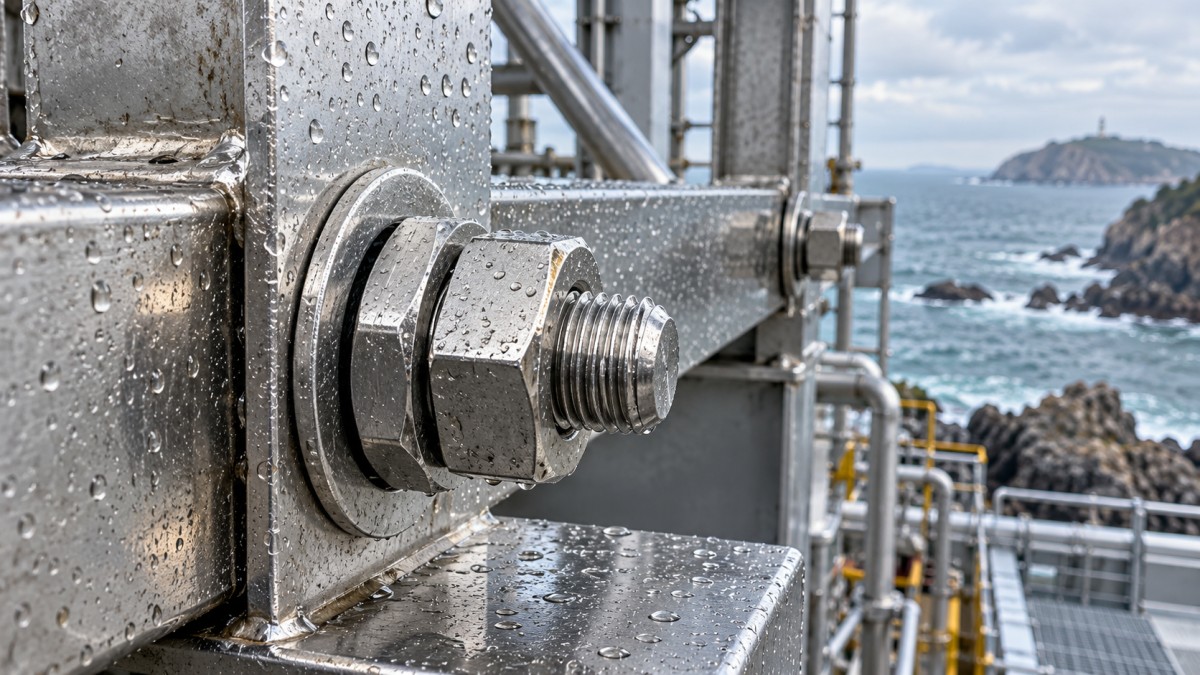
Consider an equipment frame near a coastline: wind-driven moisture and salt deposits may reach the connection, while operating loads repeatedly act on the joint. A corrosion-resistant, higher-strength assembly may reduce the need for protective coating maintenance while providing the required mechanical capacity. The decision still depends on actual chloride exposure, whether deposits are washed away or trapped, and the selected alloy’s resistance to the local conditions.
A sheltered crevice can be more troublesome than an openly exposed surface because moisture and contaminants remain trapped. Inspect the contact area beneath washers and around threads, not just the visible bolt head.
Process and washdown environments
In food, pharmaceutical, water-treatment, or chemical facilities, fasteners may encounter cleaning agents as well as the process fluid. A material compatible with the product is not necessarily compatible with a concentrated cleaning chemical, elevated temperature, or prolonged wet contact.
The joint design matters as much as the fastener grade. Blind pockets, overlapping plates, and damaged surfaces can retain residues. Where hygiene is a requirement, evaluate cleanability, lubricant acceptability, and any applicable equipment-specific rules separately from corrosion resistance.
Difficult-to-access assemblies
A fastener with a higher purchase price can be justified when replacement requires scaffolding, shutdowns, or restricted-space work. But the comparison should include the entire assembly: compatible nuts and washers, installation controls, inspection access, and the risk that corrosion may still occur at interfaces. Stainless is not a substitute for a maintenance strategy.
Match corrosion resistance to the actual exposure
A2 and A4 are common austenitic stainless fastener groups. A4 contains molybdenum and generally offers better resistance than A2 to chloride-related pitting, but “A4” is not a guarantee against seawater damage or every chemical environment. Concentration, temperature, oxygen availability, and the presence of crevices can change the outcome.
For more severe service, duplex or other corrosion-resistant alloys may be candidates, provided that suitable fasteners are available and their mechanical properties and corrosion performance are verified. Avoid choosing solely from a generic material chart: a fastener produced to a particular standard may not have the same properties as plate or bar stock carrying a similar alloy name.
Also consider stress corrosion cracking, especially where tensile stress, a susceptible material, and a damaging environment coincide. Warm chloride-containing service deserves particular scrutiny for susceptible austenitic grades. The required assessment depends on the alloy and operating conditions; a tensile-strength certificate cannot establish resistance to this failure mechanism.
Dissimilar-metal contact is another practical concern. Stainless fasteners connected to a less noble metal can contribute to galvanic corrosion when an electrolyte is present. The relative exposed areas and drainage conditions matter. Isolation washers, sleeves, coatings, or a revised material pairing may help, but any isolation system must also preserve the joint’s mechanical performance.
Design for fatigue and preload—not just a static tensile load
A bolt that passes a simple tensile check can still fail under repeated loading. Vibration, pressure cycles, thermal expansion, and rotating equipment can cause fluctuations in bolt stress. Threads, bending, misalignment, and damaged surfaces may concentrate that stress.
Adequate preload can keep clamped parts together and limit the changing load experienced by the bolt, but excessive preload risks yielding, thread damage, or crushing softer joint materials. The correct target comes from a joint calculation that considers bolt and member stiffness, external loads, friction, embedment, and expected preload scatter. For safety-critical or fatigue-sensitive joints, use the relevant design method and qualified engineering review rather than a generic torque chart.
Temperature deserves the same attention. Elevated service temperatures can alter strength and contribute to relaxation or creep; low temperatures can introduce different material and design concerns. Confirm properties for the actual service range and duration, including start-up, shutdown, and upset conditions where relevant.
Installation is often the deciding risk
Stainless threads are susceptible to galling: adhesive damage that can cause a nut and bolt to seize during tightening. High contact pressure, damaged threads, contamination, and unsuitable tightening practices can make the problem worse. A seized assembly should not be assumed to have achieved its intended clamp load.
Specify a compatible anti-galling lubricant or surface treatment where the application permits it, keep threads clean, and control tightening speed. Different mating materials or treatments may also be considered, but only after checking strength, corrosion, and galvanic compatibility. In clean-process or high-temperature service, lubricant suitability needs separate approval.
Lubrication changes friction and therefore the relationship between applied torque and bolt tension. Do not apply a dry-torque value to a lubricated assembly without verification. For joints where preload accuracy matters, consider a validated torque procedure or another approved tension-control method. Calibrated tools and representative assembly trials are more useful than relying on the maximum torque printed on a tool.
This is where fastener selection intersects with the industrial tools covered by SHSS: a capable power tool can speed assembly, but its output does not prove that the joint has reached the required preload. Tool setting, friction, access, and operator technique all influence the result.
When another fastening solution may be better
Choose coated carbon or alloy steel for further evaluation when the governing structural system calls for it, when substantially higher strength is needed, or when a controlled coating and inspection program can manage corrosion. Check coating compatibility with thread fit and installation requirements, and assess coating damage during assembly.
A lower-strength stainless fastener may be sufficient for a lightly loaded connection, avoiding unnecessary cost or availability constraints. Conversely, particularly aggressive chemical or high-temperature service may require a specialist alloy rather than a stronger conventional stainless grade. The right comparison is based on qualified joint performance over its intended life, not material price alone.
For structural work, do not assume that a stainless bolt with attractive mechanical properties can be substituted into an existing approved assembly. The applicable design code may specify a complete bolt, nut, washer, and installation system. Any substitution should be reviewed against those requirements and the project design.
What to confirm before releasing a specification
A useful specification gives the supplier enough information to deliver the intended assembly and gives the receiving team a way to verify it. Before placing an order, resolve the following points:
- Joint requirements: design loads, fatigue exposure, required preload, service life, temperature range, and the governing design standard.
- Fastener definition: material group or alloy, property class, product standard and edition, diameter, length, thread pitch, and required markings.
- Mating components: compatible nut and washer specifications, thread engagement, bearing surfaces, and any isolation needed between dissimilar metals.
- Installation conditions: thread cleanliness, approved lubricant or treatment, tightening method, tool calibration, and acceptance checks.
- Evidence and delivery: required inspection documents, material and mechanical test records, traceability, lot identification, and availability for the full assembly—not just the bolt.
Where a project calls for material certificates or independent testing, state the required document type and acceptance criteria before procurement. Confirm that the documents relate to the supplied lot and that the specified tests cover the properties needed for the application. A broad declaration of “stainless steel” leaves too much open to interpretation.
The most defensible choice is a fastener assembly whose strength, corrosion resistance, and installation method have all been checked against the same operating conditions. If any one of those remains uncertain—particularly chloride exposure, cyclic loading, or preload control—resolve it in the design review before treating a higher property class as the answer.
Recommended News