
Search News
Industry Portal
Hot Articles
Where to find product specification resources for high-strength bolts
Time
Click Count
Where to find product specification resources for high-strength bolts
Finding reliable product specification resources for high-strength bolts is essential when evaluating mechanical properties, material grades, and compliance for demanding applications. Yet manufacturer datasheets, standards documents, and supplier catalogs answer different questions. A catalog may confirm availability without proving conformity; a standard may define requirements without telling you whether the delivered batch meets them.
The most useful starting point is the project specification, followed by the applicable official standards. Manufacturer documentation explains the offered product, while traceable inspection and test records support acceptance of the actual shipment. This guide from Global Smart Hardware & Security Systems (SHSS) explains where to find those resources and how to judge their value before approving a fastener.
Start with the application, not a grade comparison chart
“High-strength bolt” is not a complete technical designation. A bolt for a pretensioned steel connection, a machine housing, and a pressure-containing flange may all be described that way, yet their governing specifications and acceptance requirements can differ substantially.
Before searching supplier libraries, check the drawing, connection schedule, equipment specification, or approved bill of materials. Identify the required standard and edition, grade or property class, diameter, thread pitch, length, coating, and matching nut and washer requirements. If those details are missing, the first task is clarification—not finding the closest-looking product.
Also establish whether the connection is designed for pretension, repeated loading, elevated temperature, or a corrosive environment. Tensile strength alone does not establish suitability. A stronger bolt can still be the wrong choice because of toughness, coating restrictions, assembly compatibility, or installation requirements.
Use official standards libraries to establish the requirements
For ASTM specifications, start at ASTM International. For ISO documents, use the ISO standards catalog or an authorized national standards body. Official catalog pages help establish a document’s title, scope, and publication status. Full requirements often require paid access or an organizational subscription.
Search summaries are useful for navigation, but they are not sufficient for acceptance decisions. Important qualifications may sit in tables, supplementary requirements, ordering information, or referenced test methods rather than in the public abstract.
Edition control deserves attention. The newest published standard is not automatically the contractual edition. Older drawings may also cite legacy designations, including ASTM A325 or A490. Resolve their relationship to current specifications through the project approval process rather than silently changing the purchase description.
Avoid treating ASTM grades and ISO property classes as direct substitutes. Similar tensile-strength values do not prove equivalence in dimensions, test requirements, material controls, or intended application. Comparison charts can identify candidates for review; they cannot authorize substitution.
Find installation guidance separately from product specifications
A product standard tells you what a fastener must satisfy. It does not necessarily tell you how to design or install the connection. For structural work, consult the governing design documents and applicable execution requirements alongside the bolt specification.
In US structural steel practice, the Research Council on Structural Connections publishes its Specification for Structural Joints Using High-Strength Bolts. The American Institute of Steel Construction also provides relevant technical resources. Their applicability depends on the project’s governing requirements; neither should be assumed to govern every machine or industrial assembly.
This distinction matters when a datasheet includes a torque table. Torque is an indirect way of developing preload, and its relationship to bolt tension changes with lubrication, coating, thread condition, and assembly characteristics. A generic value should not replace a specified installation procedure or required verification.
SHSS covers both industrial tools and fastening hardware, but those topics meet at a practical boundary: a tool’s advertised torque is not evidence that an installed joint has achieved its required preload.
Manufacturer technical libraries explain what is actually offered
Once the governing requirements are clear, move to the manufacturer’s technical library. Useful documents include controlled product drawings, dimensional tables, grade information, coating descriptions, assembly instructions, and sample inspection reports. Look for a document revision and a clear connection to the quoted part number.
Read a datasheet against the purchasing description, not in isolation. Does the drawing distinguish overall length from threaded length? Is the thread pitch explicit? Does the coating description identify a specification, or merely say “zinc plated”? Are the nut and washer requirements defined? These details can determine whether an apparently suitable bolt actually fits and performs as intended.
Distributor catalogs remain useful for finding sizes, comparing stock options, and identifying manufacturers. However, a distributor’s summarized listing may omit restrictions or retain an older designation. When the listing and manufacturer drawing disagree, request clarification rather than choosing whichever document is more convenient.
CAD files have a narrower purpose. They help check geometry and interference, but a downloadable model does not prove material grade, manufacturing quality, or conformity. Treat it as a design aid unless it is explicitly linked to controlled product documentation.
Ask for shipment evidence before the order is placed
Standards define requirements; datasheets describe products. Neither proves that a particular shipment complies. For that, request the inspection documentation required by the project and establish how it will remain traceable to the delivered fasteners.
Suppliers may offer a certificate of conformity, a material test report, a finished-fastener inspection report, or an inspection certificate under EN 10204. Those labels do not guarantee identical content. A declaration of compliance is not necessarily a record of measured test results, and a steel mill certificate alone does not demonstrate the final properties achieved after fastener heat treatment.
Ask which records cover the finished bolt and which cover only its input material. Where an EN 10204 type 3.1 certificate is specified, review its content and traceability; do not describe it as independent third-party certification merely because it carries the “3.1” designation.
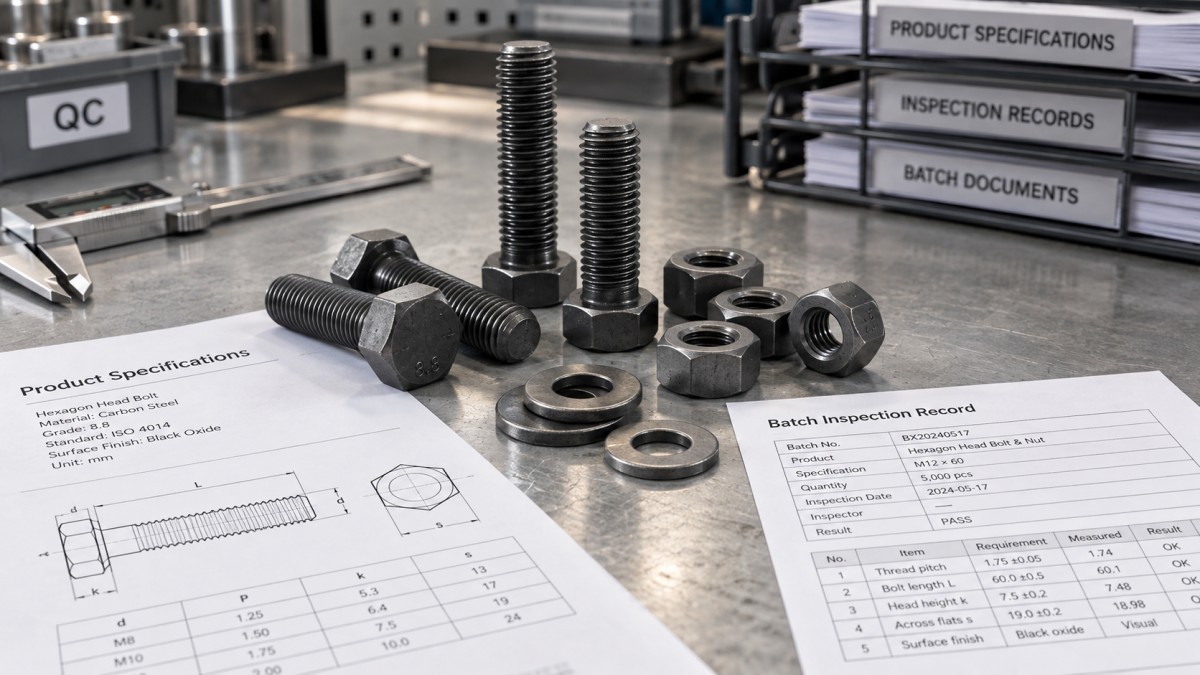
A defensible documentation chain connects the purchase order, product designation, manufacturer, production or inspection lot, test report, and package identification. Heat numbers can support material traceability, but a heat number alone may not identify the finished-fastener manufacturing lot.
- Check that the report covers the ordered grade, size, and applicable specification.
- Compare reported results with the relevant limits, rather than relying only on a “pass” statement.
- Confirm that required tests are included; chemistry alone does not establish finished-bolt mechanical performance.
- Verify how package labels and receiving records preserve the link to the report.
Request a sample documentation package during evaluation. Discovering after delivery that the supplier cannot provide the specified records creates a preventable acceptance problem.
Coatings and substitutions need closer reading
Coating information is frequently too vague for technical approval. “Galvanized” does not fully define the process, thickness requirements, thread accommodation, lubrication, or compatibility with the selected fastener grade. Relevant resources may include ASTM F2329/F2329M for applicable hot-dip zinc coatings, ISO 10684 for hot-dip galvanized fasteners, and ISO 4042 for electroplated coating systems.
These references are not permission to apply any coating to any high-strength bolt. Check the governing product standard for restrictions and additional requirements. Hydrogen embrittlement is a particular concern for susceptible high-strength steels exposed to certain processing conditions; a brief statement such as “baked after plating” is not enough to close that review.
Consider a common evaluation scenario: a supplier offers a coated ISO property class 10.9 bolt against a structural assembly requirement. The strength designation is only one part of the assessment. Geometry, assembly suitability, coating acceptance, installation behavior, and required documentation still need review. The appropriate response is an engineering substitution request, not automatic approval.
Keep the approval record small, but complete
The best product specification resources form a chain rather than a large folder of loosely related PDFs: the project requirement identifies what is needed, the official standard defines acceptance criteria, the manufacturer document identifies the offered product, and the inspection records support the delivered lot.
For routine evaluation, keep a short review sheet recording those document references, their revisions, and any unresolved deviations. Include the applicable installation document when joint performance depends on a controlled tightening procedure.
Before approval, ask one concrete question: can another reviewer connect the specified requirement to the offered part and then to the delivered batch without guessing? If not, request the missing document or clarification while the order can still be corrected.
Recommended News