
Search News
Industry Portal
Hot Articles
How to evaluate an OEM hardware manufacturer's bolt traceability
Time
Click Count
When a bolt is found to be defective, the immediate question is not just whether the supplier has a certificate. It is whether the affected shipment can be traced back to the material, production operations and inspection records—and whether other shipments made from the same material or process batch can be identified. A missing link can turn a contained investigation into a much broader stock hold.
Evaluate an OEM hardware solutions manufacturer by asking it to demonstrate both directions of that chain: from a delivered box back to its source records, and from a selected material or process lot forward to every affected delivery. Check the documents and physical controls behind the demonstration, not just the traceability policy.
Start with the traceability level the application needs
A bolt can carry several identifiers, but they do not all serve the same purpose. A head marking may identify the manufacturer and strength class where required by the applicable product standard. It does not necessarily identify a unique production lot or material heat. Packaging labels and the supplier’s internal records often provide that connection.
Before comparing suppliers, define the required traceability unit in the purchase specification. A standard commercial application may accept traceability at a defined manufacturing-lot level, while a safety-critical assembly may require tighter controls, additional records or customer-specific approval. Individual-bolt serialization is not automatically necessary or practical; establish it only when the application and specification justify it.
Agree on what constitutes a lot. Ask whether it is based on one material heat, one production run, one heat-treatment batch, a combination of these, or another defined grouping. The answer matters because a supplier that combines several heats or treatment batches under one lot number may have to place a larger quantity on hold when a problem is found. Combining material is not inherently unacceptable, but every contributing source must remain identifiable, and the customer should understand the resulting containment scope.
Follow one delivered lot through the records
Choose a representative bolt and ask the supplier to show the traceability path it would use for an actual delivery. Ideally, select a lot yourself rather than accepting only a prepared example. Start with the shipping label and record the purchase order, part number, revision, quantity and lot identifier. Then ask the supplier to retrieve the associated records while explaining each change of identifier.
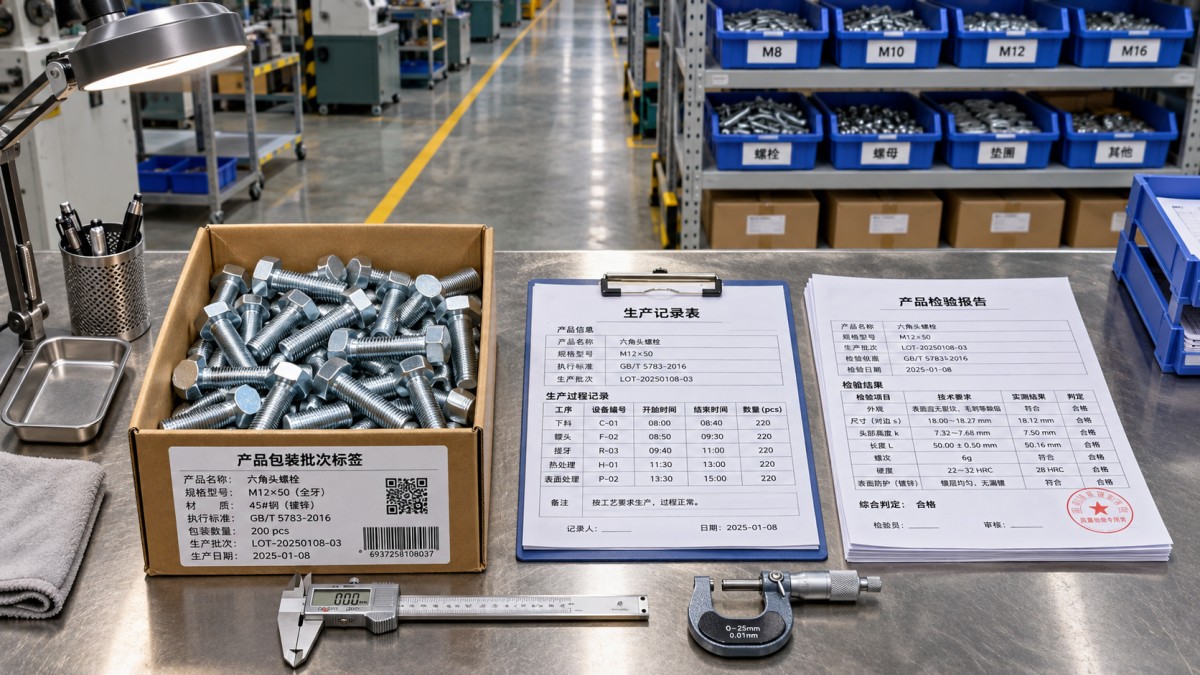
A usable chain should connect the delivered lot to records appropriate to the ordered product, such as:
- Incoming material: supplier identity, material designation, heat or cast number, receiving records and the applicable material test documentation.
- Manufacturing: production order, relevant forming and threading records, quantities and any split or merge of lots.
- Special processes: heat-treatment and coating or plating batches, including records from outside processors where used.
- Verification: inspection and test results linked to the relevant production or test lot, including sampling information where applicable.
- Release and dispatch: final acceptance, packaging identifiers, shipment quantities and delivery destinations.
The chain does not have to use the same number at every stage. Material heat numbers, work orders and treatment-batch numbers serve different purposes. The critical issue is whether recorded relationships connect them without relying on someone’s memory. If a production order uses more than one heat, the record should identify each heat and the quantity or scope involved.
Next, reverse the exercise. Pick a heat number or heat-treatment batch from the retrieved records and ask which finished lots and shipments it contributed to. A supplier that can find a certificate for a delivered lot but cannot identify all other deliveries affected by the same process batch has only demonstrated half of the control needed for containment.
Read certificates against the order, not in isolation
A certificate is useful only when its contents match the supplied goods and the agreed requirements. Compare the part description, dimensions, material or property class, applicable standard and revision where specified, quantity and lot references against the purchase order and packaging. Resolve discrepancies before accepting the documentation as evidence for that shipment.
Material documentation and finished-bolt test reports answer different questions. A steel mill’s chemistry or mechanical test results describe the supplied material under the conditions stated on that document; they do not by themselves prove that finished bolts meet every specified property after manufacturing and heat treatment. Likewise, a general certificate of conformity may state compliance without showing the actual test results or the precise production lot covered.
Where an inspection document type is specified, agree on it before placing the order. For example, EN 10204 defines different types of inspection documents, including type 3.1. Requesting one does not eliminate the need to check its scope, identification and relationship to the goods. The applicable product standard and contract determine which tests, document types and acceptance criteria are required; the document title alone is not proof that all have been met.
Ask who performed each test and which lot the sample represents. A report may cover a sample from a defined batch rather than every bolt. Confirm how the supplier establishes that the tested sample represents the supplied lot, particularly when production has been split across heat-treatment loads or subcontractors.
Examine the points where identity can be lost
Mixed inventory and repacking
Traceability often weakens after production rather than during it. Bulk bins, partial cartons, returns from the production floor and repacking operations can bring visually identical bolts together. Ask how operators distinguish lots when original packaging is opened and how new labels are generated. A handwritten replacement label may be workable, but only if its creation, verification and link to the original lot are controlled.
For mixed-lot shipments, the delivery paperwork should identify the lots and quantities supplied, or provide another agreed way to determine which packages contain which lot. If downstream operations empty several lots into a common hopper, the manufacturer’s records alone cannot preserve segregation at the point of use. Decide whether mixed use is acceptable and who maintains the subsequent installation or consumption records.
Heat treatment and outside processing
Heat treatment can be decisive for bolt properties, so establish how each load is identified and linked to the production lot. Ask what happens when a lot is divided among loads or when multiple lots share a load. Records should allow the supplier to identify the affected finished goods if a furnace cycle or acceptance test is later questioned.
Apply the same scrutiny to external coating, plating and other subcontracted operations. The OEM may retain responsibility for the supplied product, but it still needs access to the processor’s relevant batch and inspection records. Confirm whether those records are routinely retained, how quickly they can be retrieved and whether the processor can change without customer notification. A supplier’s internal database is not enough if it points to an external record that is no longer available.
Test the system during qualification
A written procedure describes intent; a witnessed retrieval shows whether the process works. During a supplier audit or remote qualification review, ask for a trace exercise using a completed lot. Observe how the supplier identifies the goods, retrieves the records, resolves identifier changes and accounts for quantities. Note any manual steps and who can perform them when the usual record owner is unavailable.
Set the expected response time and document package in the supply agreement rather than assuming that all records will be available immediately. The appropriate deadline depends on the consequence of a defect and the operating needs of the receiving organization. A safety-critical order may require faster initial containment information than a low-risk consumable, even if the full investigation takes longer.
Quantity reconciliation deserves attention. Exact matches may require documented allowances for scrap, samples and work in progress, but unexplained differences can indicate an incomplete lot history. Ask how corrections are authorized and whether the original entries remain visible. An electronic system can be effective, but a barcode or database alone does not establish that the information entered was correct.
Put the evidence requirements into the purchase agreement
Qualification should end with requirements that can be checked at receipt and enforced during supply. Specify the part and drawing revision, applicable standards, required lot definition, package marking, certificate content and any restrictions on mixing. Identify which process changes, subcontractor changes or material-source changes require notification or approval. Also agree on record retention, access during an investigation and the format for providing shipment-level data.
Include a containment procedure: who receives a defect notification, what identifiers must be supplied, how suspect stock is segregated, and how the manufacturer identifies potentially affected deliveries. Define the first information expected within the agreed response window separately from the eventual root-cause report. This prevents a supplier from treating a preliminary list of suspect lots as a completed investigation.
When a manufacturer cannot demonstrate a link, the decision depends on its significance to the application and contract. Do not substitute an untraceable certificate for missing evidence. Hold the affected lot where required, ask for documented reconstruction or additional verification, and have the responsible engineering and quality functions decide whether the risk is acceptable. If the missing link prevents the required scope of containment from being established, qualify an alternative source or require the control to be corrected before release.
Recommended News